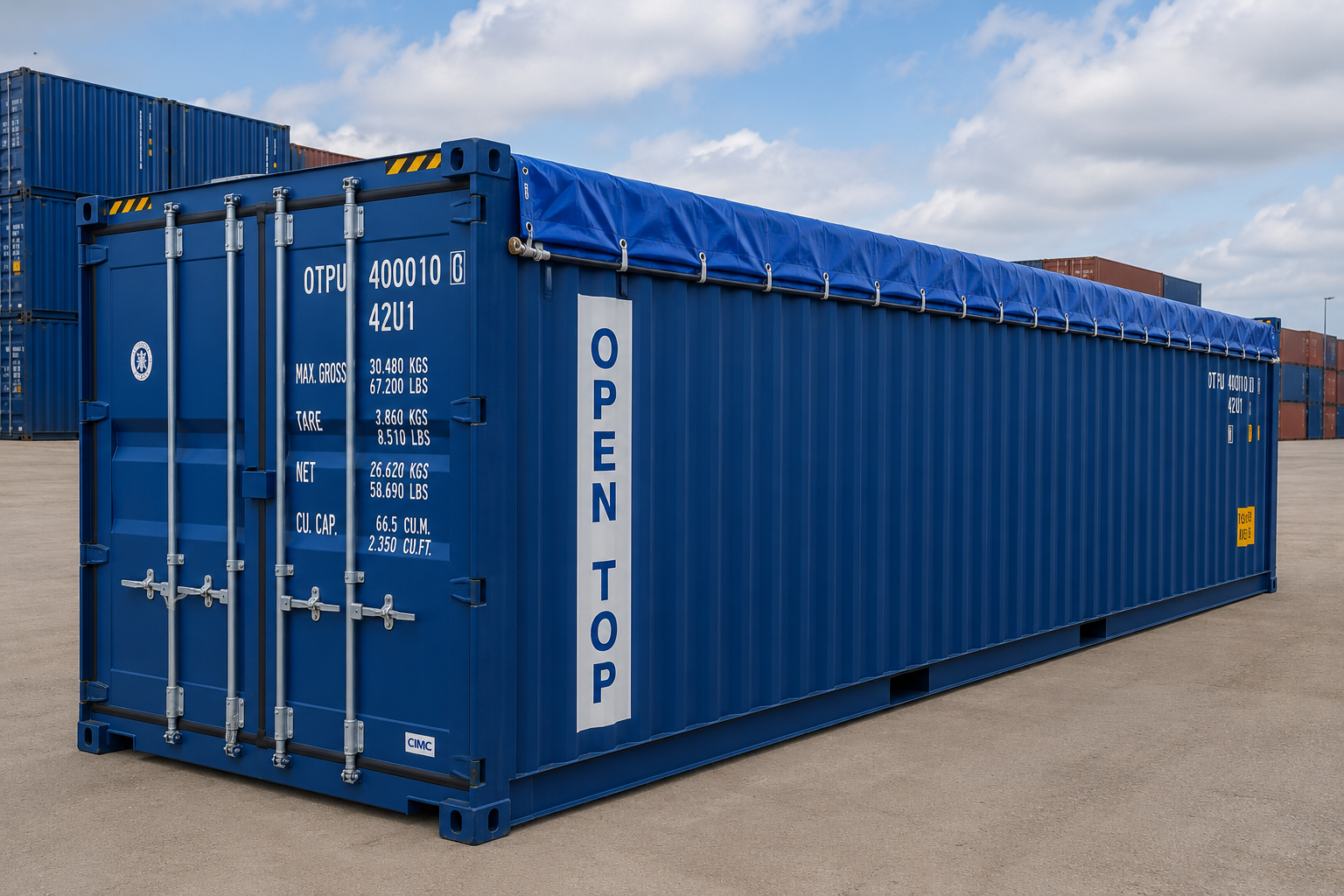
Most cargo fits through a standard container door without any trouble. Some of it doesn’t. Machinery that stands too tall, pipe sections that need to be lowered in from above, timber bundles longer than a forklift wants to deal with sideways — that’s the gap a 40ft open top shipping container for sale is built to close. Instead of loading everything through a single rear opening, you drop it straight in from the top, then pull a tarpaulin roof back over once it’s settled.
This 40ft open top shipping container for sale is built for buyers who move oversized, awkward, or top-loaded freight and need a box that won’t fight them on the way in. This page covers the actual specification, how the roof system works, what it’s built from, and what to check before you commit to an order.
What a 40ft Open Top Shipping Container Actually Is
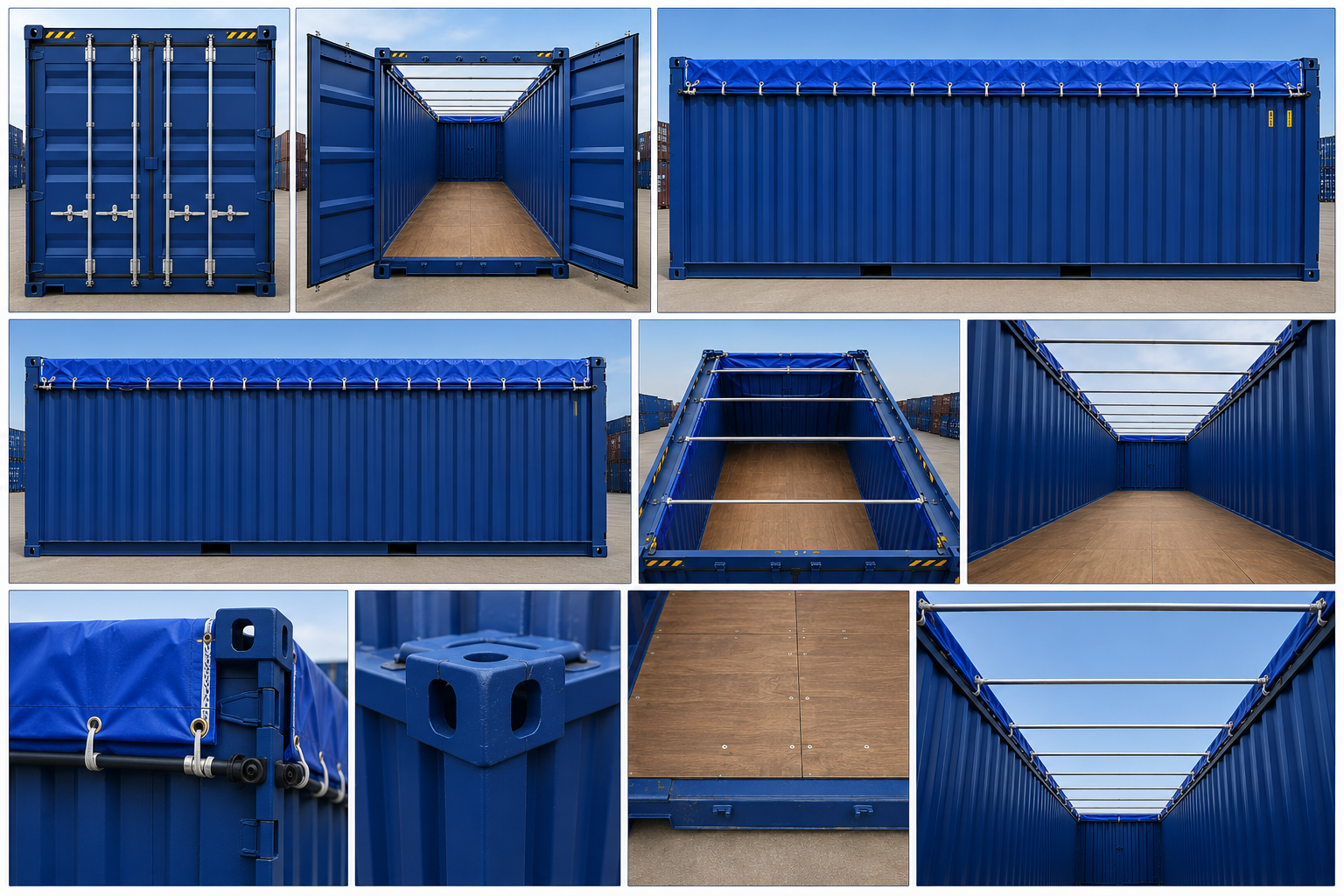
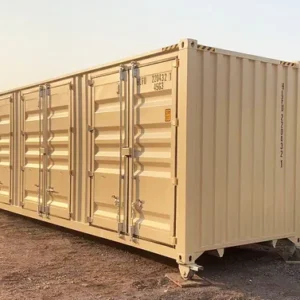
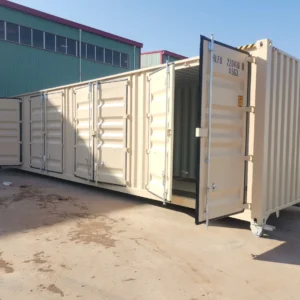
Strip away the marketing language and it’s a standard 40ft steel container with the roof swapped out. In place of a solid steel top, you get removable roof bows supporting a heavy-duty tarpaulin cover. The bows can come out entirely for full open-air loading, or stay in place with the tarp rolled back for partial access. Everything else — the corrugated steel walls, the floor, the door end — is built the same way a standard dry container is built, so it handles like one on a truck bed or a crane hook.
The point isn’t that it’s a different category of box. It’s the same rugged steel container with one flexible feature added, so cargo that would otherwise need a flat rack or specialized handling can still travel in a sealed, weather-protected unit.
Full Specification
| Specification | Details |
|---|---|
| External Length | 40 ft (12.19 m) |
| External Width | 8 ft (2.44 m) |
| External Height | 8 ft 6 in (2.59 m) |
| Internal Length | Approx. 39 ft 5 in (12.03 m) |
| Internal Width | Approx. 7 ft 8 in (2.35 m) |
| Door Opening Height | Approx. 8 ft 2 in (2.49 m) |
| Roof Type | Removable tarpaulin cover with removable steel roof bows |
| Construction Material | Corten weathering steel |
| Floor | Marine-grade plywood, forklift-rated |
| Certification | CSC certified |
| Condition | New |
Ask for the exact tare weight and maximum payload on your specific unit before finalizing an order, since these can shift slightly depending on the production batch and any optional fittings.
How the Removable Roof System Works
The tarpaulin sits over a set of steel roof bows that run across the width of the container, giving the tarp its shape and supporting a reasonable amount of weight from rain or light snow when it’s rolled out flat. For loading, you have two options depending on what you’re actually moving:
- Bows in, tarp rolled back partway — good for cargo that needs top access but doesn’t require the full width, since the bows stay in place for structural support.
- Bows removed, tarp fully off — for genuinely oversized loads that need the entire top opening clear, typically lowered in by crane.
Once loading is done, the tarp pulls back over and secures at the sides with the same locking mechanism used on the rest of the container, keeping the load sealed and reasonably weatherproof for transit.
Why Buyers Choose an Open Top Container Over a Flat Rack
Flat racks handle oversized cargo too, but they leave the load fully exposed to weather and give up the security of a locked door. A 40ft open top container splits the difference — you still get top-loading flexibility, but the sides and doors close up for a properly locked, weather-resistant shipment once the cargo is in. For anything that doesn’t need the complete absence of side walls a flat rack offers, the open top version is the more practical choice.
What Gets Shipped in a Container Like This
- Industrial machinery and processing equipment too tall for standard door clearance
- Construction materials — rebar bundles, pipe sections, precast components
- Timber and lumber loaded lengthwise without needing to angle through a door
- Vehicles or vehicle parts requiring crane loading
- Bulk materials loaded from above by conveyor or chute
If your cargo fits any of these categories, a 40ft open top shipping container is usually the simplest way to move it without renting specialized flat rack equipment or breaking the shipment into smaller pieces.
Construction and Build Quality
Corten steel, sometimes called weathering steel, forms a stable oxide layer on the surface that slows corrosion compared to standard steel — the same reason it’s the industry default for shipping containers generally. The walls are corrugated for structural rigidity without adding unnecessary weight, and the floor is marine-grade plywood rated for forklift traffic, so you’re not limited to hand-loading everything that goes in through the top.
Being new rather than reconditioned matters more on an open top unit than it does on a standard dry container, since the tarpaulin, roof bow fittings, and locking mechanisms all see more wear from repeated opening and closing. A used open top unit with worn bow locks or a tarp that’s lost its seal defeats the purpose of buying this configuration in the first place.
CSC Certification and What It Confirms
CSC certification — under the International Convention for Safe Containers — confirms the unit has been inspected and meets the structural safety standards required for international transport. It’s not a formality; a shipping line, port authority, or customs office can and will check for it, and a container without valid certification can get held up or refused outright. Every unit we sell carries current CSC certification, and we can provide the documentation directly rather than leaving you to chase it down after purchase.
Delivery and Logistics
We arrange delivery of 40ft open top shipping containers to buyers across Africa, the Middle East, Asia, Europe and the Americas. Because these units are typically bought for a specific job or project rather than as standing inventory, we confirm a realistic delivery window at quote stage based on your actual location rather than a generic estimate that doesn’t hold up once logistics gets involved.
Site access matters more with this configuration than a standard container, since crane loading is common with open top units. Let us know your unloading setup — crane, side-loader truck, or forklift — so we can flag anything that might affect delivery before the truck actually shows up.
Common Questions Before Buying
Can the roof bows be removed and reinstalled repeatedly? Yes, that’s the intended use. They’re designed for regular removal without damaging the fittings, provided they’re handled correctly rather than forced.
Is the tarpaulin actually waterproof? It’s weather-resistant and holds up well under normal rain when properly secured, but it’s not a substitute for a fully sealed steel roof on cargo that absolutely cannot tolerate any moisture exposure. For that level of protection, a standard dry container is the better fit.
What’s the maximum height cargo can protrude above the container? This depends on your shipping method and destination regulations — over-height cargo often needs specific permits or handling arrangements, so confirm this with your freight forwarder before finalizing load dimensions.
Does the open top design weaken the container structurally? No. The side walls, floor, and door end retain the same structural rating as a standard container. The roof modification doesn’t compromise the rest of the unit’s strength.
Buying New vs Used for This Configuration
| Factor | New | Used |
|---|---|---|
| Tarpaulin condition | Full waterproofing, no wear | Variable, often needs replacement sooner |
| Roof bow fittings | Tight, unworn locking mechanism | Can be loose or stiff from repeated use |
| Structural condition | No dents, no prior repairs | Depends heavily on prior use and handling |
| Price | Higher upfront cost | Lower upfront cost |
| Best fit for | Repeated top-loading, long-term use | One-off or infrequent oversized shipments |
If you’re moving oversized cargo regularly, the tighter seal and unworn fittings on a new unit are worth the price difference. For a single project shipment, the calculation might land differently — worth discussing directly based on your actual use case.
What to Confirm Before You Order
- Exact internal dimensions against your cargo’s actual footprint, not just the general spec sheet
- Whether you need bows removable or fixed, based on your loading method
- CSC certification documentation, provided directly rather than promised verbally
- Delivery timeline against your actual project schedule, not a best-case estimate
- Site access and unloading method, confirmed before the delivery truck is booked
What Drives the Price of a 40ft Open Top Shipping Container
- Steel market pricing. Container prices track global steel costs, and that’s the biggest single factor behind any quote you receive.
- Tarpaulin and roof bow hardware. The open top conversion adds cost over a standard dry container, since the tarp material and bow fittings are additional components beyond a plain steel roof.
- Order volume. Buying multiple units at once typically brings the per-unit price down, since delivery and paperwork costs spread across the order.
- Delivery distance. Trucking a container to your site is priced separately from the unit itself and depends heavily on how far it has to travel.
- Optional fittings. Lashing rings, additional tie-down points, or custom paint can add to the base price depending on your specific needs.
Be wary of a quote for a 40ft open top shipping container that sits noticeably below what other suppliers are quoting for the same new, CSC-certified specification. That gap usually means either a used unit being sold as new, a tarp of lower quality than advertised, or missing certification that will cause problems later.
Comparing the Open Top Container Against Other Configurations
| Configuration | Best for | Access method |
|---|---|---|
| 40ft open top | Oversized or top-loaded cargo | Top loading, plus standard rear doors |
| 40ft standard double door | General cargo needing access from both ends | Front and rear doors |
| Flat rack | Extremely oversized cargo with no side wall requirement | Fully open sides and top |
| 40ft refrigerated | Temperature-sensitive cargo | Rear doors, insulated |
If your cargo genuinely needs to be lowered in from above but still benefits from a locked, weather-resistant enclosure once loaded, the open top configuration is usually the right call over a fully open flat rack.
Regional Considerations for Import and Delivery
Import requirements for shipping containers vary by country, and it’s worth checking these before finalizing an order rather than after the unit has already shipped:
- Customs classification. Containers are typically classified differently depending on whether they’re entering as cargo-carrying equipment or as a standalone purchased asset — confirm which applies in your country.
- Road transport permits. A 40ft container is a wide, heavy load on most road networks, and some jurisdictions require specific permits for oversized road transport.
- Site access regulations. Some municipalities have restrictions on where a shipping container can be placed or how long it can sit before requiring a permit, particularly for permanent installation rather than transit use.
We can flag anything relevant to your specific destination at quote stage, but local regulations are ultimately worth confirming with your own logistics contact or local authority before delivery is scheduled.
Using an Open Top Container for Storage Rather Than Shipping
Not every buyer of a 40ft open top shipping container is moving it internationally. Plenty of buyers use these units for on-site storage where top-loading access is genuinely useful — construction sites where materials get craned in and out repeatedly, or storage yards handling irregular-shaped inventory that doesn’t fit neatly through a standard door. For this kind of use, the tarpaulin roof needs more routine attention than it would in a single-transit scenario, simply because it’s exposed to the elements for a much longer period.
Common Mistakes Buyers Make
- Ordering based on external dimensions instead of internal clearance. Always check your cargo against the internal dimensions, not the external footprint, since wall thickness eats into usable space.
- Assuming the tarp is fully waterproof in all conditions. It’s weather-resistant, not a substitute for a sealed steel roof on cargo that cannot tolerate any moisture at all.
- Not confirming crane access at the delivery site before ordering. If your cargo needs to be lowered in by crane, confirm that capability exists at both the loading and unloading locations before committing to this configuration.
- Skipping the CSC certification check. Always request the documentation directly rather than assuming it’s included, particularly if the container will cross international borders.
Who Buys This Configuration
- Construction and infrastructure contractors moving equipment and materials
- Freight forwarders handling oversized or irregular cargo for clients
- Manufacturing companies shipping large finished equipment
- Import and export traders dealing in bulk materials loaded from above
- Storage yard operators needing flexible top-access units on site
A Practical Example
A construction contractor recently needed to move a piece of processing equipment roughly nine feet tall between two sites, well beyond what would clear a standard container door. A flat rack was the obvious alternative, but the client wanted the load secured and weather-protected during a multi-day transit window. A 40ft open top container with the bows fully removed let the equipment get lowered in by crane, and the tarp went back over once it settled, keeping the load both accessible from above during transit checks and sealed against rain along the route.
Maintenance Once It’s on Site
- Check the tarpaulin seal regularly if the container will sit outdoors long-term, since UV exposure gradually affects any tarp material over years of use.
- Keep the roof bow locking mechanisms lubricated if you’re removing and reinstalling them frequently, to prevent them seizing over time.
- Inspect the floor periodically for any moisture that’s found its way past the tarp seal, particularly after heavy rain.
- Store spare tarpaulin sections if the unit will see frequent open-air loading, since a torn tarp is a faster fix with a replacement on hand.
How Ordering Works, Step by Step
- Send your requirements. Quantity, destination, and intended cargo or use case.
- Receive a formal quote. Pricing for the unit plus delivery to your location, with CSC certification confirmed.
- Confirm delivery logistics. Site access, unloading method, and a realistic delivery window based on your actual location.
- Payment and order confirmation. Terms discussed directly based on order size.
- Delivery and documentation. The unit arrives with certification paperwork included, ready for immediate use.
This process is deliberately straightforward. If a supplier can’t walk you through it clearly before you commit to anything, that’s worth noticing before you pay a deposit.
Inspecting a 40ft Open Top Shipping Container on Delivery
- Check the tarpaulin for any shipping damage. Tears or loose fittings should be flagged immediately, not discovered on first use.
- Test the roof bow removal and reinstallation. Confirm the fittings operate smoothly before you need them under time pressure on an actual job.
- Verify the CSC plate is present and current. This should be visibly attached to the unit, not just referenced in paperwork.
- Check door seals and locking mechanisms the same way you would on any standard container, since the open top modification doesn’t change this part of the build.
Frequently Asked Questions
What’s the difference between an open top container and a flat rack?
An open top container keeps the side walls, floor, and door end of a standard container, with the roof replaced by a removable tarpaulin over steel bows. A flat rack has no side walls or roof at all — just a base platform with end walls, offering maximum loading flexibility but no weather protection or locked security once cargo is loaded.
Can I remove just the tarpaulin and leave the roof bows in place?
Yes. This is common for cargo that needs top access for loading but doesn’t require the bows removed entirely, since the bows provide some structural support even with the tarp pulled back.
Is a 40ft open top shipping container suitable for permanent storage use?
Yes, though the tarpaulin will need more regular inspection and eventual replacement compared to a fully sealed steel roof, particularly if the unit sits outdoors long-term in a harsh climate.
How much weight can the roof bows support?
Enough for the tarpaulin and normal weather load like rain accumulation, but the bows are not designed to be walked on or loaded with additional cargo weight from above once the container is closed.
Do you deliver worldwide?
Yes, we arrange delivery of new 40ft open top shipping containers to buyers across Africa, the Middle East, Asia, Europe and the Americas, with realistic timelines confirmed at quote stage.
Get a Quote on This 40ft Open Top Shipping Container For Sale
This 40ft open top shipping container for sale ships worldwide, CSC certified, with full specifications and delivery arranged to your site. Send us your destination, quantity, and intended cargo, and we’ll respond with current pricing and a realistic delivery window.
Need standard side-loading access instead? Our 40ft standard double door shipping container gives you full access from both ends without the top-loading setup. Moving temperature-sensitive cargo? See our 40ft refrigerated shipping container for cold chain applications, or our 20ft shipping container if you need a smaller footprint.

Reviews
There are no reviews yet.