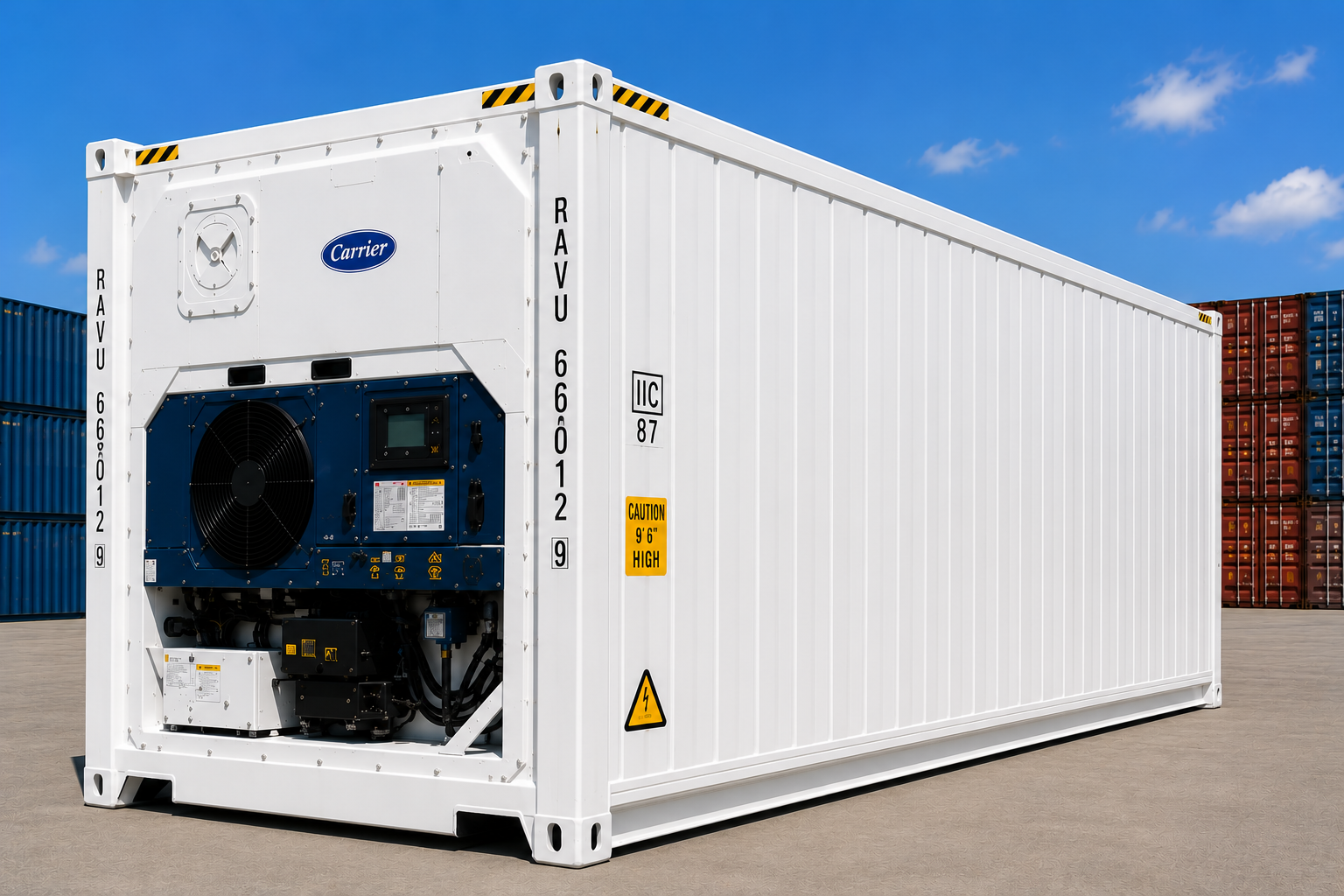
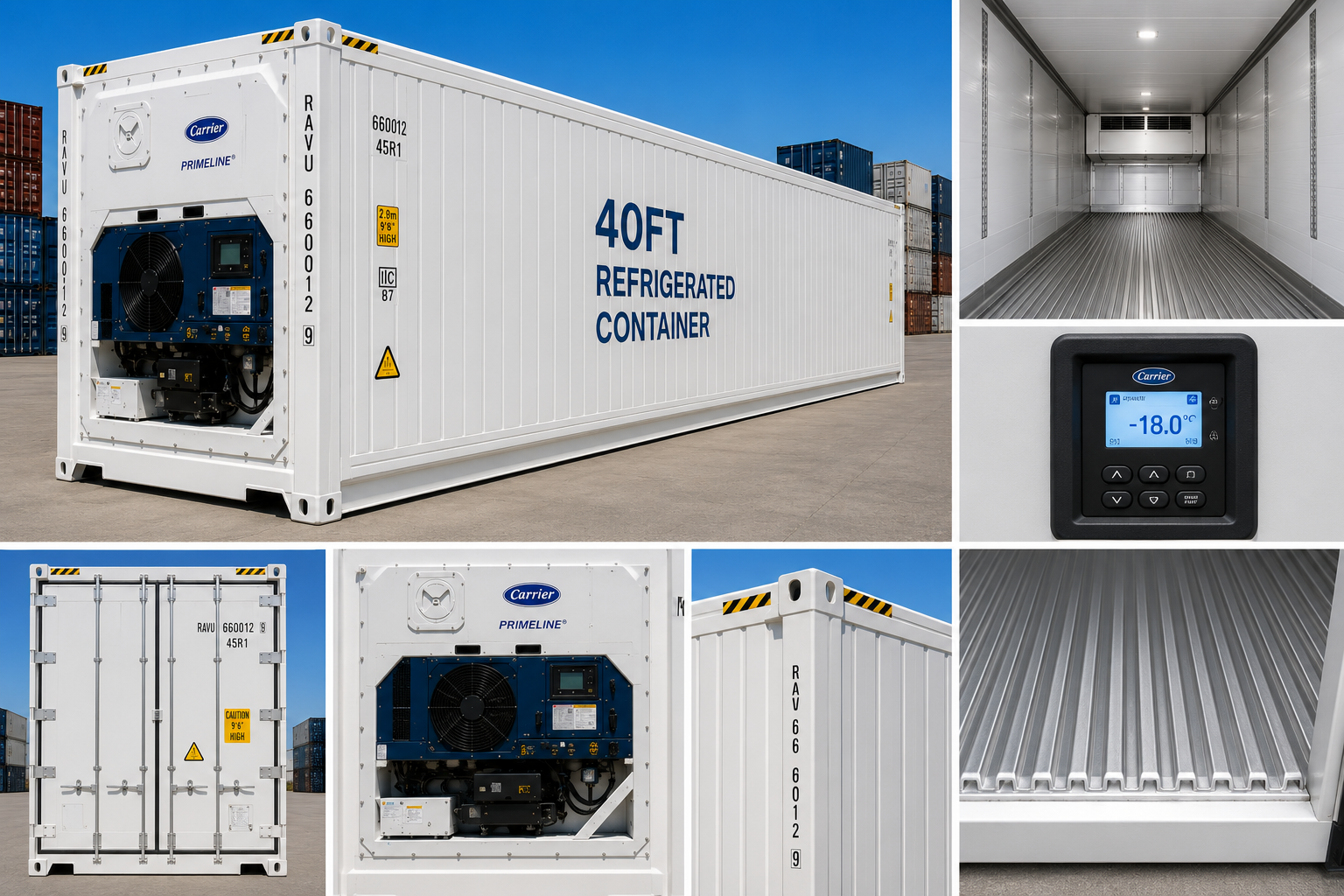
Once a cold storage operation grows past what a 20ft unit can hold, the next question is usually whether to add a second unit or go bigger. A 40ft refrigerated shipping container for sale answers that by roughly doubling the internal volume of the 20ft version while running on the same core technology — one refrigeration system, one power connection, one unit to maintain instead of two.
This 40ft refrigerated shipping container for sale is built for businesses that have outgrown smaller cold storage or that need serious volume from day one — food distributors, pharmaceutical logistics operations, exporters moving container-scale perishable loads. This page covers the full build, the temperature performance, and what actually matters when you’re comparing this against smaller units or a second location entirely.
What a 40ft Refrigerated Shipping Container Gives You Over the 20ft Version
The core technology is identical to the 20ft reefer — same insulation approach, same digital temperature control, same stainless steel interior built for washdown durability. What changes is the volume: roughly double the cubic capacity in a single unit, running off one refrigeration system rather than two separate units. For operations moving real volume, that’s a meaningful efficiency gain, both in upfront cost per cubic foot and in ongoing maintenance, since you’re servicing one compressor instead of two.
Full Specification
| Specification | Details |
|---|---|
| External Length | 40 ft (12.19 m) |
| External Width | 8 ft (2.44 m) |
| External Height | 8 ft 6 in (2.59 m) |
| Internal Length | Approx. 37 ft 8 in (11.48 m) |
| Internal Width | Approx. 7 ft 5 in (2.29 m) |
| Cubic Capacity | Approx. 2,040 cu. ft. (57.8 m³) |
| Maximum Gross Weight | 67,200 lbs (30,480 kg) |
| Maximum Payload | Approx. 58,000 lbs (26,300 kg) |
| Temperature Range | -30°C to +30°C (-22°F to +86°F) |
| Insulation | High-density polyurethane foam |
| Interior | Stainless steel |
| Flooring | Aluminum T-bar floor |
| Power Supply | 460V, 3-phase, 60Hz (varies by model) |
| Condition | New |
| Certification | CSC certified |
The refrigeration unit comes from Carrier, Thermo King, or Daikin depending on current stock — confirm which brand is fitted to your specific unit, since parts and service availability differ regionally between manufacturers.
How the Refrigeration System Performs at This Scale
Cooling a larger volume takes a proportionally larger compressor, and the 40ft unit is engineered for that from the ground up rather than being a 20ft compressor stretched to cover more space. Air circulation runs the full length of the container through a ducted system, so temperature stays consistent from the refrigeration unit end all the way to the far end, which matters more in a longer container where uneven cooling would otherwise be a real risk. The same -30°C to +30°C range applies, giving you frozen, chilled, or controlled ambient storage in one unit depending on what a particular load needs.
What Gets Stored and Shipped in a 40ft Reefer
- Bulk frozen and fresh seafood for export
- Meat and poultry at commercial distribution volume
- Produce and floral shipments moving container-scale quantities
- Pharmaceutical and medical cold chain logistics
- Beverage and dairy distribution
- Full-scale catering and food service operations with high-volume seasonal storage needs
If your cold storage or cold shipping needs have moved past what a single 20ft unit reasonably handles, the 40ft refrigerated shipping container is usually the more efficient next step before considering multiple units or a fixed cold storage facility.
Construction and Build Quality
Corten steel forms the exterior shell, the same corrosion-resistant weathering steel used across the shipping container industry. The interior stainless steel walls handle the repeated washdown cycles that food and pharmaceutical operations require without the corrosion risk a standard painted interior would eventually develop. The aluminum T-bar floor runs the full 40ft length, keeping cold air circulating underneath palletized loads rather than letting it stratify, which is more important in a longer unit where temperature evenness across the full length actually matters for consistent storage quality.
New construction matters even more here than on the 20ft version, simply because a 40ft unit represents a larger capital investment and a larger volume of product at risk if the compressor or insulation underperforms. A used 40ft reefer with an aging compressor is a bigger liability than the same issue on a smaller unit, given the volume of cargo riding on it.
CSC Certification and Why It Matters
CSC certification confirms the structural shell meets the safety standards required for international transport under the International Convention for Safe Containers. This is separate from the refrigeration system’s own manufacturer rating, and both matter — the CSC certificate confirms the container itself is safe to transport and stack, while the refrigeration unit’s own documentation covers its performance and warranty. Every unit we sell carries current CSC certification, included with your order.
Power Requirements and Site Setup
A 40ft refrigerated shipping container needs a stable 460V, 3-phase power connection sized for continuous operation. Given the larger compressor relative to the 20ft version, confirm your site’s electrical capacity specifically for this unit rather than assuming existing infrastructure sized for a smaller reefer will automatically handle it. If you’re setting up a new site specifically for this unit, involve an electrician familiar with reefer container requirements early in the planning rather than after the container has already arrived.
Delivery and Logistics
We arrange delivery of 40ft refrigerated shipping containers to buyers across Africa, the Middle East, Asia, Europe and the Americas. At a loaded weight approaching 30 tons and a 40ft footprint, site access planning matters — confirm road access for a long vehicle, crane or forklift capacity for the unloaded unit weight, and a level, stable surface for placement before delivery is scheduled.
Common Questions Before Buying
Is the 40ft unit meaningfully more energy efficient per cubic foot than two 20ft units? Generally yes, since you’re running one compressor instead of two, and the fixed energy overhead of running a refrigeration system is spread across more storage volume.
Can the unit be split internally to run two different temperature zones? Standard units run a single temperature zone throughout. If you need dual-zone capability, raise this at the quoting stage, since it’s a different configuration.
How does delivery differ from a 20ft unit? Mainly in road transport requirements — a 40ft container needs a longer trailer and more road clearance, which can affect delivery options in some locations with tighter access.
What’s the realistic lifespan of the refrigeration compressor? With proper maintenance, a new commercial reefer compressor typically runs reliably for many years of continuous use, though actual lifespan depends heavily on maintenance discipline and operating conditions.
Buying New vs Used at This Scale
| Factor | New | Used |
|---|---|---|
| Compressor life remaining | Full service life ahead | Unknown, higher failure risk at scale |
| Insulation integrity | Full efficiency | Can be compromised over years of use |
| Cargo value at risk | Lower risk given reliability | Higher stakes given larger cargo volume |
| Warranty coverage | Typically included | Often expired |
Given the volume of cargo a 40ft reefer typically holds, a compressor failure mid-transit or mid-storage is a much larger loss than the same failure on a smaller unit. That risk calculation is usually what pushes buyers toward new rather than used at this size.
What to Confirm Before You Order
- Site electrical capacity specifically rated for a 40ft unit’s compressor draw
- Road access and delivery vehicle requirements for a 40ft container
- CSC certification documentation provided directly with your order
- Crane or forklift capacity at your site for a heavier, longer unit
- Whether your volume actually justifies the 40ft size over multiple smaller units
A Practical Example
A regional food distributor running two 20ft reefer units at capacity found themselves regularly turning away volume during peak season because both units were full. Consolidating into a single 40ft refrigerated shipping container gave them more total capacity than the two smaller units combined, while cutting their ongoing maintenance to a single compressor and simplifying their power infrastructure to one connection instead of two separate hookups.
Maintenance for Long-Term Use
- Schedule preventive compressor servicing on a regular interval, since a larger unit represents more cargo value at risk if maintenance is skipped.
- Inspect door seals across the full width regularly, since a 40ft unit has more sealing surface where wear can develop.
- Monitor temperature logs consistently if your cargo requires documented compliance for regulatory or customer audit purposes.
- Keep the interior clean between different cargo rotations, particularly important given the larger surface area involved.
Comparing 40ft Reefer Options
| Configuration | Best for |
|---|---|
| 40ft refrigerated | High-volume cold storage or cold chain shipping |
| 20ft refrigerated | Smaller operations, single-site cold storage |
| Two 20ft units | Operations needing dual temperature zones |
What Drives the Price of a 40ft Refrigerated Shipping Container
- Refrigeration unit brand. Carrier, Thermo King, and Daikin pricing and availability shift over time, and the specific brand fitted affects the quote.
- Steel and raw material costs. The larger steel shell tracks global steel pricing more heavily than the 20ft version simply due to the greater material volume involved.
- Interior finish and insulation grade. Stainless steel and high-density insulation add cost over basic configurations but reduce long-term energy consumption.
- Order volume. Buyers ordering multiple units typically see a better per-unit price.
- Delivery logistics. A 40ft unit costs more to transport than a 20ft one simply due to size and weight, and this is quoted separately from the unit price.
A quote significantly below the market range for a new, CSC-certified 40ft reefer is worth questioning directly. At this price point, the gap is rarely a genuine bargain — it’s more often a used compressor, a lower-tier refrigeration brand than advertised, or missing certification.
Regional Considerations for Import and Delivery
| Consideration | Why it matters |
|---|---|
| Power standard compatibility | Confirm local voltage and phase match the unit before ordering |
| Refrigerant regulations | Some countries restrict specific refrigerant types on imported cooling equipment |
| Road transport permits | A 40ft container is an oversized load in many jurisdictions, requiring specific permits |
| Customs classification | Refrigeration equipment can be classified differently from standard containers for duty purposes |
We flag anything relevant to your destination during the quoting process, but confirming these details with your own customs broker or import agent before the unit ships avoids surprises once it’s already in transit.
Fixed Installation vs Mobile Cold Chain Use
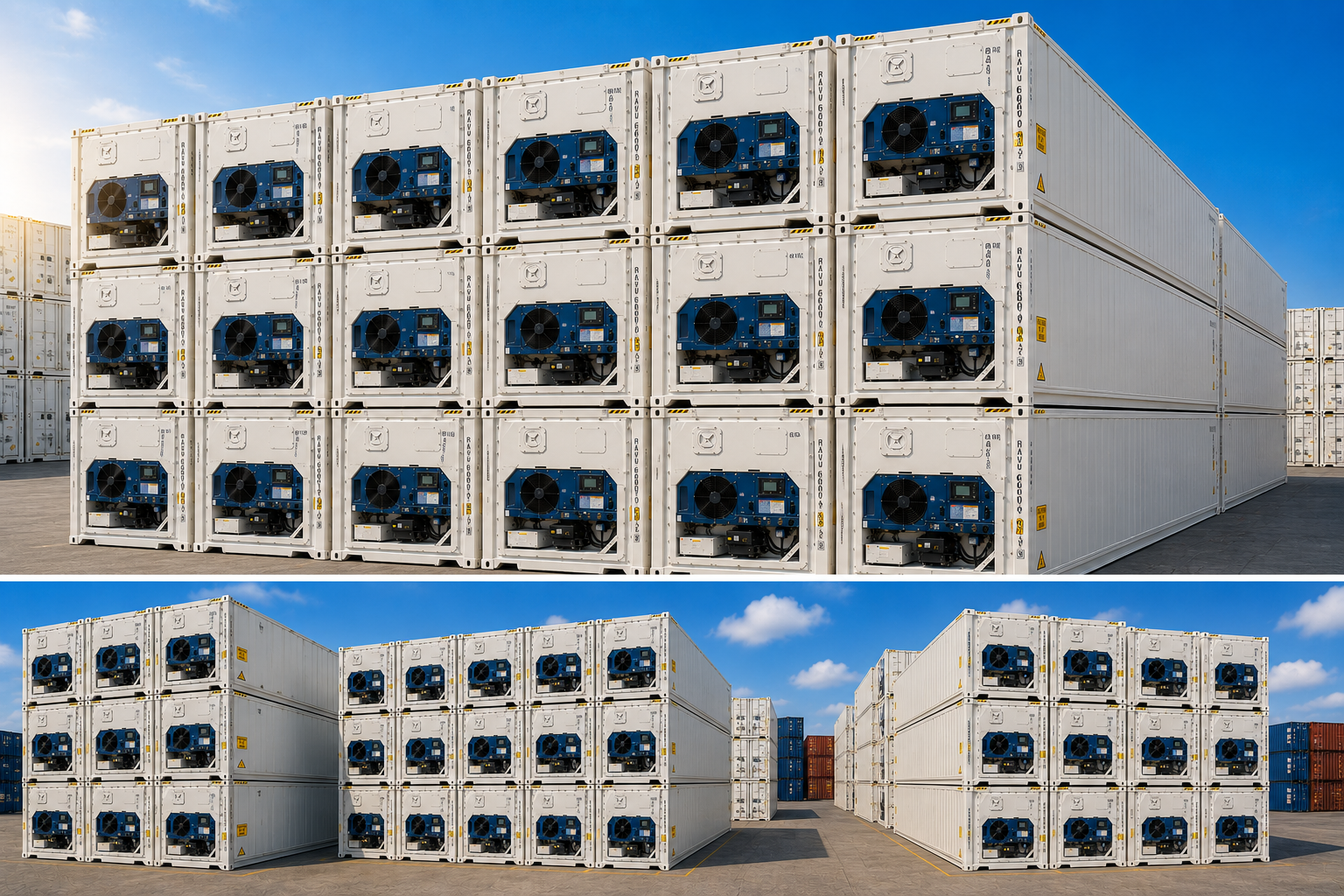
A meaningful share of buyers install a 40ft refrigerated shipping container as permanent or semi-permanent infrastructure — a distribution center’s overflow cold storage, a processing facility’s buffer capacity, or a farm’s harvest-season storage solution. Others use it as active shipping equipment, moving cargo between locations or across borders with the refrigeration running continuously throughout transit. The unit performs identically either way, but a fixed installation benefits from a permanent, dedicated power connection and a properly prepared level surface, while active shipping use requires more attention to power continuity at each stop along the route.
Common Mistakes Buyers Make
- Sizing power infrastructure for a 20ft unit and assuming it scales. The 40ft compressor draws more power — confirm capacity specifically for this unit.
- Underestimating road access requirements. A 40ft container needs more clearance and turning radius for delivery than a 20ft unit — check this before delivery is scheduled, not on delivery day.
- Buying 40ft capacity when actual volume doesn’t justify it. If your storage needs genuinely fit a 20ft unit, the larger container adds unnecessary cost and energy consumption.
- Not confirming the specific refrigeration brand before ordering. Service and parts availability differ by manufacturer and region.
Who Buys This Configuration
- Food distributors and wholesalers running high-volume cold storage
- Pharmaceutical logistics companies with container-scale cold chain requirements
- Seafood and meat exporters shipping bulk perishable cargo
- Agricultural operations with large-scale seasonal harvest storage needs
- Cold chain logistics providers building out fleet or facility capacity
How Ordering Works, Step by Step
- Send your requirements. Destination, intended cargo volume, and your site’s power capacity.
- Receive a formal quote. Pricing for the unit and delivery, with refrigeration brand and CSC certification confirmed.
- Confirm delivery logistics. Road access, site preparation, and power connection readiness.
- Payment and order confirmation. Terms discussed directly based on order size.
- Delivery and setup. The unit arrives with full documentation, ready to connect and run.
Loading and Palletizing for Maximum Efficiency
Getting the most out of a 40ft refrigerated shipping container’s volume comes down to how cargo is arranged inside, not just how much fits on paper. Leaving adequate airflow channels around palletized loads matters more than packing every available inch, since blocked airflow creates uneven cooling and can leave cargo near the far end of the container sitting at a different temperature than cargo near the refrigeration unit. Standard pallet configurations are designed with this in mind, and deviating significantly from them without accounting for airflow can undermine the temperature consistency the unit is otherwise capable of delivering.
Insurance and Documentation for High-Value Cold Chain Cargo
Given the volume and often the value of cargo moving through a 40ft reefer, buyers frequently pair the unit with temperature monitoring equipment beyond the built-in digital controller — independent data loggers that provide a separate compliance record, particularly for pharmaceutical or export cargo subject to regulatory inspection. This isn’t something we include as standard, but it’s worth planning for if your cargo requires documented chain-of-custody temperature records for customs, quality assurance, or insurance purposes.
What to Have Ready Before You Request a Quote
- Your destination and whether the unit will be used for fixed storage or active shipping
- Confirmed power infrastructure details, or a plan to install them
- Approximate cargo volume to confirm the 40ft size actually fits your needs
- Any regulatory or certification requirements specific to your cargo type or destination country
Having these details ready when you reach out speeds up the quoting process considerably, since we can give you an accurate number rather than a placeholder that changes once the full picture comes together.
Frequently Asked Questions
How much more capacity does the 40ft version offer over the 20ft?
Roughly double the internal cubic capacity, while running on a single refrigeration system rather than two separate units.
Do I need different power infrastructure than a 20ft reefer?
The voltage and phase requirements are similar, but confirm your site’s electrical capacity is sized appropriately for the larger compressor in the 40ft unit specifically.
Is this unit suitable for international shipping with cargo loaded inside?
Yes, refrigerated containers of this size are commonly used for international cold chain shipping, provided the vessel or transport method can supply continuous power throughout transit.
Do you deliver worldwide?
Yes, we arrange delivery of new 40ft refrigerated shipping containers to buyers across Africa, the Middle East, Asia, Europe and the Americas, with site and power requirements confirmed before delivery.
Get a Quote on This 40ft Refrigerated Shipping Container For Sale
This 40ft refrigerated shipping container for sale ships worldwide, CSC certified, with full specifications and delivery arranged to your site. Send us your destination, intended cargo volume, and power setup, and we’ll respond with current pricing and a realistic delivery window.
Need a smaller footprint? Our 20ft refrigerated shipping container covers the same cold chain reliability at a more compact scale. For general dry cargo instead, see our 40ft standard double door shipping container, or our 40ft open top shipping container for oversized loads.

Reviews
There are no reviews yet.