Anyone who has watched a refrigerated truck break down mid-route with a full load of seafood or vaccines knows exactly why cold chain reliability isn’t a nice-to-have. A 20ft refrigerated shipping container for sale gives you that reliability in a self-contained unit — its own refrigeration system, its own insulation, its own power connection — so temperature control doesn’t depend on the health of a single vehicle or a shared cold room somebody else is managing.
This 20ft refrigerated shipping container for sale is built for food producers, pharmaceutical distributors, and anyone else whose product doesn’t survive a broken cold chain. This page covers the actual build, the temperature range it holds, and what to check before you buy one.
What a 20ft Refrigerated Shipping Container Actually Does
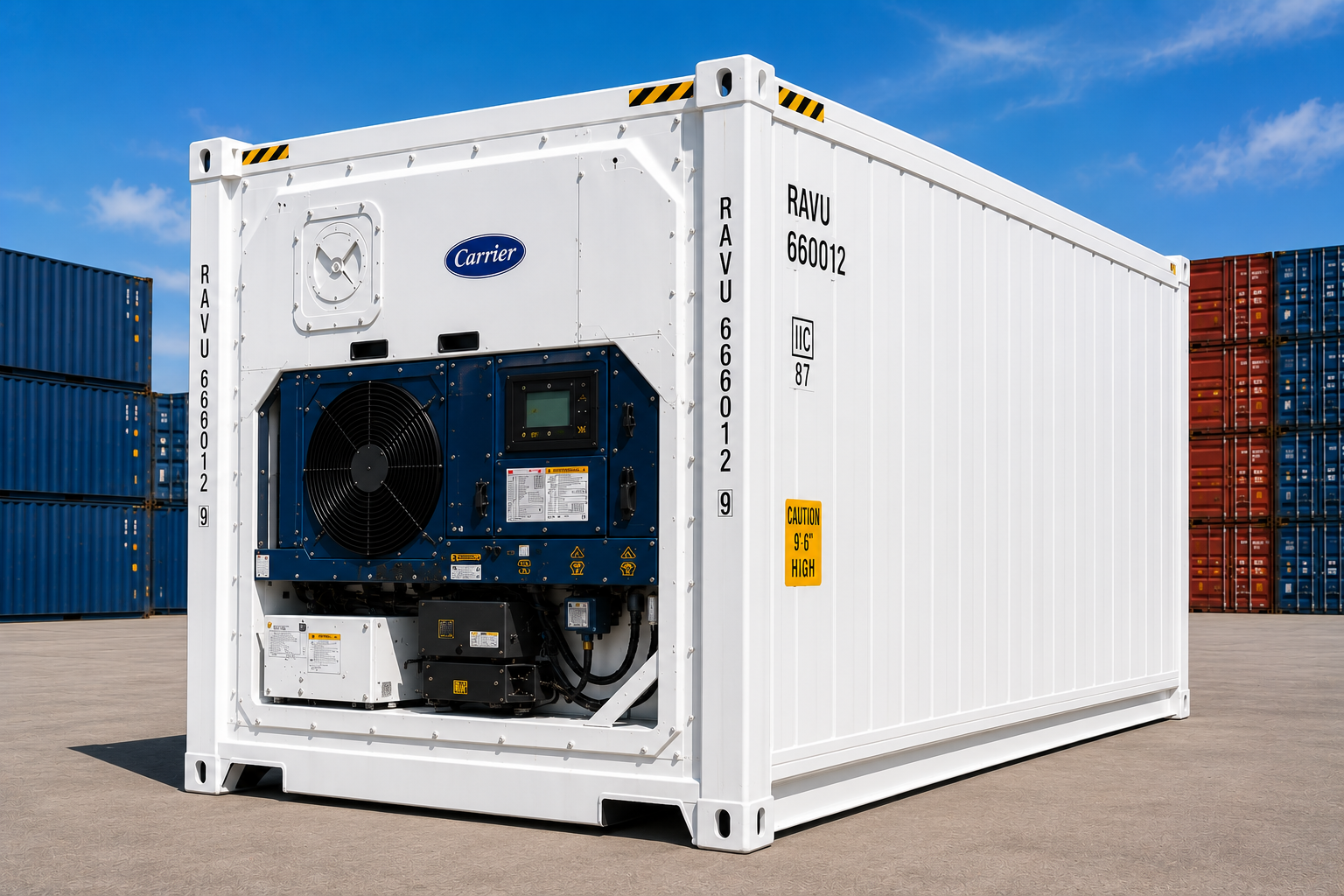
Strip away the branding and it’s a standard 20ft steel container with the refrigeration unit built into one end, high-density insulation packed into the walls, floor and roof, and a stainless steel interior that holds up to repeated washdown without corroding. Plug it into a power source, set the temperature on the digital controller, and it holds that temperature independently — no external cooling infrastructure required beyond the electrical connection.
That independence is the entire point. A reefer container can sit on a farm, at a port, behind a restaurant, or on a ship, and as long as it has power, it does the same job in every one of those settings.
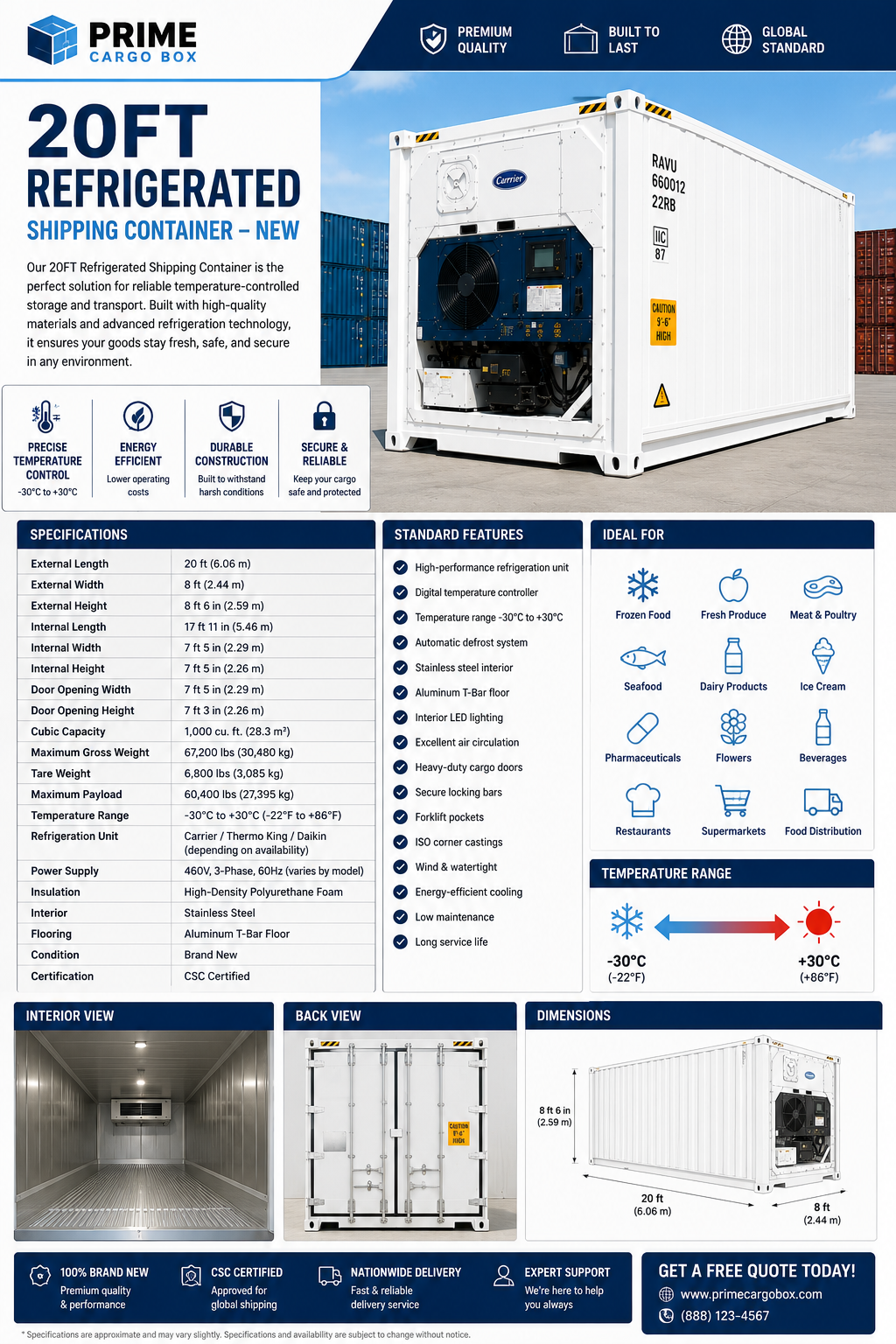
Full Specification
| Specification | Details |
|---|---|
| External Length | 20 ft (6.06 m) |
| External Width | 8 ft (2.44 m) |
| External Height | 8 ft 6 in (2.59 m) |
| Internal Length | Approx. 17 ft 11 in (5.46 m) |
| Internal Width | Approx. 7 ft 5 in (2.29 m) |
| Cubic Capacity | Approx. 1,000 cu. ft. (28.3 m³) |
| Maximum Gross Weight | 67,200 lbs (30,480 kg) |
| Maximum Payload | Approx. 60,400 lbs (27,395 kg) |
| Temperature Range | -30°C to +30°C (-22°F to +86°F) |
| Insulation | High-density polyurethane foam |
| Interior | Stainless steel |
| Flooring | Aluminum T-bar floor |
| Power Supply | 460V, 3-phase, 60Hz (varies by model) |
| Condition | New |
| Certification | CSC certified |
The refrigeration unit itself typically comes from Carrier, Thermo King, or Daikin depending on current availability — ask which manufacturer’s unit is on your specific container before ordering, since spare parts and service networks differ by brand and matter if you need support down the line.
How the Refrigeration System Holds Temperature
The compressor and refrigeration unit sit at one end of the container, drawing power externally and circulating cooled air through the interior via a ducted system that keeps temperature consistent from front to back rather than concentrated near the unit. A digital controller lets you set an exact target temperature, and an automatic defrost cycle prevents ice buildup on the evaporator coils from degrading cooling performance over time.
The -30°C to +30°C range covers nearly everything a cold chain business needs — frozen seafood and pharmaceuticals at the low end, chilled produce and beverages in the middle, and even controlled ambient storage above typical refrigeration if that’s what a particular load calls for.
What Gets Stored and Shipped in a 20ft Reefer
- Fresh and frozen seafood
- Meat and poultry requiring strict temperature control
- Fresh produce and cut flowers
- Pharmaceuticals and vaccines with tight temperature tolerances
- Dairy products and beverages
- Catering and food service inventory for events or seasonal demand
If your product spoils, degrades, or loses potency outside a specific temperature band, a 20ft refrigerated shipping container is built specifically to prevent that from happening on your watch.
Construction and Build Quality
The exterior is Corten steel, the same weathering steel used across the shipping container industry for its corrosion resistance in outdoor and marine environments. Inside, stainless steel walls resist the corrosion that a standard painted steel interior would eventually suffer from repeated moisture and washdown cycles, particularly relevant for food and pharmaceutical applications where hygiene standards matter. The aluminum T-bar floor allows cold air to circulate underneath palletized loads rather than trapping it, which keeps temperature more even throughout the interior instead of stratifying near the floor or ceiling.
Buying new rather than used matters more with a reefer than with a standard dry container, because the refrigeration compressor and insulation integrity are the entire value proposition here. A used unit with a compressor nearing the end of its service life, or insulation that’s degraded from years of temperature cycling, can fail exactly when you need it most — mid-shipment, with a full load of perishable product on board.
CSC Certification and Why It Matters
CSC certification confirms the container has been inspected against the structural safety standards required for international transport under the International Convention for Safe Containers. For a reefer container specifically, this covers the structural shell — the refrigeration system itself is separately rated by its manufacturer. Every unit we sell carries current CSC certification, provided directly with your order rather than something you have to chase down afterward.
Power Requirements and Setup
A 20ft refrigerated shipping container needs a stable 460V, 3-phase power connection to run continuously — confirm your site or vessel can supply this before ordering, since running off an unsuitable power source is the single most common cause of reefer performance problems that have nothing to do with the unit itself. If you’re moving the container between locations with different power infrastructure, ask about the specific power requirements for your unit before committing to a route or delivery plan.
Delivery and Logistics
We arrange delivery of 20ft refrigerated shipping containers to buyers across Africa, the Middle East, Asia, Europe and the Americas. Because these units are heavier and more sensitive to handling than a standard dry container, confirm your site’s crane or forklift capacity for a loaded weight of over 30 tons before delivery is scheduled, and let us know your power setup so we can flag anything relevant ahead of time.
Common Questions Before Buying
How long can the unit run without interruption? Indefinitely, provided it has a stable power supply. There’s no built-in runtime limit — the compressor is designed for continuous operation.
What happens if power is interrupted? Insulation buys you some time before internal temperature drifts significantly, but for genuinely temperature-critical cargo, a backup generator or uninterrupted power supply is worth having on hand for extended outages.
Can the temperature range go below -30°C for specialized frozen goods? The standard range covers most commercial applications, but if you need a more extreme range for a specific product, raise this at the quoting stage since it may affect which unit fits your needs.
Is the interior easy to clean between different types of cargo? Yes, the stainless steel interior is specifically chosen for washdown durability, which matters if you’re rotating between different food products or need to meet hygiene inspection standards.
Buying New vs Used for a Reefer Container
| Factor | New | Used |
|---|---|---|
| Compressor life remaining | Full service life ahead | Unknown remaining life, higher failure risk |
| Insulation integrity | Full efficiency, no degradation | Can be compromised, raising energy costs |
| Warranty coverage | Typically included | Often expired or limited |
| Upfront cost | Higher | Lower |
| Best fit for | Cargo that cannot tolerate failure risk | Lower-stakes or short-term use |
For genuinely temperature-critical cargo — pharmaceuticals, high-value seafood, anything with real financial or safety consequences if it spoils — the reliability of a new unit is usually worth the price difference over a used reefer with an unknown maintenance history.
What to Confirm Before You Order
- Your site’s power supply matches the unit’s requirements, confirmed in writing before delivery
- The specific refrigeration unit brand and its local service and parts availability
- CSC certification documentation, provided directly rather than promised verbally
- Crane or forklift capacity at your delivery site for the loaded unit weight
- Realistic delivery timeline against your actual operational schedule
A Practical Example
A seafood exporter recently needed reliable cold storage at a coastal facility without existing refrigeration infrastructure. Rather than building a permanent cold room, they installed a 20ft refrigerated shipping container directly on site, connected to existing power, and had temperature-controlled storage running within days rather than the months a permanent facility would have required. The mobility of the unit also meant it could relocate to a different site entirely if their operation shifted, something a fixed cold room could never offer.
Maintenance for Long-Term Use
- Schedule regular compressor servicing even when the unit is running well, since preventive maintenance catches issues before they become failures.
- Keep door seals clean and inspected — a compromised seal forces the compressor to work harder and shortens its service life.
- Monitor the digital temperature log if your product requires documented compliance, since most units can export temperature history for audit purposes.
- Clean the interior thoroughly between different cargo types, particularly when switching between products with different hygiene requirements.
What Drives the Price of a 20ft Refrigerated Shipping Container
- Refrigeration unit brand and specification. Carrier, Thermo King, and Daikin units differ slightly in cost and performance, and availability shifts the price at any given time.
- Steel market pricing. Like any container, the base steel shell tracks global steel costs.
- Insulation grade and interior finish. Stainless steel interiors and high-density insulation cost more than basic configurations but pay off in energy efficiency and durability over the unit’s life.
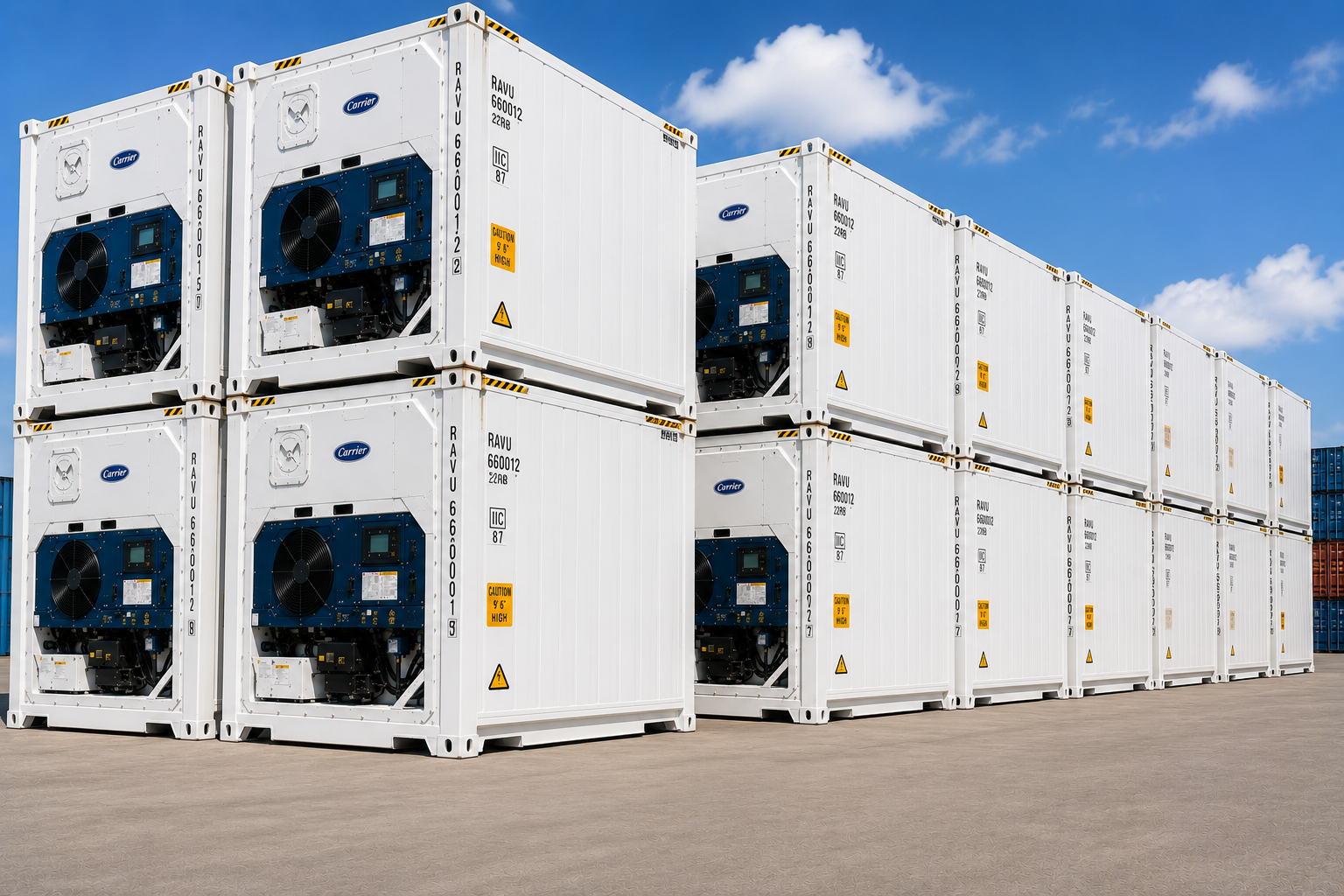
- Order volume. Multiple units ordered together typically bring the per-unit price down.
- Delivery distance and power setup complexity. Trucking a 30-ton loaded unit is priced separately and depends on distance and site access.
Be cautious of a quote for a new 20ft refrigerated shipping container that comes in well below what other suppliers are quoting for the same specification. A price gap that large usually means a used compressor being sold as new, a lower-grade refrigeration unit than advertised, or missing warranty coverage.
Comparing Reefer Sizes and Configurations
| Configuration | Best for | Internal capacity |
|---|---|---|
| 20ft refrigerated | Smaller operations, single-site cold storage | Approx. 1,000 cu. ft. |
| 40ft refrigerated | Higher volume cold storage or shipping | Approx. double the 20ft capacity |
| 20ft standard dry | Non-perishable cargo, general storage | Similar footprint, no refrigeration |
If your volume needs are modest or your site has limited space, the 20ft reefer gives you full cold chain capability without the footprint of a 40ft unit. If you’re regularly moving larger volumes, the 40ft version usually works out more cost-efficient per cubic foot of cold storage.
Regional Considerations for Import and Setup
Power standards vary by country, and this matters more for a refrigerated container than almost any other type of shipping equipment:
- Voltage and phase compatibility. Confirm your local power infrastructure matches the unit’s requirements, or budget for a transformer or generator setup if it doesn’t.
- Import classification for refrigeration equipment. Some countries classify reefer containers differently from standard dry containers for customs purposes, which can affect duties or required documentation.
- Refrigerant regulations. Some jurisdictions have specific rules around refrigerant types used in cooling systems — confirm the refrigerant type on your unit meets local requirements before importing.
We flag anything relevant to your specific destination at quote stage, but final confirmation with your own customs broker or import agent is always worth doing before the unit ships.
Using a Reefer Container for Fixed Cold Storage vs Mobile Transport
Plenty of buyers never move their refrigerated container after initial delivery — it becomes permanent or semi-permanent cold storage on a farm, at a distribution facility, or behind a restaurant. Others use it as genuinely mobile cold chain equipment, moving between sites or even shipping internationally with cargo inside. The unit itself handles both use cases identically, but the setup considerations differ: fixed installations benefit from a stable, dedicated power connection and a level concrete pad, while mobile use requires more attention to how the unit will be secured and powered at each location it visits.
Common Mistakes Buyers Make
- Not confirming power supply compatibility before ordering. This is the most common cause of performance issues that have nothing to do with the container itself.
- Underestimating the loaded weight for delivery planning. A fully specified reefer unit is significantly heavier than a standard dry container of the same size — confirm your site can handle it.
- Skipping the refrigerant and unit brand question. Different manufacturers have different service networks, which matters if something needs repair years down the line.
- Assuming any electrician can wire the connection correctly. Reefer units have specific electrical requirements — use someone familiar with this type of equipment.
Who Buys This Configuration
- Food producers and processors needing on-site cold storage
- Pharmaceutical and medical supply distributors
- Restaurants, catering businesses, and event operations with seasonal cold storage needs
- Farms and agricultural operations storing perishable produce
- Seafood exporters and fishing operations
How Ordering Works, Step by Step
- Send your requirements. Destination, intended cargo, and your site’s power setup.
- Receive a formal quote. Pricing for the unit plus delivery, with the refrigeration unit brand confirmed.
- Confirm delivery logistics. Site access, power connection readiness, and a realistic delivery window.
- Payment and order confirmation. Terms discussed directly based on order size.
- Delivery and setup. The unit arrives with CSC certification and operating documentation included.
Frequently Asked Questions
What’s the difference between a reefer container and a standard container with a portable cooling unit?
A refrigerated shipping container has the cooling system, insulation, and interior finish built in as one integrated unit designed for continuous cold storage. A portable cooling unit retrofitted into a standard container is generally less efficient, less reliable, and not built for the same duty cycle.
How energy efficient is a new 20ft refrigerated shipping container?
New units benefit from current-generation compressor technology and undamaged insulation, both of which directly affect energy consumption. An older or used unit with degraded insulation will typically cost more to run for the same temperature performance.
Can this container be used for controlled ambient storage rather than cold storage?
Yes, since the temperature range extends up to +30°C, the unit can maintain a controlled ambient temperature for products that don’t need refrigeration but do need protection from external heat fluctuation.
Do you deliver worldwide?
Yes, we arrange delivery of new 20ft refrigerated shipping containers to buyers across Africa, the Middle East, Asia, Europe and the Americas, with power and site requirements confirmed before delivery.
Get a Quote on This 20ft Refrigerated Shipping Container For Sale
This 20ft refrigerated shipping container for sale ships worldwide, CSC certified, with full specifications and delivery arranged to your site. Send us your destination, intended cargo, and power setup, and we’ll respond with current pricing and a realistic delivery window.
Need more capacity? Our 40ft refrigerated shipping container covers the same cold chain reliability at double the internal volume. For general dry cargo instead, see our 20ft shipping container, or our 40ft standard double door shipping container for larger dry storage needs.

Reviews
There are no reviews yet.