
An open side container is a steel shipping container with bi-fold doors running along almost the whole length of one long side, plus the normal cargo doors at the end. Open the side and you can reach every pallet, shelf or machine inside without unloading anything first. We sell the open side container in 20ft and 40ft high cube sizes, new, one trip and used, with prices starting at $2,950 for a used 20ft open side container and running to $6,200 for a one trip 40ft high cube side opening box. Every unit ships worldwide.
That is the short version. The rest of this page is for people who are close to buying and want to get it right the first time: what the side doors actually do, how much a side opening box weighs compared with a standard one, which size and condition suits which job, and what your ground has to look like before the truck turns up. If you already know what you want, the product links are all in the next section and in the buying section further down.
Table of Contents
Quick answers before you scroll
- Cheapest way in: the used 20ft open side container at $2,950, wind and watertight with the side doors checked.
- Best near-new 20ft: the one trip 20ft side access unit at $5,200.
- Factory new 20ft: the new 20ft side opening container at $5,700.
- Most space with full side access: the one trip 40ft open side container, a high cube with roughly 11.5 m of side opening, at $6,200.
- Biggest box for less: the used 40ft side access box at $5,500.
- Delivery: worldwide, quoted to your address. Freight and local handling are added to the box price.
What is an open side container?
A normal shipping container has one way in: the double cargo doors at one end. That works fine if you fill the box once and empty it once. It works badly if you need something from the back every week, because everything in front of it has to come out first. Most owners of a standard box end up leaving an aisle down the middle, which wastes a third of the floor.
An open side container fixes that by turning one of the long walls into a row of doors. On a 20ft unit there are usually four door leaves, hinged in pairs, that fold back like a concertina. On a 40ft unit there are usually eight. Each pair has its own locking bars, so you can open a single section to grab one item or open the lot and stand looking at the full length of the interior.
The end doors stay. That matters more than it sounds. You can still load it from the end like any other box, back it up to a loading bay, or use it as a straight-through store with the side closed. You just have a second, much bigger way in.
You will see the same thing sold under other names: side opening container, side access container, full side access container, or “SD” container in some trade listings. They all describe the same layout. If a listing says “open sided” with a curtain or canvas wall, that is a different and much less secure product.
How the side doors work
When the side is closed, the door leaves lock into a heavy top rail and bottom rail and press against rubber gaskets, the same way the end doors seal. Cam locks on the locking bars pull each pair tight. The doors swing outward, so you need clear ground along the opening side. Many units have tie-backs or hooks to hold the leaves open in wind, and you should use them. A door leaf on a 40ft box is a big piece of steel and a gust will move it.
Because the long wall is now doors instead of solid corrugated steel, the frame has to carry the loads that the wall used to carry. Manufacturers do this with a deeper bottom side rail, a stronger top rail and steel posts between the door pairs. That extra steel is the reason this box weighs more than a standard box of the same size, and it is why the internal width and side opening height are a little smaller than you might expect.
Is it still a real shipping container?
Yes. A properly built side opening box keeps the standard outside dimensions set out in ISO 668, the international standard for freight container sizes and ratings, and it has the same corner castings as any other box. That means it fits the same trailers, twist locks and lifting gear. Units built for sea service carry a safety approval plate under the International Convention for Safe Containers (CSC), which records the maximum gross weight and stacking rating. Our new and one trip units come CSC plated. The owner code painted on the door is registered with the Bureau International des Containers (BIC), the body that manages container owner prefixes worldwide.
Open side container sizes and specifications
There are two common sizes. The 20ft version is usually standard height (8 ft 6 in). The 40ft version is almost always a high cube (9 ft 6 in), partly because the extra height offsets the lower side opening. The figures below are the ones we quote on our own listings. Side opening boxes vary more between factories than standard containers, so we confirm the exact numbers for your unit on the quote, and the ratings are printed on its CSC plate.
| Specification | 20ft open side container | 40ft high cube open side container |
|---|---|---|
| External size | 6.06 x 2.44 x 2.59 m (20 x 8 x 8 ft 6 in) | 12.19 x 2.44 x 2.90 m (40 x 8 x 9 ft 6 in) |
| Internal length | approx. 5.85 m | approx. 12.03 m |
| Internal width | approx. 2.25 to 2.29 m | approx. 2.29 m |
| Internal height | approx. 2.30 to 2.39 m | approx. 2.47 m |
| Side door opening | approx. 5.70 to 5.82 m wide x 2.15 to 2.19 m high | approx. 11.56 m wide x 2.31 m high |
| End door opening | approx. 2.29 x 2.27 m | approx. 2.23 x 2.39 m |
| Cubic capacity | approx. 31 m³ | approx. 68 m³ |
| Tare weight | approx. 3,000 to 3,400 kg | approx. 5,900 to 6,600 kg |
| Max gross weight | typically 30,480 kg | 30,480 or 32,500 kg depending on build |
| Side door leaves | usually 4 | usually 8 |
| Floor | marine plywood, forklift rated | marine plywood approx. 28 mm, forklift rated |
Two numbers deserve a second look. First, the tare weight. A standard 20ft box weighs somewhere around 2.2 tonnes empty. The 20ft side opening version is closer to 3 to 3.4 tonnes. That does not matter much for storage, but it matters for delivery, for lifting and, if you are shipping cargo in it, for how much payload you have left. Second, the side opening height. On a standard-height 20ft it is about 2.15 to 2.19 m, which is lower than the end door. If you plan to drive a tall machine in from the side, measure it first. If you need more height, the 40ft high cube version gives you about 2.31 m at the side and around 2.47 m inside.
For the full set of numbers on standard boxes, our guide to shipping container dimensions lists inside, outside and door sizes for every common type.
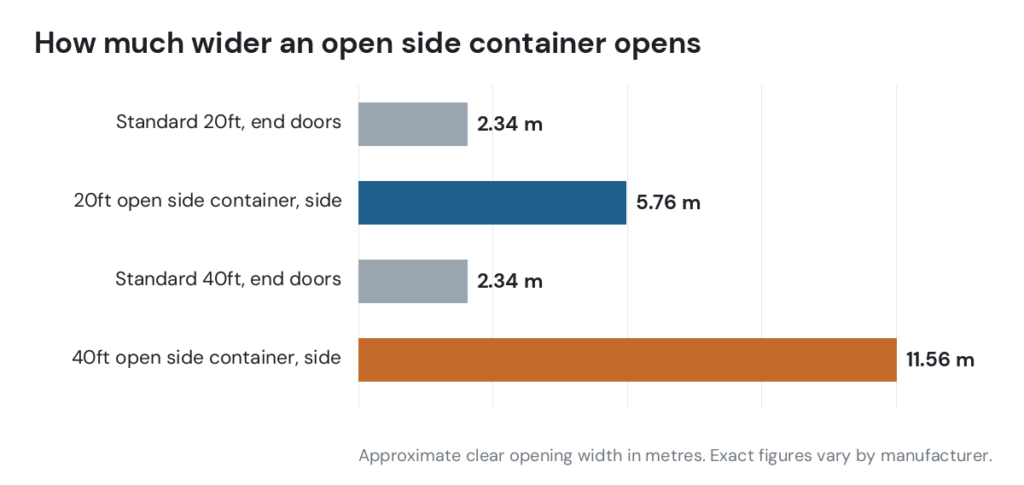
The chart makes the point better than words. A standard container gives you a doorway about 2.3 m wide, whatever its length. A 20ft side access unit gives you about 5.8 m. The 40ft gives you more than 11.5 m. On the 40ft that is five times the access, and it is the whole reason people pay extra for this box.
Open side containers we sell right now
These are our current listings. Prices are in US dollars, before freight and delivery, and they move with stock, so the product page always shows the live figure. Every unit below is wind and watertight, with lockable end and side doors.
Used 20ft open side container: $2,950
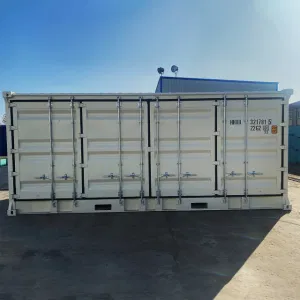
The used 20ft open side container is the lowest priced way to get full side access. It has worked in service before, so expect dents, scrapes and patches of surface rust on the outside. What we check is what matters on a side opening box: every side door section opens, closes and locks, the gaskets seal, the floor is sound and the box is wind and watertight.
Short spec: 20 x 8 x 8 ft 6 in; full-length bi-fold side doors plus double end doors; side opening approx. 5.70 to 5.82 m; tare approx. 2,930 to 3,400 kg; used, wind and watertight.
It suits farms, yards, builders and hire firms that want easy access and do not care about a perfect finish. It is also a sensible base if the outside is going to be painted or clad anyway.
One trip 20ft open side container: $5,200
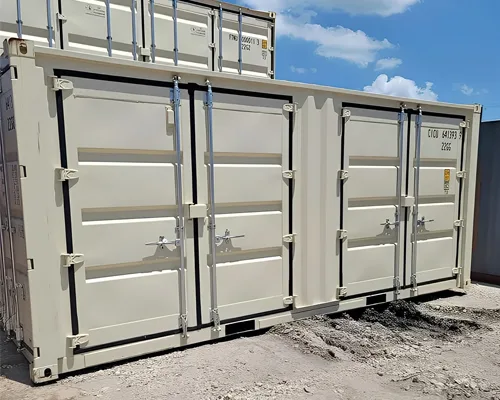
A one trip box has made a single loaded voyage from the factory and then been sold. On a standard container that mostly buys you looks. On a side access box it buys you something more useful: door hardware that is close to new. There are a lot of hinges, cams and gaskets along that side, and on the one trip 20ft open side container they are all straight and lined up.
Short spec: 20 x 8 x 8 ft 6 in; four-leaf bi-fold side doors plus end doors; side opening approx. 5.70 to 5.82 m; tare approx. 3,000 to 3,400 kg; max gross typically 30,480 kg; Corten steel; CSC plated.
New 20ft open side container: $5,700
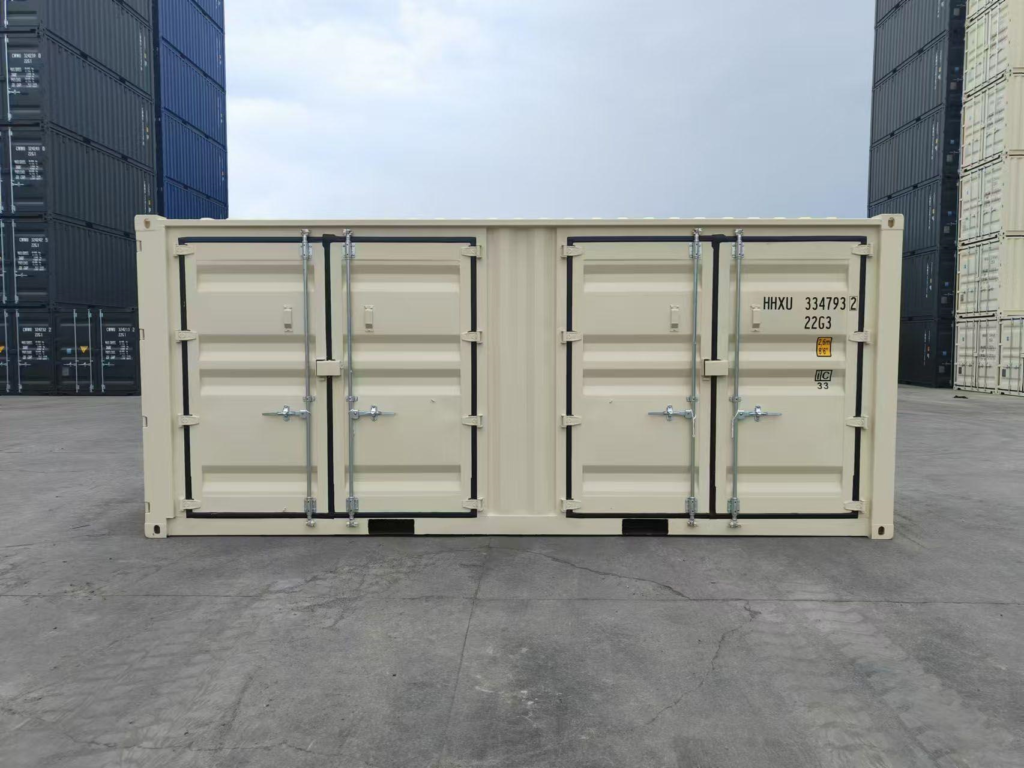
The new 20ft open side container is for buyers who want an unmarked box, usually because customers will see it every day. Shops, cafes, showrooms and branded event units fall into this group.
Short spec: 20 x 8 x 8 ft 6 in; internal approx. 5.85 x 2.25 to 2.29 x 2.30 to 2.39 m; side opening approx. 5.70 to 5.82 x 2.15 to 2.19 m; approx. 31 m³; marine plywood floor on steel cross members; CSC plated.
Used 40ft open side container: $5,500
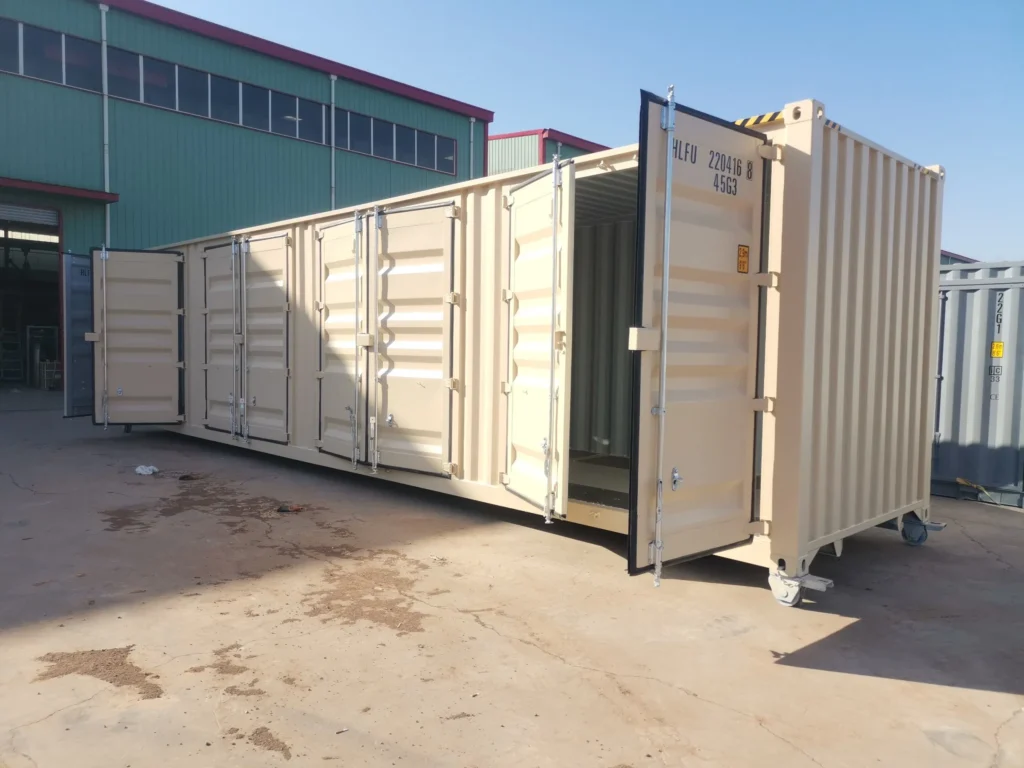
Used side opening forties are not common, and condition varies more than on standard boxes, so the ones that pass our checks do not sit around long. The used 40ft open side container gives you the full-length side access of the big box for $700 less than a one trip unit.
Short spec: 40 x 8 x 9 ft 6 in high cube; bi-fold side doors opening approx. 11.56 m plus end doors; internal height approx. 2.47 m; tare approx. 5,900 to 6,600 kg; used, wind and watertight, side doors checked.
One trip 40ft open side container: $6,200
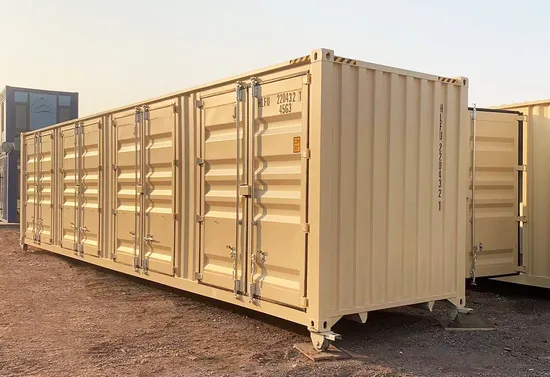
This is the largest side access container in common use. The one trip 40ft open side container is a high cube with eight door leaves on the long side and standard doors at the end. With everything open you have more than 11.5 m of clear access, which is enough to run a forklift along the whole length and set down pallets in any bay.
Short spec: 40 x 8 x 9 ft 6 in (12.19 x 2.44 x 2.90 m); internal approx. 12.03 x 2.29 x 2.47 m; side opening approx. 11.56 x 2.31 m; approx. 68 m³; max gross 30,480 or 32,500 kg; Corten steel; CSC plated.
If none of these fit, browse the whole open side containers category, or look at our 40ft high cube containers and 20ft shipping containers for other layouts.
How much does an open side container cost?
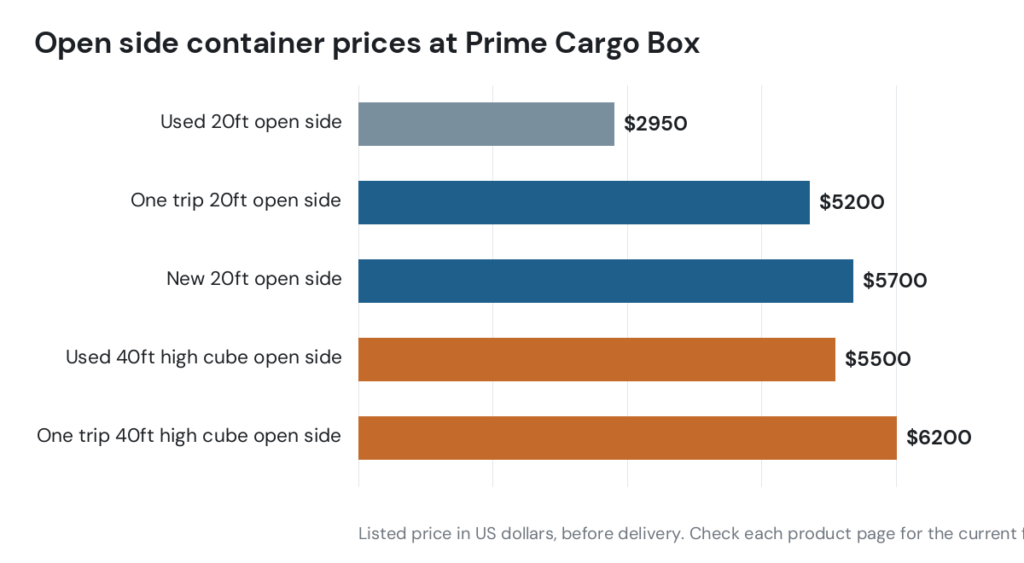
On our current listings, side access costs between $2,950 and $6,200 before delivery. For comparison, a used 20ft standard container is $1,000 and a one trip 20ft standard is $1,550. So you are paying roughly two to three times the price of a plain box for the side doors. On a one trip 40ft high cube at $2,900, the jump to the one trip 40ft side opening unit at $6,200 is a bit over double.
That premium is not a markup for the sake of it. Three things drive it:
- More steel. The heavier side rails and posts add close to a tonne on a 20ft and around two tonnes on a 40ft.
- More moving parts. Four or eight extra door leaves means extra hinges, locking bars, cams and gaskets, all of which have to be fitted and aligned by hand.
- Lower volume. Factories build far fewer open side units than standard dry boxes, so there are no big economies of scale, and the used market is thin.
Notice too that the gap between used and one trip is much smaller on the 40ft ($700) than on the 20ft ($2,250). That reflects how scarce good used 40ft side opening boxes are. If you need a forty, the one trip unit is often the better value once you think about door wear.
Delivery is the other cost to plan for. It depends on distance, the type of truck your site needs and, for export orders, freight and local import charges. Our shipping container prices guide explains how box price and delivery add up, and our cheap shipping containers guide covers ways to keep the total down.
Open side container vs other container types
Side doors are not always the right answer. Here is how it compares with the boxes people usually weigh it against.
| Container type | How you get in | Best for | Watch out for |
|---|---|---|---|
| Standard dry container | End doors only, about 2.3 m wide | Bulk storage you rarely touch, lowest price | Hard to reach items at the back |
| Open side container | Full long side plus end doors | Daily access, forklift loading, shop fronts | Higher price, heavier, needs level ground |
| Double door (tunnel) container | Doors at both ends | Drive-through storage, two-ended access | Still only 2.3 m wide openings |
| Open top container | Removable roof plus end doors | Tall loads lifted in by crane | Not suited to everyday picking |
| High cube container | End doors, extra 30 cm height | Tall racking and machinery | Same narrow access as standard |
Open side container vs standard container
If you fill the box and leave it, buy a standard container and save the money. Our storage containers for sale guide is the place to start for that. If you will be in and out of it every day, or you load with a forklift, side access pays for itself in time and floor space. With a standard box you lose a central aisle. With side access the aisle is outside, so you can rack from the floor to the back wall and use nearly the whole interior.
Open side container vs double door container
A double door container (often called a tunnel container) opens at both ends. That helps if you want to drive a pallet truck straight through, or split a box into two stores. It does not help you reach the middle. For a store that is picked from along its length, side doors win. A tunnel box is cheaper, though: our one trip 20ft double door container is $2,500.
Open side container vs open top container
An open top container is for loads that come in from above, usually by crane. Think tall machinery, logs or stone. It is a loading solution more than a storage one, because the roof is a tarpaulin. If your goods go in by forklift and you need a hard, lockable roof, choose side access. Our guide to the types of shipping containers covers every layout in more detail.
9 best uses for an open side container
These are the jobs where the side doors make a real difference. Each one is a common reason buyers pay extra for side doors over a cheaper box.
1. Builders’ merchants and timber yards
Long stock like timber, pipe, steel sections and guttering is awkward to feed through a 2.3 m end door, and even worse to pull back out. With side access you lift it in from the side on a forklift and set it on racks along the back wall. A 40ft box takes 6 m lengths with room to spare.
2. Site storage for contractors
On a building site, the tool store gets opened every morning and every evening. When the whole side opens, crews can see where everything is and get it out without a queue at the door. Lock it with the side closed and it is as secure as any other steel box.
3. Event, staging and hire companies
Hire firms load and unload the same kit week after week. Staging, lighting, barriers and furniture can be put away in labelled bays and picked straight off the shelf. A 20ft unit also travels well between shows on a standard container trailer.
4. Pop-up shops and market stalls
Open the side and the container becomes a shop front. This is one of the most visible uses, and container markets in many cities use exactly this layout. Add a counter, lights and power and it is a trading unit. Close it at night and leave the stock inside.
5. Bars, cafes and food stands
The open side works as a serving hatch or a full open front. The end doors give staff a separate way in. For food use you will want insulation, lining and ventilation, which our container modification team can fit before delivery.
6. Workshops and repair bays
A mechanic, welder or joiner gets daylight, airflow and space to work on long pieces from a fully open front. A 40ft high cube side access unit with a bench along the back wall is a practical small workshop.
7. Farms
Machinery, feed, fencing, seed and tools all sit together on a farm, and they get used at different times of year. Side access means you can get the mower out in spring without shifting the feeders.
8. Exporters with awkward cargo
If you ship machinery or long items that will not fit through end doors, a side opening box lets you load from the side at origin and unload the same way at destination. Check the side opening height and the payload against the weight of your cargo first.
9. Exhibition stands and showrooms
Brands use open side units at trade shows because the whole box becomes a display with no assembly. Paint it, put a sign on the roof line and open the side. A new 20ft open side container is the usual starting point here because the finish has to look good.
New, one trip or used open side container?
Condition matters more on a side opening box than on any other dry box, because condition is mostly about the doors.
New boxes come straight from the factory without a voyage. They cost the most and are the right pick when the container is part of your brand.
One trip boxes have carried one load from the factory. The steel is straight, the gaskets are fresh and the side doors line up and lock without a fight. For most buyers this is the sweet spot, especially on a 40ft where a twisted frame makes the doors hard to close.
Used boxes have been in service for years. They are sound, but the paint is tired and the door hardware has had heavy use. Expect to adjust and grease the side doors more often. A used unit is still a smart buy when price matters most or the outside will be covered anyway.
If you want the wider picture on condition grades, our one trip vs used shipping container comparison explains what each grade really means, and the used shipping containers and new shipping containers categories show what is in stock.
20ft or 40ft open side container?
Choose the 20ft if your site is tight, if you are moving the box between locations, or if your stock fits in about 31 m³. It is easier to deliver, cheaper to buy and lighter to lift.
Choose the 40ft if you have the space and you are storing long goods, a lot of pallets, or running a retail or workshop front where length is the point. Per cubic metre it is better value, and because it is a high cube you also get the extra height. Our 20ft vs 40ft shipping container guide and high cube vs standard container guide go further into the trade-offs.
Preparing your site for an open side container
Most problems with side opening boxes come from the ground, not the box. Get this part right and the doors will work for years.
Level matters more than on any other box
Over 6 m, and especially over 12 m, a small dip in the ground is enough to twist the frame slightly. On a standard container you might not notice. On a side access box the door leaves stop lining up, the locking bars will not engage and the gaskets will not seal. Put the box on a concrete pad, well-compacted level gravel, or solid blocks under each corner (and at mid-length points on a 40ft). Check it with a level before you load anything.
Leave room for the doors and the forklift
The side doors fold outward, so plan for clear, firm ground of at least 4 to 5 m along the opening side. If a large forklift will work there, allow more. Leave space at the end doors too. For a 40ft unit you need a level base of roughly 12.5 x 2.5 m plus that working strip.
Decide which way the doors face before you order
Most units open on the right-hand side when you stand at the end doors and look along the box, but it varies. Tell us which way you need the opening to face on your site and we will confirm before dispatch. Turning a 40ft box round on a tight site after delivery is not fun.
Delivery access
The truck needs a straight approach, firm ground and overhead clearance. A 40ft high cube on a tilt-bed or side-lifter needs a lot of room. Our shipping container delivery guide has the clearances and a checklist, and our shipping and delivery policy explains how we plan delivery for orders around the world.
Forklift safety
If you will load from the side with a forklift, make sure operators are trained and the floor rating is respected. The OSHA guidance on powered industrial trucks is a good, free reference on safe forklift use wherever you work. Never drive onto the container floor with a heavier machine than it is rated for, and do not stand under a door leaf in wind.
What to check when you receive an open side container
Whatever condition you buy, run through this list when the box lands. It takes twenty minutes and it catches anything that needs sorting while the delivery details are fresh.
- Open every side door pair fully and close it again. Each one should swing freely and lock without forcing.
- Check the locking bars engage the keepers at top and bottom on every pair.
- Look along the gaskets for splits or gaps. On a sunny day, close the box, stand inside and look for daylight.
- Check the end doors the same way.
- Walk the floor. It should feel solid with no soft spots, especially near the side opening where forklifts run.
- Look at the corner castings and the bottom side rail on the door side for damage from lifting.
- Find the CSC plate and note the max gross weight and tare.
If something is not right, get in touch with photos and we will sort it out. Our refund and returns policy sets out how that works.
Modifying an open side container
The side opening makes this one of the easiest boxes to convert, because there is a huge gap to work through and nothing to cut. Common additions are:
- Shop counters and fold-down serving shelves along the side opening
- Roller shutters fitted inside the side doors for daily use, so the steel doors only close at night
- Insulation and wall lining for cafes, offices and workshops
- Lighting, sockets and a consumer unit
- Racking along the back wall
- Ventilation, windows and air conditioning
Our custom container modifications page shows what we can fit before delivery. It is almost always cheaper and neater to do the work at the depot than on your site.
Looking after your open side container
Containers are built from weathering steel (Corten), which forms a protective rust layer and resists corrosion far better than ordinary mild steel. That does not make the box maintenance free. The side doors are the part that needs attention.
- Grease the hinges and locking bar cams every few months, more often near the sea.
- Keep the gaskets clean and wipe them with a rubber-safe protectant once a year.
- Do not let water sit on the roof. Clear leaves and check it stays level.
- Touch up bare steel with a zinc primer and paint when you see scratches.
- Re-check the base level every year, especially after a wet season.
Treat the side doors well and they will keep sealing for the life of the box. If you want to see how professionals grade container condition, the Institute of International Container Lessors (IICL) publishes the inspection and repair criteria used across the leasing industry.
Mistakes to avoid when buying
A few errors come up again and again with side opening boxes, and all of them are easy to avoid.
- Measuring only the end door. The side opening is lower than the end door on a standard-height 20ft. Measure your tallest item against the side height, not the end.
- Ignoring the extra weight. Tell your delivery driver or crane operator the real tare. A forklift that lifts a standard 20ft empty may struggle with a side opening unit.
- Putting it on soft ground. A base that sinks a few centimetres after rain is enough to jam the doors.
- Ordering the wrong hand. Check which side the doors need to face before the box leaves the depot.
- Buying a curtain-sided unit by mistake. Some listings use “open sided” for canvas walls. Make sure you are getting steel doors.
How to buy an open side container from Prime Cargo Box
Buying is straightforward. Pick the size and condition from the product pages above, add it to your cart or ask for a quote, and give us your delivery address. We confirm the exact unit, its dimensions and weights, the side the doors face and the delivery cost. For orders outside the country of dispatch we handle export paperwork and give you a delivered price, with any local duties shown separately.
If you have never bought a container before, our step-by-step guide on how to buy a shipping container walks through payment, inspection and delivery. You can also browse all cargo containers for sale or see the full range on our products page.
Open side container FAQ
What is the difference between an open side container and a side door container?
They are the same thing. “Open side”, “side opening”, “side access” and “side door” all describe a container with bi-fold doors along one long side plus end doors.
How wide is the side opening on an open side container?
On a 20ft open side container it is about 5.70 to 5.82 m. On a 40ft high cube it is about 11.56 m. Exact figures vary by manufacturer and are confirmed on your quote.
Is an open side container as secure as a normal container?
Yes. Each door pair has its own locking bars, and when closed the doors lock into the top and bottom rails. Add good padlocks or a lock box on each pair you use. The steel is the same as any other container.
Can I stack open side containers?
New and one trip units carry a CSC plate with a stacking rating, so they can be stacked like other boxes. For permanent stacked storage on land, check the rating on the plate and use proper twist locks or bridge clamps. Never stack anything on a box with a damaged frame.
Are both long sides open?
On our units, one long side opens. Some specialist builds have doors on both sides, but they are rare, heavier and expensive. For almost every job, one side plus the end doors is enough.
Is an open side container heavier than a standard box?
Yes. A 20ft open side container weighs about 3,000 to 3,400 kg empty, against around 2,200 kg for a standard 20ft. A 40ft high cube open side unit is around 5,900 to 6,600 kg.
Can I ship goods overseas in an open side container?
Yes, if it is CSC plated and in sound condition. Load and secure cargo as you would in any dry box, and remember the extra tare reduces your payload.
Do you deliver an open side container worldwide?
Yes. We ship to customers around the world and quote freight, export documents and local delivery for your address. Use our contact page and tell us the destination.
How long do the side doors last?
With greasing, clean gaskets and a level base, the side doors last as long as the container. Problems almost always come from a box sitting on uneven ground or from doors that are never lubricated.
Ready to order your open side container?
If you need to reach your goods every day, load from the side with a forklift, or turn a box into a shop front, the side doors are worth the extra cost. For most buyers the choice comes down to two units: the one trip 20ft open side container at $5,200 for compact sites, or the one trip 40ft open side container at $6,200 when length matters. On a tighter budget, the used 20ft at $2,950 and the used 40ft at $5,500 give you the same layout for less.
Browse every unit in our open side containers range, or contact our team with your size, site and destination and we will quote a delivered price.
Cover photo: Akos Kokai (CC BY 2.0), via Wikimedia Commons.