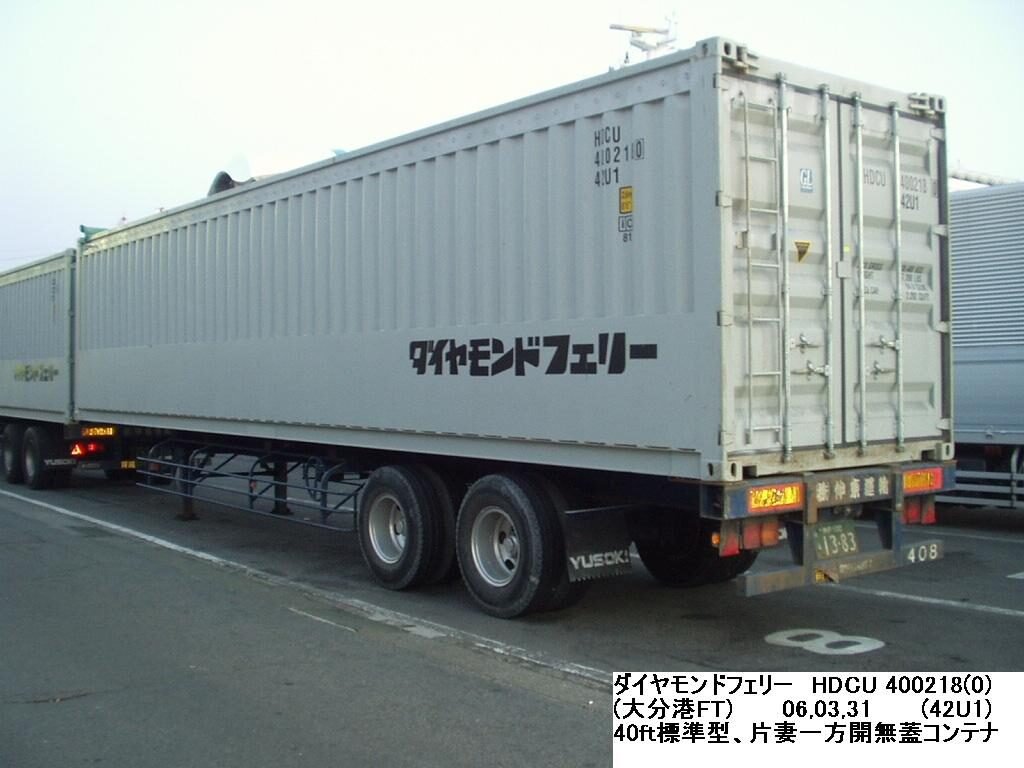
An open top container is a steel shipping container with no fixed roof. Instead of a solid steel top, it has removable roof bows and a heavy tarpaulin, so you can take the cover off and lower cargo in from above with a crane. The walls, floor and end doors are the same as a normal box. We sell the open top container in 20ft and 40ft, new, one trip and used, from $2,600 for a used 20ft open top container, with worldwide delivery.
People buy them for one reason: the cargo will not go through the doors, or it would be slow and risky to push it through. Machinery, stone blocks, steel coils, tall plant, scaffold bundles and anything that comes off a lorry on a crane hook. This guide covers what an open top is, the real dimensions, what you can and cannot do with the tarpaulin roof, what it costs against a standard box, and which size and grade makes sense for your job.
Table of Contents
Quick answers
- Cheapest open top we list: the used 20ft open top at $2,600.
- Best value near-new: the one trip 20ft open top container at $3,150.
- Factory new 40ft: the new 40ft open top shipping container at $4,300.
- 40ft one trip and used: the one trip 40ft open top and used 40ft open top are priced on request, because stock moves quickly.
- Roof opening: about 5.34 x 2.23 m on a 20ft and 11.55 x 2.23 m on a 40ft.
- Delivery: worldwide, quoted to your address.
What is an open top container?
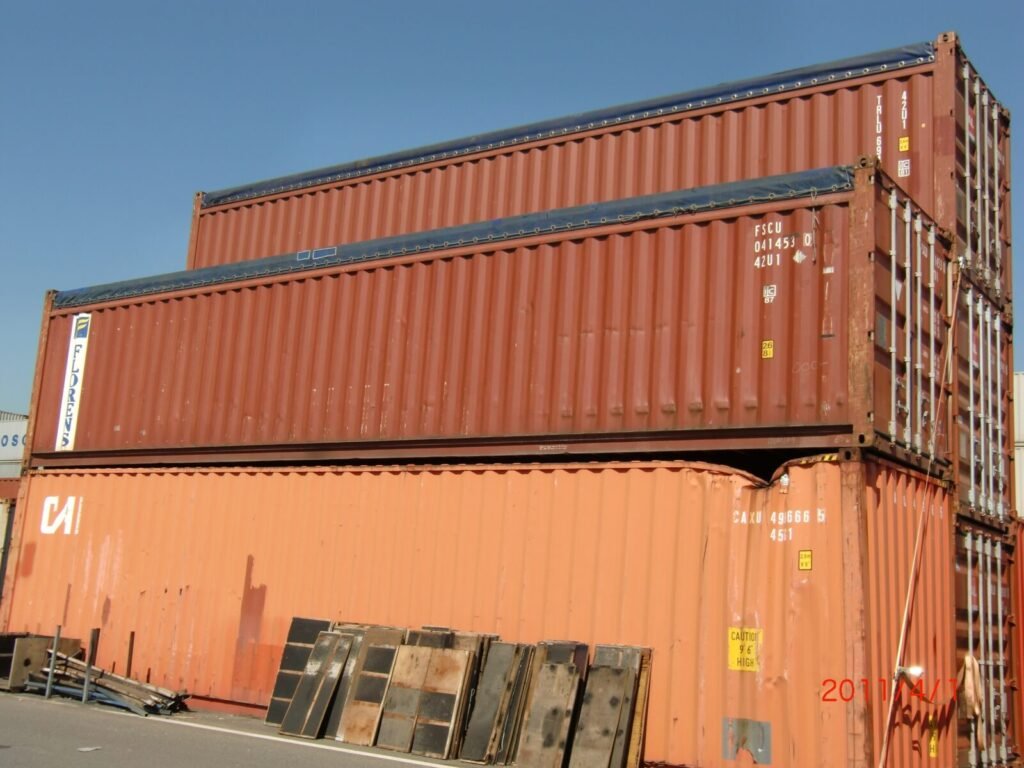
Take a standard dry container and remove the corrugated steel roof. Leave the top side rails and end frames, and fit sockets along the rails. Steel roof bows drop into those sockets and span the width of the box. A heavy PVC tarpaulin goes over the bows and is held down with a cable or rope threaded through eyelets around its edge. That is an open top container.
Everything else is what you would expect from a normal ISO box. The outside size follows ISO 668, the international standard for freight container sizes and ratings, so it fits standard trailers, twist locks and spreaders. There are double cargo doors at one end, a marine plywood floor on steel cross members, Corten steel walls and corner castings at every corner. New and one trip units carry a plate under the International Convention for Safe Containers (CSC), which means they can carry cargo by sea.
You will see the type written as OT, 20’OT or 40’OT in shipping paperwork, and in the ISO size and type code as 22U1 for a 20ft and 42U1 or 45U1 for a 40ft. The “U” in the code is the open top group.
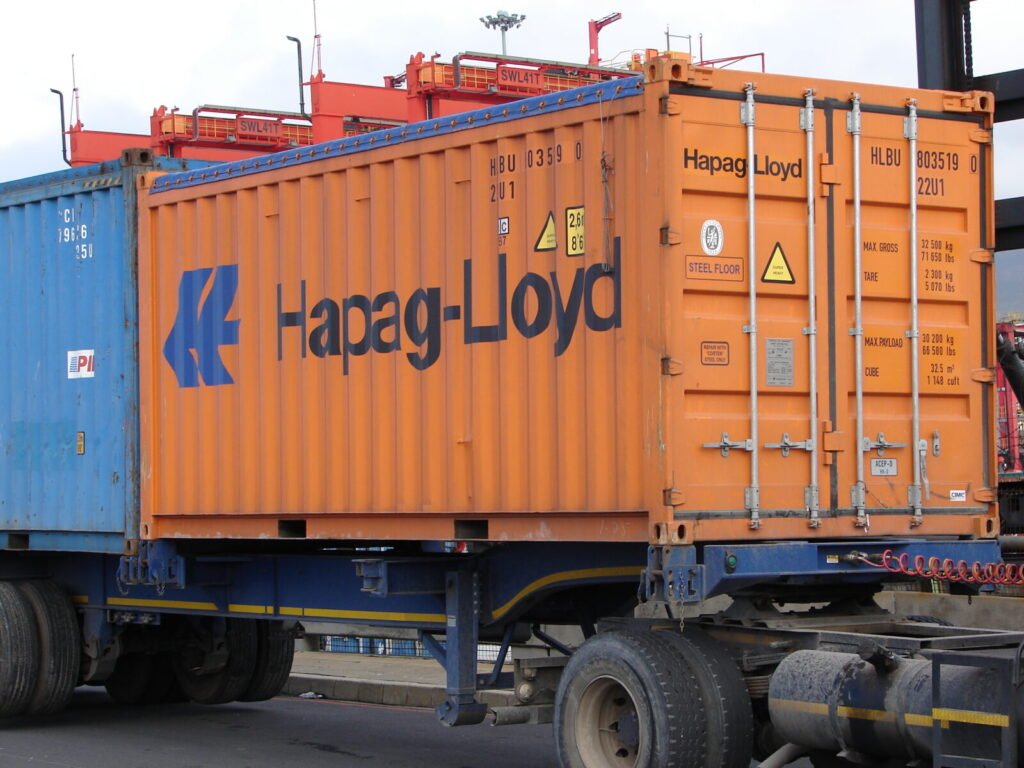
How the roof works
On an open top container the roof is a set of parts, not a panel. To open it, release the roof cable from the eyelets, fold or roll back the tarpaulin, then lift the bows out of their sockets. One person can lift a bow, but on a 40ft there are a lot of them, so plan for two people and twenty minutes or so. Load the cargo, put the bows back, pull the tarpaulin tight and re-thread the cable.
When the box ships with cargo, the roof cable can take a customs seal, the same way the door handles do. That is how an open top travels on a ship with a soft roof and still counts as sealed.
The swing header
Most open top containers also have a swing header, a hinged steel beam above the end doors. Release the pins and it swings out of the way, which raises the height at the door end. That helps when you drive a forklift in with a tall load, or when part of the cargo goes in through the doors and part from above.
Does the open top leak?
A good tarpaulin pulled tight over straight bows sheds rain well. Water gets in when the tarp is loose, torn or sagging between bows, or when the bows are bent and do not sit level. That is why condition matters more on an open top than on most container types, and why we pay close attention to the roof parts on every unit we sell.
Open top container sizes and specifications
The figures below come from our own listings. They match the published specifications from major carriers, for example the Hapag-Lloyd 20ft open top specification and the Hapag-Lloyd 40ft open top specification. Exact numbers vary a little by factory, so we confirm the plate data of your unit on the quote.
| Specification | 20ft open top container | 40ft open top container |
|---|---|---|
| External size | 6.06 x 2.44 x 2.59 m (20 x 8 x 8 ft 6 in) | 12.19 x 2.44 x 2.59 m (40 x 8 x 8 ft 6 in) |
| Internal length | approx. 5.90 m | approx. 12.03 m |
| Internal width | approx. 2.35 m | approx. 2.35 m |
| Internal height to roof bows | approx. 2.34 m | approx. 2.34 m |
| Roof opening | approx. 5.34 m x 2.23 m | approx. 11.55 m x 2.23 m |
| Door opening | approx. 2.34 m wide x 2.28 m high | approx. 2.34 m wide x 2.28 m high |
| Cubic capacity | approx. 32.5 m³ | approx. 66.5 to 66.8 m³ |
| Tare weight | approx. 2,300 to 2,500 kg | approx. 3,800 to 4,100 kg |
| Max gross weight | 30,480 or 32,500 kg depending on build | 30,480 or 32,500 kg depending on build |
| Payload | approx. 28,000 to 30,000 kg | approx. 26,400 to 28,450 kg |
| Roof | removable steel bows and tarpaulin | removable steel bows and tarpaulin |
| Doors | double cargo doors at one end, swing header on most units | double cargo doors at one end, swing header on most units |
A few things in that table matter more than they look.
The roof opening is smaller than the inside of the box. The top rails and end frames stay in place, so you lose a bit at the ends and edges. On a 20ft you have about 5.34 m of clear length to lower cargo through, not the full 5.90 m. Measure your load against the roof opening, not the internal length.
The payload is high. A 20ft open top container can carry close to 30 tonnes on a 32,500 kg rated build. That is why so many heavy, dense loads go in 20ft open tops. They hit the weight limit long before they fill the space.
The inside height is quoted to the bows. With the bows out and the tarp off, you can load cargo taller than the side walls. More on that below, because it changes how the box ships.
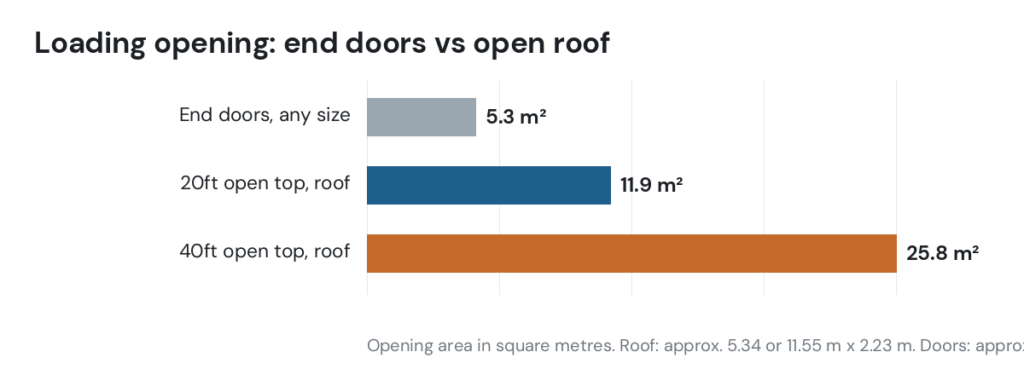
The chart shows why people pay for the roof. Every standard container gives you the same doorway, about 5.3 m². A 20ft open top container gives you about 11.9 m² of roof opening on top of that. A 40ft gives you nearly 26 m². And a crane can place cargo anywhere along that opening, not just at the door end.
Open top containers we sell right now
All prices are in US dollars before freight and delivery. They change with stock, so the product page always has the current figure. Every open top we sell is wind and watertight, with its roof bows and tarpaulin included.
Used 20ft open top container: $2,600
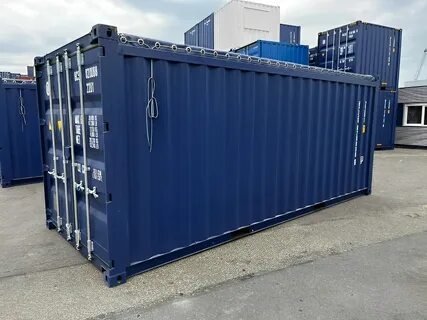
The used 20ft open top container is the cheapest way to get crane access. It has worked in shipping before, so expect dents, faded paint and some surface rust. We check the parts that matter on this type: the top rails, the bow sockets, the tarpaulin and the doors.
Short spec: 20 x 8 x 8 ft 6 in (6.06 x 2.44 x 2.59 m); removable roof for loading from above; roof opening approx. 5.34 x 2.23 m; tare approx. 2,300 to 2,500 kg; used, wind and watertight, tarpaulin and roof bows included.
One trip 20ft open top container: $3,150
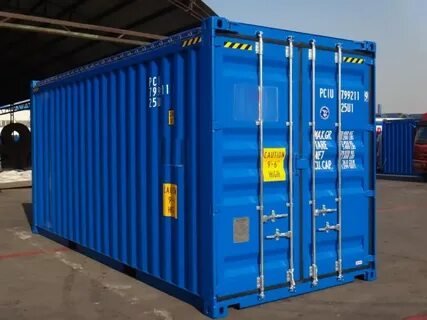
A one trip box has carried one load from the factory and then been sold. On an open top that buys you a tarpaulin with no patches, bows that drop straight into their sockets and top rails with no crane dents. The one trip 20ft open top container is the one we suggest to most buyers, because the roof parts are where a used open top costs you money later.
Short spec: 20 x 8 x 8 ft 6 in; removable roof bows and tarpaulin; roof opening approx. 5.34 x 2.23 m; tare approx. 2,450 kg; max gross 30,480 to 32,500 kg; Corten steel; marine plywood floor; CSC plated.
One trip 40ft open top container: price on request
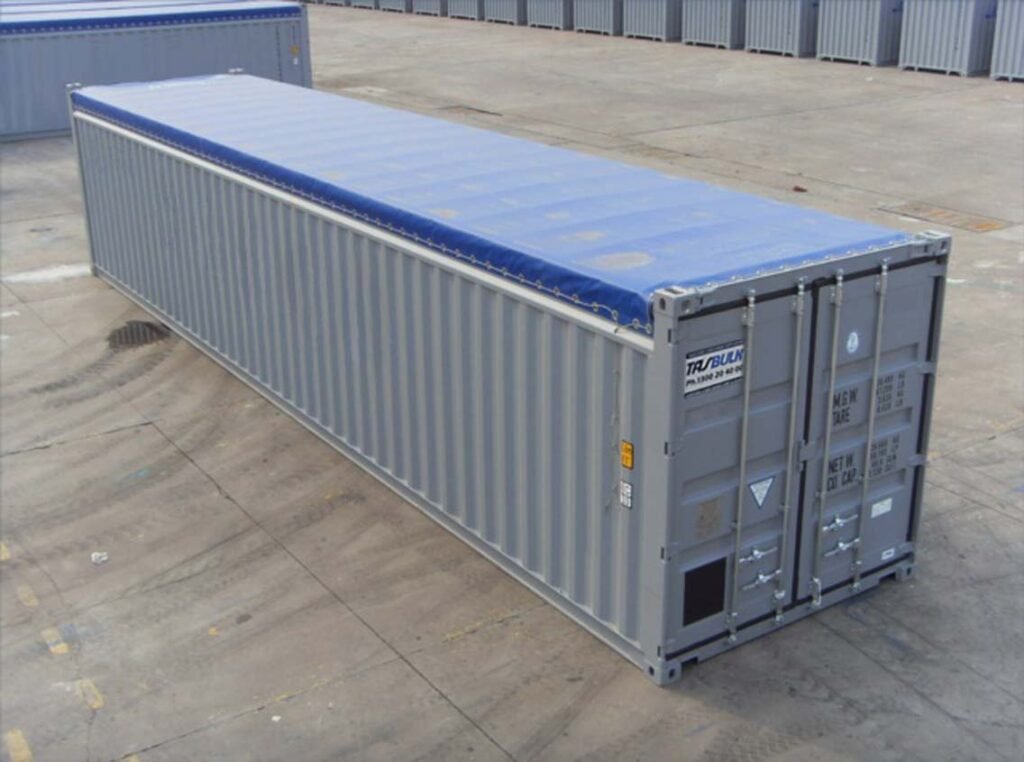
The one trip 40ft open top container is for long cargo: pipe, steel sections, timber, and machinery that needs more than 5 m. It has about 11.55 m of roof opening and near-new roof parts. One trip forties do not stay in stock long, so we quote them as they come in.
Short spec: 40 x 8 x 8 ft 6 in (12.19 x 2.44 x 2.59 m); removable roof for crane loading long cargo; roof opening approx. 11.55 x 2.23 m; tare approx. 4,050 kg; max gross 30,480 to 32,500 kg; Corten steel; CSC plated.
Used 40ft open top container: price on request
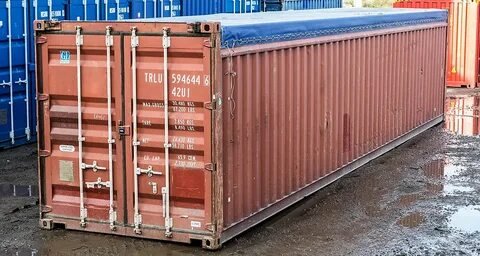
The used 40ft open top container gives you the same long roof opening for less. Used forties often show crane marks on the top rails, so we check that every bow seats properly and the tarpaulin closes the box fully before we sell it.
Short spec: 40 x 8 x 8 ft 6 in; removable roof; roof opening approx. 11.55 x 2.23 m; tare approx. 3,800 to 4,100 kg; used, wind and watertight, tarpaulin and roof bows included.
New 40ft open top shipping container: $4,300
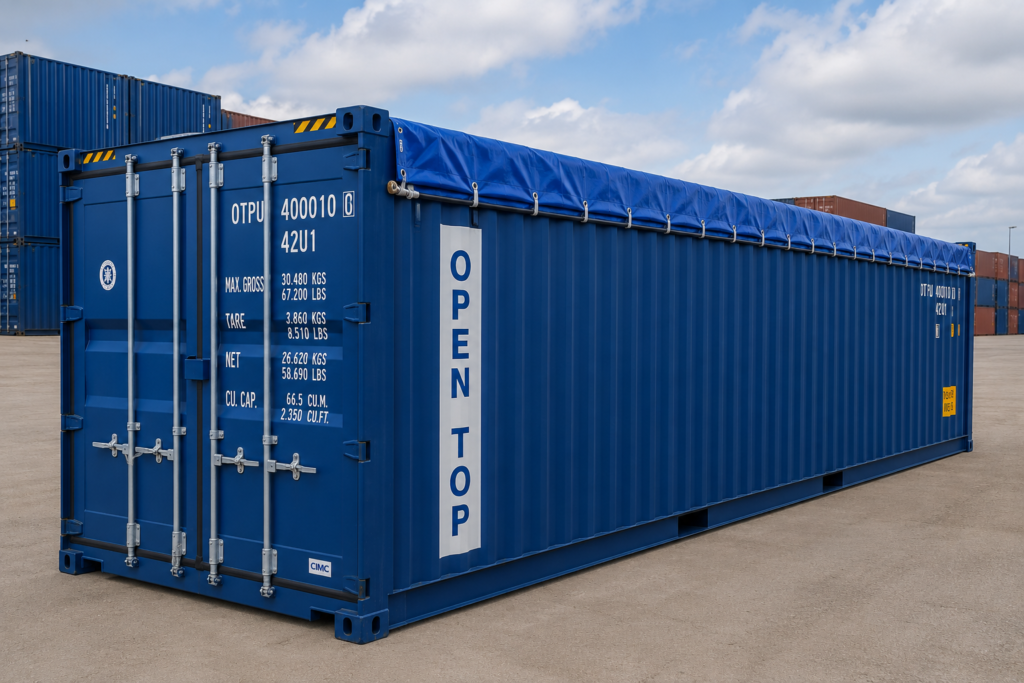
The new 40ft open top shipping container has never carried cargo. Buy new when the box will do years of heavy crane work, or when you want the longest possible life from the tarpaulin and roof bows.
Short spec: 40 x 8 x 8 ft 6 in; internal approx. 12.03 x 2.35 x 2.35 m; door opening 2.34 x 2.28 m; approx. 66.5 m³; tare approx. 3,900 kg; max payload approx. 26,580 kg; max gross 30,480 kg; removable tarpaulin roof; brand new.
You can see the full range in our open top containers and open top shipping containers categories, or on our open top shipping container for sale page.
How much does an open top container cost?
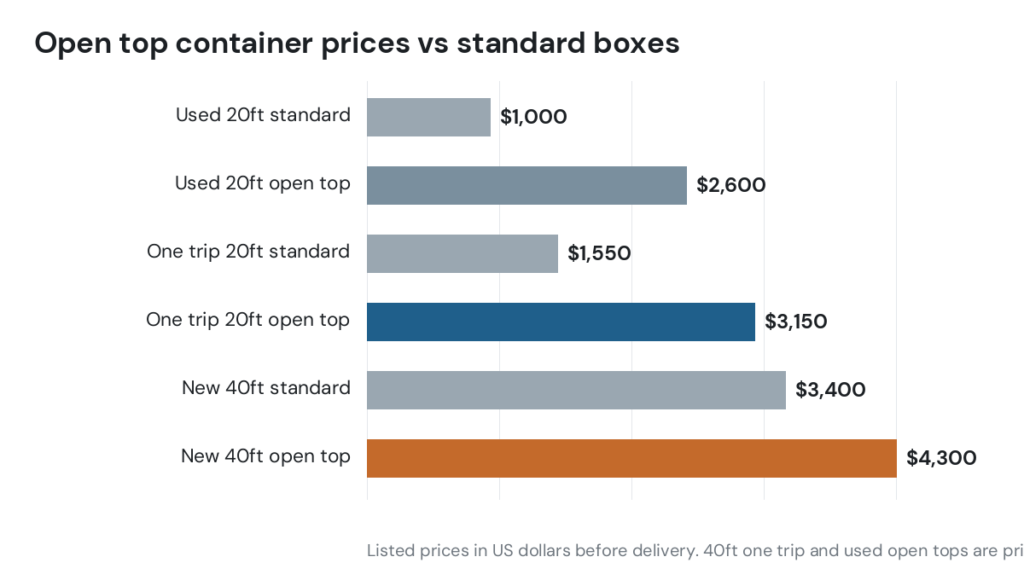
On our current listings, an open top runs from $2,600 used to $4,300 new for the priced units, with the one trip and used forties quoted on request. Against a standard box of the same size and grade, that looks like this:
| Size and grade | Standard container | Open top container | Difference |
|---|---|---|---|
| Used 20ft | $1,000 | $2,600 | +$1,600 |
| One trip 20ft | $1,550 | $3,150 | +$1,600 |
| New 40ft | $3,400 | $4,300 | +$900 |
The standard prices come from our used 20ft, one trip 20ft and new 40ft listings.
Why the extra cost? Three reasons.
- More parts. The roof is a kit: bows, a tarpaulin, a roof cable and a swing header. Each needs fitting and each wears.
- Fewer built. Open tops are a specialist type. Factories make far fewer than standard dry boxes.
- Steady demand. Project cargo, machinery and stone shippers want them all the time, so there is not a big surplus of used units sitting around.
Then there is delivery. That depends on distance, the vehicle your site needs and, for export, freight and import charges at your end. Our shipping container prices guide explains how box price and delivery add up, and the cheap shipping containers guide shows where you can save.
When the extra money is worth it
Work it out in crane time and risk, not just box price. If you would otherwise need to push a 4 tonne machine through a 2.34 m doorway on skates, the open top pays for itself on the first job. If your goods are palletised and come in on a forklift, it does not, and a standard container is the better buy.
Open top container vs other container types
| Container | How cargo goes in | Best for | Watch out for |
|---|---|---|---|
| Standard container | End doors only | Palletised goods, secure long-term storage | Nothing taller or wider than the doors |
| Open top container | From above by crane, plus end doors | Heavy, tall or awkward loads, crane loading | Soft roof, not as secure for unattended storage |
| Open side container | Along the long side plus end doors | Daily access and forklift loading from the side | Costs more, needs very level ground |
| Double door container | Doors at both ends | Pass-through storage, two stores in one | Same door size as standard |
| High cube container | End doors, about 30 cm more height | Tall racking and machines that fit the door | Still limited by the door opening |
Open top container vs standard container
A standard box has a solid steel roof and is the better store for goods you leave unattended. An open top lets you place things a forklift cannot reach. If you are not sure, ask one question: will a crane ever load this box? If yes, buy the open top. If no, buy a standard container from our standard shipping containers range and save the money.
Open top container vs open side container
An open side container opens along the long side so a forklift can load every bay. It suits daily picking and shop fronts. An open top container suits loads that come from above. They solve different problems, and the open side is the more expensive of the two: our one trip 20ft open side is $5,200 against $3,150 for the one trip 20ft open top.
Open top container vs double door container
A double door container has doors at both ends. Its openings are the same size as a standard box, so it does nothing for tall or heavy loads. Pick it for storage you open often. Pick the open top container for cargo that will not fit through a door.
Open top container vs high cube
A high cube adds about 30 cm of height inside, but the load still has to go through the end doors. If your cargo is tall but narrow enough for the door, a one trip 40ft high cube at $2,900 might do. If it needs a crane, it needs an open top container.
What to use an open top container for
Machinery and plant
Excavator attachments, generators, compressors, pumps, gearboxes, presses and machine tools. Heavy items with lifting points are lowered straight in and set on timber, with no skates or jacks. Engineering firms and machinery dealers use open tops for both shipping and site storage.
Stone, marble and granite
Stone blocks and slabs are heavy and dense. A 20ft open top takes close to its full payload in a small footprint, and a crane can set each block where it needs to be for even weight across the floor.
Steel coils, bundles and sections
Coils and bundles come off a lorry on a crane. Lowering them into an open top is quicker and safer than handling them through doors. Long sections and pipe go in a 40ft, which has about 11.5 m of roof opening.
Timber and logs
Sawn timber packs and logs are often crane-loaded at the yard. In a 40ft open top, long lengths go in from above without the risk of catching on the door frame.
Scaffolding and site plant
Builders store scaffold tubes, boards, fittings and tall plant in open tops on longer projects. The crane on site does the loading, and the box doubles as a lockable store with the tarp on.
Bulk materials in bags
Big bags of sand, aggregate, fertiliser and similar materials are lifted by their loops. They are much easier to load from above than to drag through a door.
Out of gauge cargo
Some loads stand taller than the side walls. An open top can carry those with the tarp fitted over the top or left off, but the shipping line then treats it as out of gauge (OOG). That changes where it can be stowed on the ship and what it costs, so talk to your forwarder before you book.
Loading an open top container safely
Crane loading is the whole point of this box, and it is also where things go wrong. A few rules keep it straightforward.
Before the lift
- Check the box is on firm, level ground and the doors are closed and locked unless you are loading through them.
- Remove the tarpaulin and all the roof bows you need clear. Keep the bows somewhere they cannot be stood on or driven over.
- Swing the header open if part of the load goes through the end.
- Lay timber dunnage on the floor where heavy items will sit, so point loads spread across the cross members.
During the lift
- Keep the heaviest item over the centre of the floor, not at one end. An open top full of steel at one end can tip a trailer or overload one pair of corner castings.
- Lower slowly and land the load on the dunnage, not on the floor edge or the bottom side rail.
- Never stand inside the box under a suspended load. Guide it with tag lines from outside.
- Follow your local crane and rigging rules. The OSHA crane, derrick and hoist safety overview is a free, practical reference that covers the main hazards on any site.
Securing the load
Use the lashing rings on the bottom side rails and corner posts. Block heavy items against movement in every direction, especially if the box will travel by road or sea. For shipping, the IMO/ILO/UNECE Code of Practice for Packing of Cargo Transport Units (CTU Code) sets out how cargo should be packed and secured in containers. Your forwarder will expect you to follow it.
Closing up
Put every bow back in its socket. Pull the tarpaulin evenly over the top, then thread the cable through every eyelet and tension it. A tarp that sags between bows holds water, and a pool of water on a tarp will eventually find a way in.
Will your load fit? Worked examples
The quickest way to decide is to run your own cargo against the numbers. Here are three common cases, worked through with the figures from the spec table above. They are examples, not quotes, so check your real dimensions and weights before you book.
Example 1: a machine 2.6 m tall
A compressor skid is 3.2 m long, 1.9 m wide and 2.6 m tall, weighing 6 tonnes. It will not go through the end doors of any standard container, because the door opening is about 2.28 m high. In a 20ft open top container it fits the roof opening easily (5.34 x 2.23 m). But at 2.6 m it stands above the 2.34 m line of the bows, so the bows over it come out and the tarp goes over the top. For site storage that is fine. For shipping, the box becomes out of gauge, and you need to book it that way.
Example 2: steel coils at 8 tonnes each
Three coils at 8 tonnes each make 24 tonnes. A 20ft open top container rated at 32,500 kg gross, with a tare of about 2,450 kg, has a payload of about 30 tonnes, so the weight works. The coils need proper cradles or timber chocks and must sit along the centre line, spread across the floor rather than in one end. A crane lowers each coil straight onto its cradle. Through the doors, this load would need a heavy forklift and a lot of care.
Example 3: 9 m steel pipe
A bundle of 9 m pipes is too long for any 20ft box. In a 40ft open top container the roof opening is about 11.55 m, so the bundle goes in from above with room to spare, and you can set it down on timber bearers without threading it through the doors. If the pipes are under about 11.5 m and the bundle fits within 2.23 m width, a 40ft open top is the easy answer.
Shipping cargo in an open top container
If you plan to ship goods abroad in your own box, there are a few things your freight forwarder will ask for.
- A valid CSC plate. Our new and one trip units have one. Used units for sea service need a valid plate or an examination scheme in place.
- Weights. The verified gross mass of the packed box: tare plus cargo plus dunnage and lashings.
- Dimensions of any out of gauge cargo. Height above the top rails, and any overhang at the sides or ends.
- Packing and lashing. How the cargo is blocked and lashed. The CTU Code linked above is the standard reference.
- Seal. The roof cable and door handles both take a seal number for customs.
Shipping your own open top container (often called shipper-owned, or SOC) can make sense for project cargo, because the box arrives with the goods and you keep it at the other end as a store. We can quote the box and talk you through the delivery side.
Choosing size and grade
20ft or 40ft open top container?
Pick the 20ft for heavy, compact cargo: machinery, stone, steel coils, bags of dense material. It reaches full payload with room to spare, it is easier to place on site and it fits on more vehicles. Pick the 40ft when the cargo is long: pipe, beams, timber, long machines. You get more than double the roof opening and the same 2.23 m width. Our 20ft vs 40ft shipping container guide covers the site and delivery side of the choice.
New, one trip or used?
| Grade | Roof parts | Price on our listings | Best for |
|---|---|---|---|
| New | Unused tarp and bows | $4,300 (40ft) | Years of heavy crane work, longest life |
| One trip | Near-new tarp, straight bows | $3,150 (20ft), 40ft on request | Most buyers |
| Used | Tarp may be patched, bows may need adjusting | $2,600 (20ft), 40ft on request | Occasional use, tight budgets |
On most container types, used versus one trip is mostly about looks. On an open top container, it is about the roof. Crane work dents the top rails and bends bows. Sun ages the tarpaulin. A one trip unit has none of that yet. A used unit is still a good buy, and every one we sell closes up wind and watertight, but plan to replace the tarp sooner. Our one trip vs used shipping container guide explains the grades in more detail.
Using an open top container for storage
An open top container makes a good site store as long as you understand the roof.
- Security. The steel walls and doors are as strong as any container. The tarpaulin is the weak point. Someone with a knife can get in through the roof. For valuable goods left unattended, a standard box with a steel roof is safer.
- Weather. A tight tarp keeps rain out. In places with heavy snow, clear the roof so the weight does not stretch the tarp or bend the bows.
- Condensation. The tarp breathes a little better than a steel roof, but metal walls still sweat. Leave a gap between goods and walls and keep the floor dry.
- Ventilation. On a dry day you can fold back part of the tarp to air the box out, which is something a steel roof cannot do.
- Hard top option. If you need a lockable steel roof that can still be lifted off for loading, ask us about hard top containers, which use a removable steel roof panel instead of a tarpaulin.
Site and delivery
Where you put an open top container matters more than with most boxes, because a crane has to reach it and a loaded lorry has to park next to it. Walk the site with the crane operator before the box arrives if you can. Think about where the tarp and bows will go while the roof is open, too. Twenty bows lying on the ground get stood on and bent, so a rack or a pallet beside the box is worth having.
The ground needs to be firm and level. A box carrying 20 tonnes of stone sits hard on its four corners, so put concrete pads or solid blocks under each casting. If the box twists, the doors will not line up and the bows will not seat.
Plan for the crane. Check the crane can reach the box with your heaviest load at that radius, and that there are no power lines overhead. Leave room for the lorry that brings the cargo to park beside the container.
The delivery vehicle needs a straight approach, firm ground and overhead clearance. Our shipping container delivery guide has a checklist, and our shipping and delivery policy explains how we arrange delivery for customers around the world. For standard box sizes you can compare against, see our shipping container dimensions guide.
Checking an open top container on delivery
- Count the roof bows. Make sure every socket has one and every bow drops in cleanly.
- Spread the tarpaulin and look for tears, worn patches and missing eyelets.
- Check the roof cable is complete and long enough to go all the way round.
- Look along the top side rails for dents that would stop a bow from seating.
- Open and close the swing header and the end doors, and check the locking bars engage.
- Walk the floor for soft spots.
- Find the CSC plate and note the gross weight and tare.
If anything is wrong, send us photos and we will sort it out. Our refund and returns policy sets out how that works.
Looking after an open top container
- Keep the tarpaulin tight. Re-tension the cable after strong wind.
- Clean the tarp now and then and check it for small tears. Patch them early with a PVC repair kit before they spread.
- Store spare or removed bows flat and off the ground so they stay straight.
- Grease the swing header pins and door hinges every few months.
- Touch up scratches on the steel with zinc primer and paint. The boxes are weathering steel (Corten), which slows corrosion, but bare scratches still rust.
- Expect to replace the tarpaulin after several years of outdoor use. It is a normal wear part, like tyres on a truck.
Mistakes to avoid
- Measuring the inside, not the roof opening. The opening is shorter and narrower than the floor. Measure your load against 5.34 x 2.23 m or 11.55 x 2.23 m.
- Loading all the weight at one end. Spread it over the centre.
- Booking tall cargo as standard. If it sticks out above the walls, it is out of gauge. Tell your forwarder first.
- Leaving the tarp loose. Water pools, the tarp stretches and the box leaks.
- Using it as a secure store for high-value goods. The roof is fabric. Use a standard container for that.
How to buy an open top container from Prime Cargo Box
Choose your size and grade from the product pages above. Add it to the cart or ask for a quote, and give us the delivery address. We confirm the unit, its plate data and the delivered price. For export we arrange the paperwork and show local duties separately.
If this is your first container, our guide on how to buy a shipping container walks through payment, inspection and delivery step by step. You can also look at our types of shipping containers guide, browse all cargo containers for sale, or see everything on our products page.
Open top container FAQ
What is an open top container used for?
Loading cargo from above by crane. Typical loads are machinery, stone, steel coils, timber, scaffolding and big bags of bulk material.
What size is the roof opening?
About 5.34 x 2.23 m on a 20ft and 11.55 x 2.23 m on a 40ft. Exact figures vary slightly by factory.
How much does an open top container cost?
On our current listings, $2,600 for a used 20ft, $3,150 for a one trip 20ft and $4,300 for a new 40ft, before delivery. The one trip and used 40ft units are priced on request.
Is an open top container waterproof?
Yes, when the tarpaulin is in good condition and pulled tight over straight bows. Leaks usually come from a loose, torn or sagging tarp.
Can cargo stick out of the top?
It can, but then it is out of gauge cargo. The shipping line has to stow it specially and will charge more, so arrange it with your forwarder before booking.
Can I lock an open top container?
The end doors lock like any container, and the roof cable can take a seal. The tarpaulin itself can be cut, so it is less secure than a steel roof for unattended storage.
How much weight can it carry?
A 20ft open top container carries about 28 to 30 tonnes and a 40ft about 26 to 28 tonnes, depending on the gross rating on its CSC plate.
What is a swing header?
A hinged beam above the end doors that can be swung out of the way to give more height at the door end when loading.
Do you ship open top containers worldwide?
Yes. We quote freight, export documents and local delivery for your address. Use our contact page and tell us where it is going.
Ready to order your open top container?
If a crane will ever load your cargo, or if it is too tall or too heavy to push through a door, an open top container is the box to buy. For most heavy, compact loads the one trip 20ft open top at $3,150 is the sensible choice. On a budget, the used 20ft at $2,600 does the same job. For long cargo, look at the new 40ft open top at $4,300, or ask us for a price on the one trip 40ft and used 40ft.
Browse the open top containers range, or contact our team with your cargo, site and destination and we will send a delivered price.
Photos: Gazouya-japan (CC BY-SA 4.0) and Col André Kritzinger (CC BY-SA 3.0), via Wikimedia Commons.