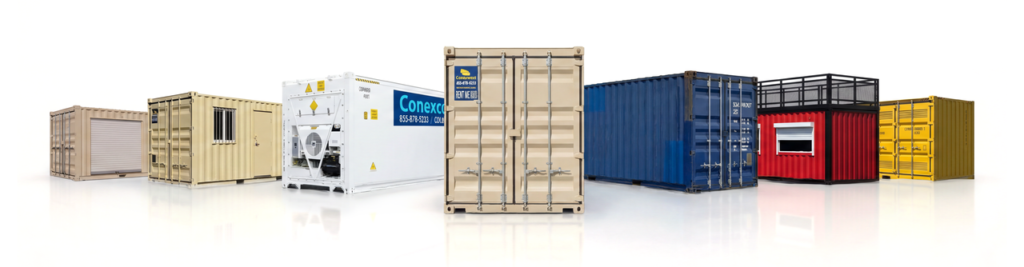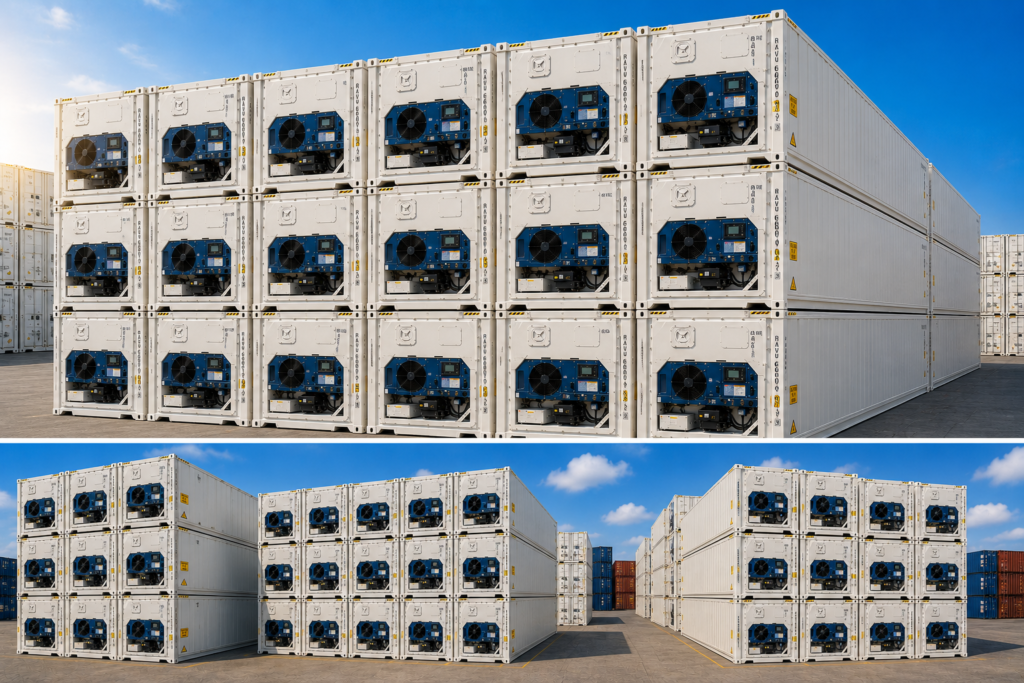
An insulated shipping container is a steel container with insulation in its walls, roof, floor and doors, so the temperature inside stays steadier than outside. You can get one two ways: buy a refrigerated (reefer) container, which comes factory-insulated, or buy a dry container and insulate it yourself. At Prime Cargo Box a used 20ft reefer costs $5,800 and a one trip 40ft high cube reefer is $8,500, while dry high cubes for DIY insulation start at $1,650 for a used 20ft and $2,900 for a one trip 40ft, before delivery.
This guide is for anyone who needs storage, workspace or a site room that does not bake in summer or drip with condensation in winter: farmers, contractors, artists, pharmacies, event companies, wine and food sellers, and homeowners building a workshop. It explains the difference between factory and DIY insulation, which materials work, how much space you lose, condensation and fire points people miss, and which insulated shipping container to buy for your job.
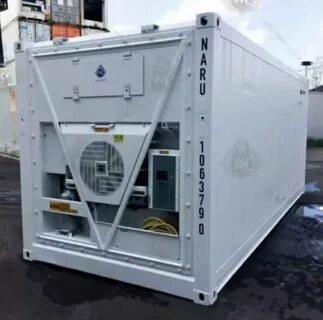
Table of Contents
Insulated shipping container: the short answers
- What it is: a container with insulation built in or added, to slow heat moving in or out.
- Fastest option: a reefer. It is already fully insulated and lined, and the refrigeration unit can cool or heat. A used 20ft reefer is $5,800.
- Cheapest option: insulate a dry box yourself. A used 20ft high cube is $1,650.
- Best DIY base: a high cube, because insulation eats headroom.
- Best DIY material: closed-cell spray foam, which insulates and air-seals in one go.
- Biggest mistake: ignoring condensation and fire protection.
Why buy an insulated shipping container?
Without insulation, a bare steel container heats up fast in the sun and cools down fast at night. That swing causes two problems. First, the inside can get too hot or too cold for what you are storing or the people working there. Second, when warm damp air meets a cold steel roof, water condenses and drips. An insulated shipping container fixes both.
- Steadier temperature: protects goods that dislike heat or frost, like paint, adhesives, seeds, electronics, documents, wine, cosmetics and medicines.
- Far less condensation: insulation keeps the inner surface closer to room temperature, so moisture does not form on it.
- Comfortable workspace: offices, workshops, studios and site cabins need it to be usable year round.
- Lower heating and cooling costs: any air conditioner or heater works far less hard in an insulated box.
- Quieter inside: foam and lining soften rain noise on the roof and outside sound.
If you only store tools and garden kit, a plain box with good vents may be enough. Our shipping container shed guide covers that. Once temperature or comfort matters, you want an insulated shipping container.
Insulated shipping container vs a bare container
It helps to picture what actually changes when you insulate. A bare steel box follows the weather closely. On a sunny afternoon the roof can get far hotter than the air outside, and the inside follows. On a clear night the roof radiates heat to the sky and drops below air temperature, which is when condensation starts.
An insulated shipping container slows all of that down. Heat from the sun takes much longer to reach the inside, so afternoon peaks are lower. Night-time cooling is slower too, so the inner surfaces stay warmer and drier. The result is a smaller daily swing, fewer drips and a box that feels more like a room than a tin can.
| Point | Bare container | Insulated shipping container |
|---|---|---|
| Daily temperature swing inside | Large | Much smaller |
| Condensation | Common on the roof and walls | Rare if sealed and ventilated |
| Comfort for people | Poor in hot or cold weather | Good with modest heating or cooling |
| Heating and cooling cost | High, heat escapes quickly | Far lower |
| Noise from rain | Loud | Softened |
| Upfront cost | Lowest | Higher |
For general tool or garden storage, a bare box with good vents can be enough. For anything temperature sensitive, or anywhere people spend time, an insulated shipping container is worth the extra.
Two ways to get an insulated shipping container
Option 1: buy a reefer (factory insulated)
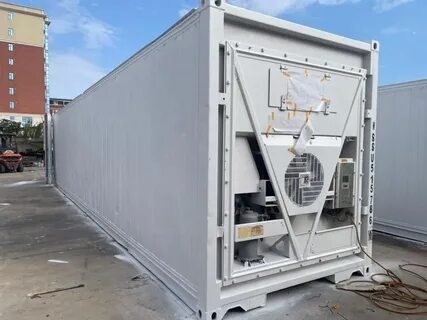
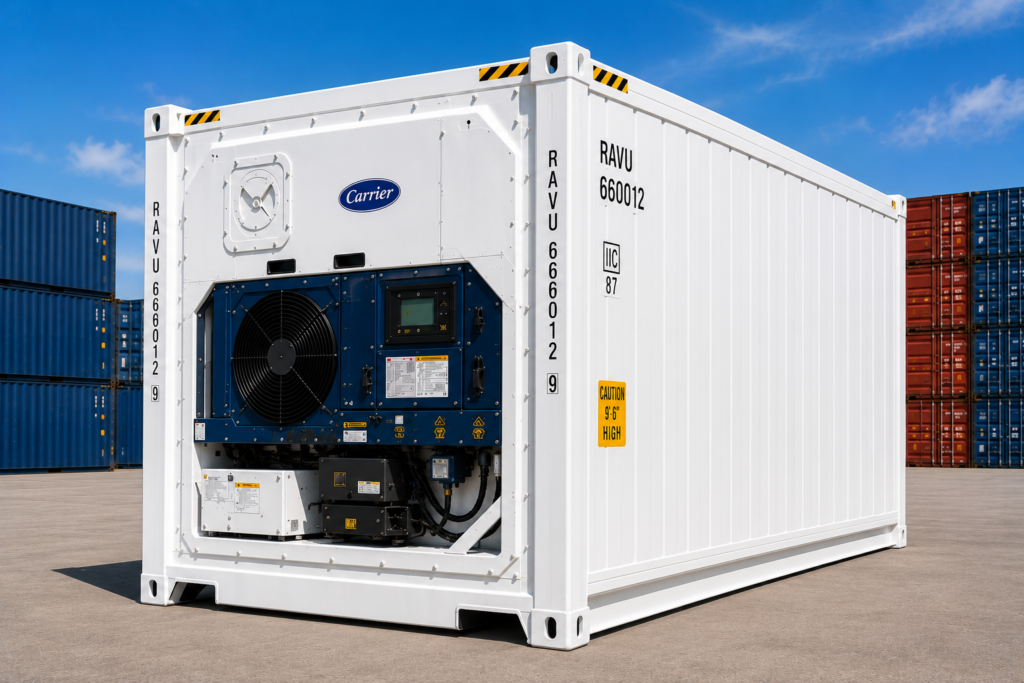
A refrigerated container is built as a thermal container from the start. Its walls, roof, floor and doors are filled with foam between an outer steel skin and an inner lining, usually stainless steel or aluminium, and the doors close on thick gaskets. These boxes are covered by ISO 1496-2, the international standard for specification and testing of thermal containers, which includes heat leakage testing. That makes a reefer the most thermally efficient insulated shipping container you can buy off the shelf.
The refrigeration unit is a bonus. Carrier’s service manual for its PrimeLINE units describes them as self-contained, all-electric units with both cooling and heating, running on 380/460 volt three-phase power (Carrier Transicold PrimeLINE manual). So the same box can be a fridge, a freezer, or a heated store that never freezes. Even switched off, the insulation still slows heat gain and loss.
Option 2: insulate a dry container
Buy a standard or high cube dry box and add insulation inside: spray foam, rigid foam boards or batts in a stud frame, then a lining. It costs less to start, you choose the materials and finish, and it suits offices, workshops and homes where you want windows, doors and a nicer interior. We go through the materials below.
Which is right for you?
| Point | Reefer (factory insulated) | DIY insulated dry container |
|---|---|---|
| Starting price | From $5,800 (used 20ft) | From $1,650 (used 20ft high cube) plus insulation |
| Ready to use | Yes, on delivery | After fit-out |
| Insulation quality | Factory foam, tested to ISO 1496-2 | Depends on materials and workmanship |
| Inside finish | Hygienic metal lining, easy to wash | Your choice: ply, boards, timber |
| Cooling and heating | Built in (needs three-phase power) | Add your own air conditioner or heater |
| Inside space | Less, thick factory walls | Depends on thickness used |
| Windows and extra doors | Not ideal, cutting damages the insulated panels | Easy to add before insulating |
| Best for | Food, pharma, chemicals, any temperature-critical stock | Offices, workshops, studios, homes, general storage |
Rule of thumb: if the contents must stay at a set temperature, buy a reefer. If people will work inside or you want windows and a homely finish, insulate a dry box.
Insulated shipping container prices
Here are our current prices for both routes to an insulated shipping container. Delivery is quoted separately.
Factory insulated (reefer) containers
| Container | Condition | Price |
|---|---|---|
| 20ft reefer | Used, fully working | $5,800 |
| 20ft reefer | One trip | $6,200 |
| 20ft refrigerated | New | $11,500 |
| 40ft high cube reefer | Used, fully working | $7,800 |
| 40ft high cube reefer | One trip | $8,500 |
| 40ft refrigerated | New | $14,900 |
Dry containers to insulate yourself
| Container | Used | One trip | New |
|---|---|---|---|
| 20ft high cube | $1,650 | $2,950 | $4,250 |
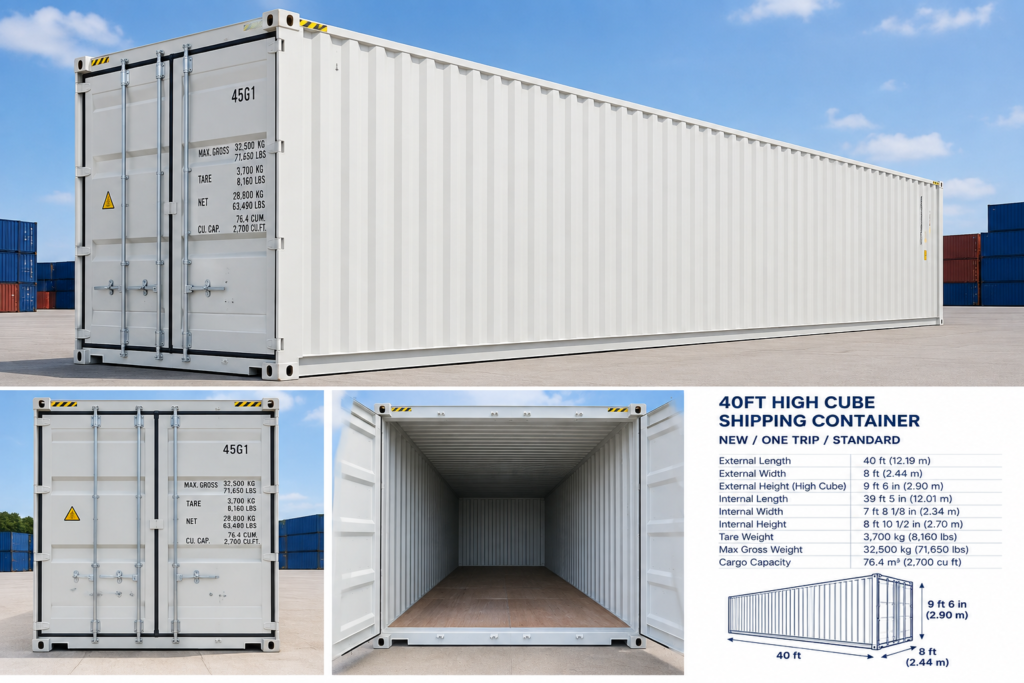
| 40ft high cube | $2,200 | $2,900 | $3,800 |
| 20ft standard | $1,000 | $1,550 | $2,400 |
| 40ft standard | $1,900 | $3,200 | $3,400 |
Prices change with stock, so the product page shows the latest. Insulation materials and labour for the DIY route vary a lot by country and finish, so price those locally. Our shipping container prices guide explains what drives container costs.
Insulation materials for a DIY insulated shipping container
Different materials give very different results in a steel box. Thickness matters, because every centimetre of insulation is a centimetre less inside. The figures below come from Natural Resources Canada’s renovation guide, Keeping the Heat In, chapter on insulation materials, which lists typical thermal resistance per inch.
| Material | Typical R-value per inch | Air barrier? | Notes for containers |
|---|---|---|---|
| Closed-cell spray polyurethane foam | R-5.5 to 6.5 | Yes | Sticks to corrugated steel, seals gaps, can act as a vapour barrier at about 50 mm |
| Polyurethane / polyiso board | R-5.5 to 6.8 | Yes, if seams sealed | High value in thin layers; foil-faced boards also block vapour |
| Extruded polystyrene (XPS) board | R-5 | Yes, if joints sealed | Moisture resistant; good for floors |
| Expanded polystyrene (EPS) board | R-3.8 to 4.4 | Partly | Cheaper, thicker for the same result |
| Open-cell spray foam | R-3.6 to 3.8 | Yes, not a vapour barrier | Needs a separate vapour control layer in a steel box |
| Mineral or glass fibre batts | R-3 to 4.3 | No | Need a stud frame and a sealed vapour barrier; risky against cold steel |
The same guide warns that any product claiming long-term performance above about R-6.5 per inch may not be backed by recognised tests, and that reflective bubble foil can range from almost nothing to about R-3.5 depending on air gaps. Be wary of thin “miracle” foil wraps sold for containers.
Closed-cell spray foam: the usual winner for an insulated shipping container
For most DIY insulated shipping container projects, closed-cell spray foam is the best fit. It bonds to the corrugations, fills every gap, works as an air barrier, and at around 50 mm can also control vapour. That last point matters because condensation forms where warm damp air touches cold steel. Seal that contact and the problem mostly goes away. It is usually applied by a trained contractor.
Rigid foam boards: the tidy DIY option
Polyiso or XPS boards cut to fit between timber or steel battens, with every joint taped and gaps foamed. Cheaper than spray foam if you do the labour, and easy to line over. The corrugations leave small air pockets behind the boards, so seal the edges well.
Batts in a stud wall: workable, with care
Glass or mineral wool batts in a timber frame are cheap and familiar. In a steel box they need a continuous, sealed vapour barrier on the warm side, because any damp air that reaches the cold steel will condense in the insulation. Get this wrong and you build a mould box.
How much space does an insulated shipping container lose?
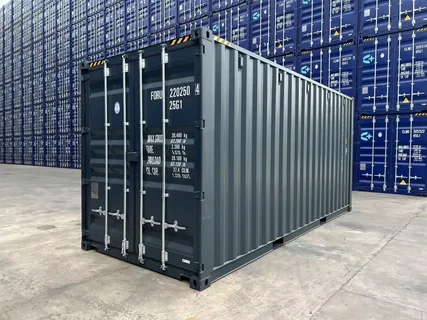
This is the question most guides skip. Here is our own calculation of approximate inside volume, using typical inside sizes and assuming insulation on the walls, end wall and roof but not on the floor or doors.
| Container and insulation | Inside L x W x H (approx.) | Volume (approx.) |
|---|---|---|
| 20ft standard, bare | 5.90 x 2.35 x 2.39 m | 33.1 m³ |
| 20ft standard, 50 mm closed-cell foam | 5.85 x 2.25 x 2.34 m | 30.8 m³ |
| 20ft standard, stud wall with boards and lining (about 90 mm) | 5.81 x 2.17 x 2.30 m | 29.0 m³ |
| 20ft high cube, 50 mm closed-cell foam | 5.85 x 2.25 x 2.64 m | 34.7 m³ |
| 20ft reefer, factory insulated | 5.46 x 2.29 x 2.26 m | 28.3 m³ |
Two things stand out. A 20ft high cube with 50 mm of spray foam ends up with more room inside than a bare standard 20ft. And a factory reefer gives up the most space, because its walls are thick enough to hold freezing temperatures. If you need a workspace rather than a freezer, a foamed high cube is the space-efficient insulated shipping container. See high cube vs standard container and our shipping container dimensions guide for more.
Condensation and the insulated shipping container
Steel does not breathe and does not hold moisture. When the outside is cold and the inside air is warm and damp, the steel skin drops below the dew point and water forms on it. In a bare box you see drips. In a badly insulated shipping container you do not see it, because it happens behind the insulation, soaking batts and rotting timber.
Natural Resources Canada describes the vapour barrier as protecting the structure and insulation from moisture damage, and says it belongs on the warm side of the insulation, with joints and penetrations given special attention. In a container the “warm side” is the inside.
How to get it right
- Air-seal the steel. Closed-cell foam or sealed foam boards stop damp air reaching the cold skin.
- Add a vapour barrier with batts. Continuous, taped, on the inside face.
- Insulate the roof first. It is the coldest surface on clear nights and where drips start.
- Do not forget the doors. Bare steel doors become cold spots; insulate them or fit an inner door.
- Ventilate. People, kettles, heaters and wet gear add moisture. Keep vents clear and add a small extractor in workspaces.
- Raise the box. Set it on blocks so air moves underneath and the floor stays dry.
A reefer avoids most of this, because its foam is sealed between steel and lining at the factory.
Fire safety in an insulated shipping container
Foam plastic insulation burns. Natural Resources Canada states that plastic-based foam and rigid board insulation installed on interior surfaces must be covered with a fire-resistant material, typically 13 mm drywall, mechanically fastened to the structure. Local rules differ, but the principle holds everywhere: in an office, workshop or room people use, do not leave spray foam or foam boards exposed. Line them with fire-resistant board.
Also keep heaters, stoves and hot tools clear of foam, use a qualified electrician for wiring that passes through insulated walls, and fit a smoke alarm and extinguisher. A factory reefer’s foam is already sealed behind a metal lining.
Doors, windows and openings in an insulated shipping container
Openings are where most heat and moisture get in, so plan them carefully.
- Cut first, insulate second. Every window, door, vent and cable hole should be cut and framed before insulation goes in.
- Frame every opening in steel. Cutting the corrugated wall removes stiffness; a steel frame puts it back.
- Choose insulated units. Double-glazed windows and insulated personnel doors keep the gains you made with foam.
- Seal around frames. Low-expansion foam and good sealant stop drafts and water.
- Deal with the cargo doors. Insulate their inner faces, or build an insulated inner wall and door just inside them and use the cargo doors only for security.
A reefer is the exception. Its sealed panels should not be cut for windows; choose a dry high cube if you want light and views in your insulated shipping container.
Insulating the floor of an insulated shipping container
In any insulated shipping container, the floor is thick marine plywood over steel cross members, with the underside open to the air. Heat escapes downward, especially in cold climates. Options:
- Underneath: spray closed-cell foam on the underside between the cross members before the box is set down. Best result, no lost headroom.
- On top: lay XPS boards over the plywood and a new floor over them. Easy, but costs a few centimetres of height.
- Skirting: close in the gap under a raised box with timber or panels to cut wind chill, leaving ventilation openings.
Heating and cooling an insulated shipping container
Insulation slows heat flow; it does not create heat or cold. For workspaces and sensitive stock you will usually add some heating, cooling or both.
Split air conditioners and heat pumps
A small wall-mounted split unit is the most popular choice for an insulated shipping container office or studio. It cools in summer, heats in winter and dehumidifies. Mount the outdoor unit on the end wall or a frame beside the box, and run the pipes through a sealed hole cut before insulating. A heating and cooling installer can size it for your climate and use.
Electric heaters
Panel or oil-filled heaters work for occasional use. Keep them clear of foam and fabric, and never use open-flame or unvented gas heaters in a sealed box, because they add moisture and fumes.
Reefer units
A reefer’s own unit controls temperature precisely, from deep freeze to mild heat, but needs three-phase power and is designed for storage rather than people.
Ventilation
Every occupied insulated shipping container needs fresh air. Keep factory vents open, add a small extractor fan with a matching inlet vent, and open the doors when weather allows. Ventilation also carries away moisture from breathing, kettles and wet gear.
Solar power
Off-grid sites can run lights, fans and a small efficient air conditioner from solar panels and batteries. Insulation makes this far more practical, because the box needs much less energy to stay comfortable.
Electrics and lighting
Run cables in conduit or surface trunking rather than burying them in spray foam, so you can reach them later. Use a proper consumer unit with protection, LED lighting to keep heat down, and enough sockets for heaters and tools. A qualified electrician should do the work and test it, especially where cables pass through the steel shell. In an insulated shipping container used as an office or workshop, good lighting and safe power are as important as the insulation itself.
How to build an insulated shipping container, step by step
- Choose and place the container. A high cube on a level base.
- Cut openings first. Windows, a personnel door, vents and cable entries before any insulation. Ask about our custom container modifications.
- Clean and treat the steel. Remove loose rust, prime bare spots, degrease.
- Fix battens or framing for the lining and any services.
- Run electrics in conduit so wiring is not buried in foam.
- Insulate roof, walls, end wall and doors (and floor if needed).
- Seal joints and penetrations, and add a vapour barrier if using batts.
- Line with fire-resistant board, then decorative finish.
- Ventilate and heat or cool as needed.
Choosing an insulated shipping container for your climate
Hot and sunny
The sun on the roof is the big enemy. Insulate the roof well, paint the outside a light colour to reflect heat, and consider a shade roof with an air gap above the container. An insulated shipping container with a split air conditioner stays usable in places where a bare box is unbearable by midday.
Cold
Heat loss and condensation are the issues. Use thicker insulation, insulate the floor and doors, seal every gap, and add a reliable heater. A reefer with heating keeps stock above freezing through winter.
Humid and tropical
Moisture is constant. Closed-cell foam that seals the steel, steady ventilation and a dehumidifying air conditioner keep mould away. Avoid materials that soak up water.
Dry with big day and night swings
Deserts and high plains can be hot by day and freezing by night. Moderate insulation evens out those swings, and an insulated shipping container stays far more stable than a bare one.
Coastal
Salt air is hard on steel. Keep the outside painted, check seals, and use stainless or galvanised fixings for anything you attach.
Uses for an insulated shipping container
Temperature-sensitive storage
Paint, adhesives, sealants, seeds, fertiliser, electronics, archives, artwork, wine, cosmetics and pharmacy stock. A reefer gives set-point control; an insulated dry box with a small air conditioner works for many items.
Site offices and cabins
Contractors need warm, dry rooms on site. An insulated shipping container office with heating and lighting works year round. Our construction storage container guide covers site storage alongside.
Workshops and studios
Woodwork, metalwork, pottery and music all need comfortable temperatures. An insulated 20ft or 40ft high cube is ideal.
Pop-up shops and kiosks
Staff comfort and stock protection both depend on insulation. See our shipping container pop up shop guide.
Cold and chilled storage
For food, flowers and drinks, a working reefer is the right insulated shipping container. Our cold storage container and buying a reefer container guides go deeper.
Farm use
Seed, feed, vet supplies and machinery parts last better in steady conditions. See farm storage containers.
Vehicle and equipment storage
Classic cars, batteries and electronics dislike damp and frost. Read our car storage container guide.
Three example insulated shipping container setups
These are examples to show how the choices fit together, not stories about real customers.
A pharmacy or clinic storeroom
Stock needs steady, controlled temperatures and clean surfaces. A one trip 20ft reefer at $6,200 is the natural insulated shipping container here: factory foam, a washable metal lining and a unit that can hold a set point. The buyer arranges three-phase power, temperature monitoring and whatever validation their regulator requires.
A garden studio for a painter
Comfort, light and a nice interior matter most. A one trip 20ft high cube at $2,950 gets a large window and a glazed personnel door cut in first, then 50 mm of closed-cell foam on the roof, walls and doors, fire-resistant lining boards, a timber floor over XPS, and a small split heat pump. The high cube keeps the ceiling above 2.6 m even after insulating.
A site office for a building contractor
Needs to be warm in winter, cool in summer and secure at night. A used 40ft high cube at $2,200 is split into an office at one end and a lockable store at the other. The office end is foamed, lined and fitted with a heat pump and lighting; the store end is left bare with good vents. One box, two jobs.
Using a reefer as an insulated shipping container without the machine
Some buyers want insulation but do not have three-phase power. A reefer still works as an insulated shipping container with the unit switched off: the foam slows heat gain and loss, and the metal lining is easy to keep clean. Add a domestic split air conditioner or a small heater through the wall if you need some control. Keep the reefer unit maintained if you might want refrigeration later. For power needs when you do run the unit, see our cold storage guide.
Food, drink and medicine: what an insulated shipping container must do
If the contents are perishable, insulation alone is rarely enough. You need active temperature control and proof that it works.
- Set the right temperature. Food safety agencies advise keeping a fridge at 40 °F (4 °C) or below and a freezer at 0 °F (-18 °C) or below (FoodSafety.gov cold food storage charts). Only a refrigerated unit can hold those reliably.
- Monitor it. A data logger and a remote alarm tell you when the temperature drifts or the power fails.
- Keep it clean. A reefer’s metal lining is washable; a DIY timber lining is harder to keep hygienic.
- Follow your rules. Medicines and some foods have strict storage requirements set by local regulators. The container is the starting point; your compliance plan is the rest.
For these jobs, the right insulated shipping container is almost always a working reefer. Our cold storage container guide covers power, set points and loading in detail.
Specifications of popular insulated shipping container options
One trip 20ft reefer ($6,200)
- Outside: 6.06 x 2.44 x 2.59 m
- Inside (approx.): 5.46 x 2.29 x 2.26 m, about 28 m³
- Insulation: factory polyurethane foam in walls, roof, floor and doors
- Lining: metal, washable, T-bar floor
- Temperature range: about -30 °C to +30 °C with the unit running
- Power: three-phase, normally 380 to 460 V
One trip 40ft high cube reefer ($8,500)
- Outside: 12.19 x 2.44 x 2.90 m
- Inside (approx.): 11.56 x 2.29 x 2.55 m, about 67 to 71 m³
- Insulation and lining: as above
One trip 20ft high cube for DIY insulation ($2,950)
- Outside: 6.06 x 2.44 x 2.90 m
- Inside bare: 5.90 x 2.35 x 2.69 m
- Build: corrugated weathering steel, marine plywood floor, four-bar locking doors
Outside sizes follow ISO 668, so any container truck or crane can deliver and move your box.
Is an insulated shipping container worth it?
Think about what the insulation protects. A season of spoiled paint, swollen documents, rusted tools or mouldy fabric can cost more than the insulation. For a workspace, the real question is whether the box is usable year round. A bare container that is too hot from late morning or too cold to sit in during winter is wasted space for half the year.
There is also running cost. Any heater or air conditioner in a bare steel box fights a losing battle; in an insulated shipping container it runs a fraction of the time. Over a few years, the lower energy use often goes a long way toward paying back the insulation.
Finally, resale. A well-insulated, neatly finished box, or a working reefer, is worth more to the next buyer than a bare one.
New, one trip or used insulated shipping container?
- Used reefer: best value for factory insulation. Check the lining, door gaskets and that the unit runs.
- One trip reefer: near-new insulation and machinery. The safest choice for temperature-critical stock.
- Used dry high cube: cheapest DIY base; treat any rust before insulating.
- One trip or new dry high cube: clean steel, straight walls, easy to insulate and finish neatly.
Our one trip vs used shipping container guide compares conditions in depth.
Questions to ask before buying an insulated shipping container
- What temperature range do the contents or people need?
- Do I have three-phase power for a reefer, or will I use a split unit?
- Will I need windows or extra doors? If so, a dry box is easier.
- How much inside space do I need after insulation?
- What are the local rules for occupied structures, fire protection and electrics?
- Who will apply the insulation, and what fire-resistant lining will cover it?
- How will the box be ventilated?
Answer these and the right insulated shipping container usually becomes obvious. If you are still unsure, tell us the answers and we will suggest a unit.
Common mistakes with an insulated shipping container
- Batts against bare steel with no vapour barrier. Hidden condensation and mould.
- Leaving foam exposed in a room people use. A fire risk.
- Insulating before cutting openings. You end up cutting through finished work.
- Skipping the roof or doors. Cold spots drip.
- Buying a standard height box and losing too much headroom.
- Trusting thin foil wraps to do the job of real insulation.
- No ventilation in a workspace.
- Cutting windows into a reefer. It damages the sealed panels; use a dry box if you want windows.
Looking after an insulated shipping container
- Keep the outside painted. Rust on the outer skin can eventually let water reach the insulation.
- Check the roof. Clear leaves and standing water; dents that hold water speed corrosion.
- Inspect seals and gaskets on doors and any windows.
- Watch for damp patches on the lining, which point to a leak or a gap in the vapour control.
- Service any air conditioner or reefer unit on schedule.
- Keep vents clear and fans working.
Treat it like a small building and an insulated shipping container will stay dry and comfortable for many years.
How to order an insulated shipping container from Prime Cargo Box
- Pick your route. A reefer from our refrigerated containers range, or a high cube from the 40ft high cube range or the 20ft range.
- Tell us the job. Storage, office, workshop or chilled stock, and your power supply.
- Add openings such as windows or a side door before delivery.
- Send delivery details and site photos.
- Get your quote, pay and book. See our billing and payment policy and shipping and delivery policy.
Questions? Contact us, or read how to buy a shipping container.
Insulation terms explained
- R-value: resistance to heat flow. Higher is better. Usually quoted per inch of thickness.
- RSI: the metric version of R-value, used in many countries.
- U-value: how much heat passes through a wall or panel. Lower is better; it is roughly the inverse of the total R-value.
- Air barrier: a layer that stops air leaking through gaps. Damp air leaks are a main cause of hidden condensation.
- Vapour barrier (vapour retarder): a layer that slows water vapour moving through materials. Goes on the warm side.
- Dew point: the temperature at which moisture in the air turns to water on a surface.
- Thermal bridge: a path where heat bypasses insulation, such as steel frames or fixings touching the outer skin.
- Closed-cell foam: dense foam with sealed cells; high R-value, resists moisture.
- Open-cell foam: softer, lighter foam; lower R-value, lets vapour through.
- Polyiso, XPS, EPS: common rigid foam boards, from highest to lowest insulating value per inch.
- Thermal container: the industry term for a container with insulated walls, roof, floor and doors, with or without refrigeration.
Knowing these terms makes it much easier to compare quotes and products for your insulated shipping container.
Insulated shipping container FAQs
How much does an insulated shipping container cost?
A factory-insulated reefer starts at $5,800 for a used 20ft and $8,500 for a one trip 40ft high cube. For DIY insulation, dry high cubes start at $1,650 for a used 20ft, plus insulation and lining. Delivery is extra.
Is a reefer the same as an insulated shipping container?
A reefer is an insulated container with a built-in refrigeration unit. Every reefer is insulated; not every insulated container has refrigeration.
What is the best insulation for a shipping container?
Closed-cell spray foam for most projects, because it insulates, air-seals and controls vapour in one layer. Sealed rigid foam boards are a good DIY alternative.
Will an insulated shipping container stop condensation?
Yes, if the insulation stops warm damp air reaching the cold steel and you ventilate. Badly fitted batts can hide condensation instead of stopping it.
How thick should container insulation be?
Around 50 mm of closed-cell foam suits many climates and workspaces. Colder or hotter sites, or homes, may need more. Balance thickness against inside space.
Can I live or work in an insulated shipping container?
Many people use them as offices and workshops. Living space usually needs building approval, fire protection, ventilation and services that meet local rules.
Can a reefer be used without power?
Yes, as an insulated box. Without the unit running it cannot cool or heat, but its insulation still slows temperature change.
Do you deliver worldwide?
Yes. Send your address and site photos for a delivery quote.
About Prime Cargo Box
Prime Cargo Box sells new, one trip and used shipping containers, including refrigerated and high cube units, to businesses, farms and homeowners worldwide. We help you choose between a factory-insulated reefer and a dry box to insulate, and match it to your job, your power supply and your site. Read more about us.
Final word
An insulated shipping container keeps temperatures steady, stops condensation and turns a steel box into usable storage or workspace. If the contents must stay at a set temperature, buy a reefer: a used 20ft at $5,800 or a one trip 40ft high cube at $8,500. If people will work inside or you want windows, insulate a high cube, starting from a used 20ft high cube at $1,650. Seal the steel, cover the foam, ventilate, and it will serve you for years. Browse our containers or ask for a quote today.