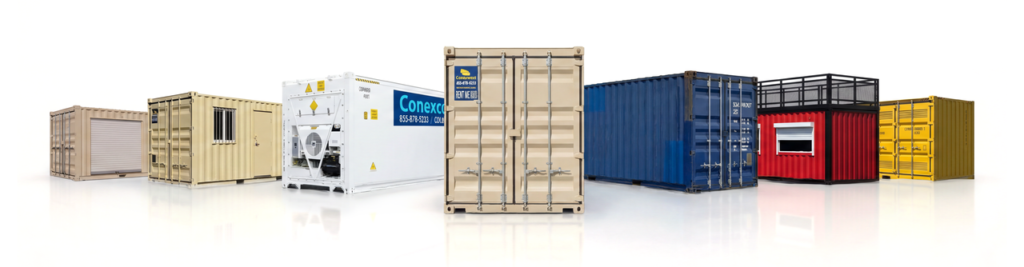
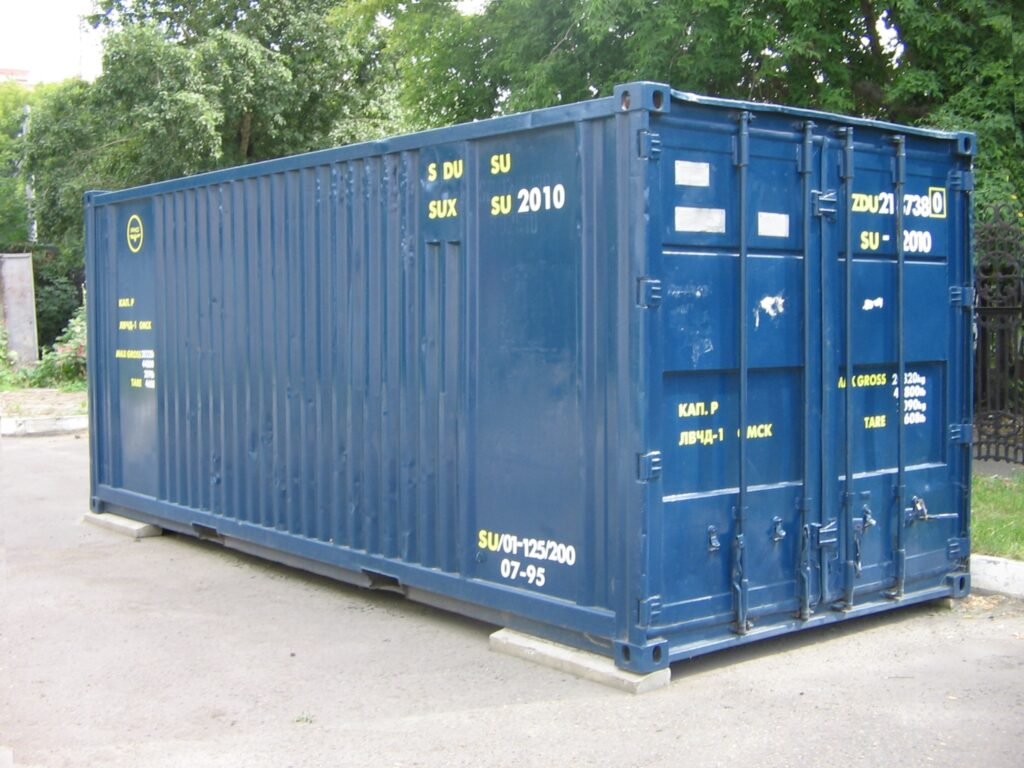
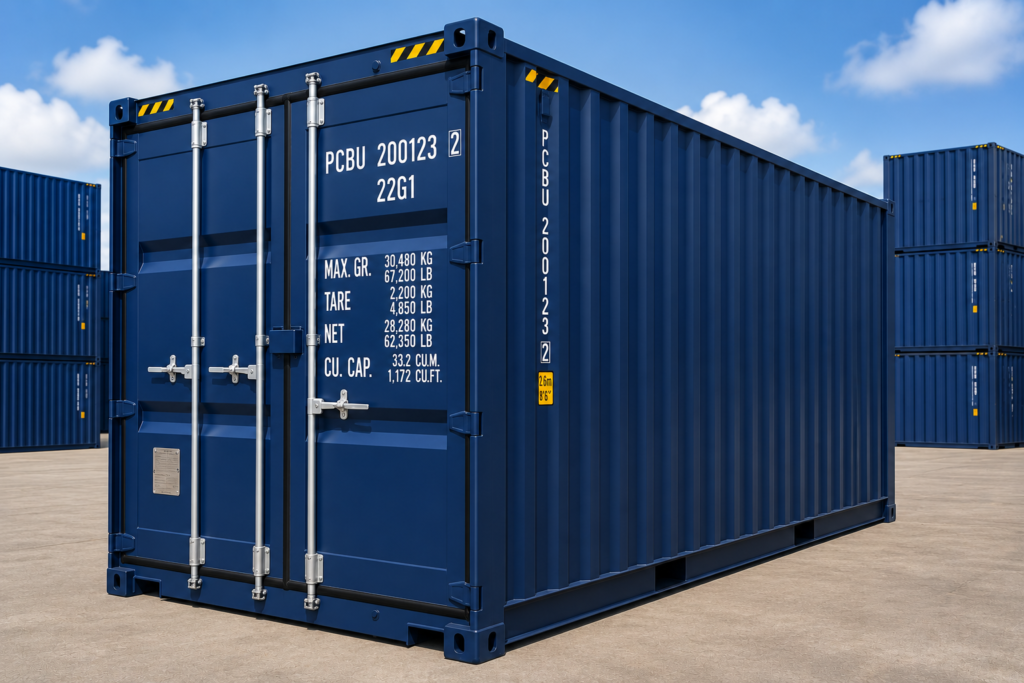
A shipping container shed is a steel shipping container bought outright and used as a lockable garden, yard or farm shed. At Prime Cargo Box a used 20ft container costs $1,000, a one trip 20ft is $1,550 and a one trip 40ft high cube is $2,900, before delivery. You get a corrugated steel box with steel doors, rubber door seals and four locking bars, delivered in one piece and ready to fill the same day. No kit to build, no felt roof to replace, and nothing for rats or rot to chew through.
This guide is for homeowners, gardeners, smallholders, hobby builders, clubs and small businesses who want a shed that lasts and keeps thieves out. It covers what a shipping container shed costs, which size suits your space, how to deal with planning rules and damp, and what to add once it lands. Every price and product link below goes to a container we sell right now, so you can go straight from reading to ordering.
Table of Contents
Shipping container shed: the short answers
- Most popular size: a 20ft container. It fits in a deep garden or one parking bay and gives about 33 cubic metres of storage.
- Cheapest way in: a used 20ft container at $1,000. Wind and watertight, with some dents and surface rust.
- Best value for a garden: a one trip 20ft at $1,550. Near new, clean paint, doors that close tight.
- Need headroom for a workshop: a 20ft high cube. It is about 30 cm taller inside than a standard box.
- Lots of gear, machinery or a car: a 40ft. A one trip 40ft high cube is $2,900.
- Foundation: none needed in most cases. Firm, level ground and solid support under the four corners does the job.
- Biggest thing to check first: local planning rules and whether a delivery truck can reach the spot.
Shipping container shed prices
The price of a shipping container shed comes down to three things: size, condition and door layout. The table shows our current prices for the boxes that make the best sheds. Delivery is quoted separately because it depends on how far the container has to travel and what kind of truck your site needs.
| Container | Condition | Price | Best shed use |
|---|---|---|---|
| 20ft standard | Used | $1,000 | Budget tool and garden store |
| 20ft standard | One trip | $1,550 | Garden shed on show near the house |
| 20ft standard | New | $2,400 | Long-term shed, custom colour |
| 20ft high cube | Used | $1,650 | Workshop on a budget |
| 20ft high cube | One trip | $2,950 | Workshop with tall racking |
| 20ft double door | Used | $1,950 | Doors at both ends for easy reach |
| 20ft double door | One trip | $2,500 | Two-zone shed, mower one end |
| 20ft open side | Used | $2,950 | Full-length access, garden machinery |
| 40ft standard | Used | $1,900 | Farm or yard bulk storage |
| 40ft standard | One trip | $3,200 | Large shed for vehicles and tools |
| 40ft high cube | One trip | $2,900 | Barn-style shed, tall machines |
Prices change with stock, so the product page always has the latest figure. If you want to see how these numbers sit against the wider market, our guide to shipping container prices explains what drives the cost up and down.
A quick way to think about value: a timber shed of the same floor size is cheaper on day one in many places, but it needs treating, re-felting and fixing. A shipping container shed needs a touch of paint now and then and that is about it. Spread over ten or fifteen years, the steel box usually works out the better buy, and it is far harder to break into while it does.
Why a shipping container shed beats timber and plastic
Shipping containers are built to carry heavy cargo across oceans, be stacked several high on ships and get lifted by cranes at every port. A garden is an easy life by comparison. Here is what that means for you as a shed owner.
It is properly secure
There are no windows, the walls are steel, and the doors lock with four vertical bars that turn into cams top and bottom. A thief cannot kick through a panel or lever off a hinge with a screwdriver like they can on a timber shed. Most break-ins on containers go after the padlock, which is why we recommend a lock box. More on that later, and our secure storage containers guide goes into the detail.
It does not rot, warp or blow away
Containers are made from weathering steel, often sold under the trade name Corten. This steel forms a tight rust layer on the surface that slows further corrosion, and tests show it holds up much better in the open air than ordinary carbon steel (Total Materia on Corten weathering steel). The same source points out a limit worth knowing: steel that sits wet all the time, or is buried, loses that advantage. So keep your shipping container shed off wet ground and it will look after itself for a long time.
A 20ft container also weighs around 2,200 kg empty. Storms that flatten plastic sheds and lift timber roofs do not move it.
It keeps pests and weather out
The doors close on rubber gaskets and the floor is thick marine plywood on steel cross members. Mice, rats and squirrels that chew into wooden sheds have nothing to grip. Rain runs off the roof instead of soaking through felt.
It is built to a world standard
The outside sizes of shipping containers are set by the international standard ISO 668, which classifies freight containers and fixes their dimensions and ratings. That matters for a shed buyer because a 20ft box from one maker is the same size as a 20ft box from another. You can plan your base, gate width and layout from known numbers before the container even leaves the depot.
It arrives in one piece
No flat-pack, no weekend of screwing panels together, no missing bolts. The truck lowers it into place and you can start loading it within the hour.
You can take it with you
A shipping container shed is not fixed to the ground. If you move house or the farm changes layout, a tilt-bed or crane truck can pick it up and move it. That also helps resale. Containers hold their value far better than any shed.

Shipping container shed vs timber, metal and plastic sheds
People who come to us have usually owned at least one other kind of shed. Here is an honest side-by-side, based on how each type is built rather than on any brand.
| Feature | Shipping container shed | Timber shed | Thin metal kit shed | Plastic shed |
|---|---|---|---|---|
| Walls | Corrugated weathering steel | Softwood boards | Thin sheet steel or aluminium | Moulded resin |
| Assembly | Arrives in one piece | Kit or built on site | Kit, many screws | Kit, clip together |
| Security | Very high with a lock box | Low | Low to medium | Low |
| Rot and pests | Not an issue | Needs treating | Not an issue | Not an issue |
| Storm resistance | Very high, around 2,200 kg empty for a 20ft | Medium | Low unless anchored | Low unless anchored |
| Upkeep | Touch-up paint, clear vents | Stain, felt, repairs | Check fixings and rust | Little |
| Can be moved | Yes, by truck | Usually not | Only by taking apart | Only by taking apart |
| Resale value | Holds value well | Low | Low | Low |
Where the others win: a small plastic or timber shed can go into a tiny garden with no vehicle access, and it does not need a delivery truck. If you can get a truck to your spot and you have the space, a shipping container shed wins on almost everything else.
Think about what you are protecting, too. If your shed holds a few hand tools and a hose, any shed will do. If it holds a ride-on mower, e-bikes, power tools or business stock, a shipping container shed is the sensible choice, and the money you save on one stolen bike can pay for a good part of the box.
Which shipping container shed size fits your space?
Pick your shipping container shed size by two numbers: how much room you have on site, and how much stuff you need to store. Measure the space, then add at least a metre around your shipping container shed so you can open the doors fully and walk round it for painting and checks.
| Container | Outside (L x W x H) | Inside height | Floor area inside | Volume |
|---|---|---|---|---|
| 20ft standard | 6.06 x 2.44 x 2.59 m | about 2.39 m | about 13.9 m² | about 33 m³ |
| 20ft high cube | 6.06 x 2.44 x 2.90 m | about 2.69 m | about 13.9 m² | about 37.4 m³ |
| 40ft standard | 12.19 x 2.44 x 2.59 m | about 2.39 m | about 28.3 m² | about 67.7 m³ |
| 40ft high cube | 12.19 x 2.44 x 2.90 m | about 2.70 m | about 28.3 m² | about 76.3 m³ |
Inside sizes vary a little between makers, so treat these as close guides. Our page on shipping container dimensions lists inside, outside and door opening sizes for every type.
20ft shipping container shed
This is the shipping container shed size most people buy. It takes a ride-on mower, a full set of garden tools, bikes, a workbench along one wall and shelving for paint, seed and odds and ends, with room to walk down the middle. It fits in most rear gardens with side or rear access, on a driveway, or in a corner of a yard. Our 20ft shipping container guide shows what fits inside in more detail.
20ft high cube shipping container shed
Same footprint as a standard 20ft shipping container shed, with an extra 30 cm of height. That sounds small, but it is the difference between hitting your head on a ceiling light and not. If you plan to stand at a bench for hours, fit tall racking or insulate the ceiling (which eats a few centimetres), go high cube. The new 20ft high cube is $4,250 and the used one is $1,650. Read high cube vs standard container if you are on the fence.
40ft shipping container shed
For farms, smallholdings, sports clubs and anyone storing a car, a boat or a small tractor alongside tools. It gives roughly double the floor space of a 20ft for not much more money. The catch is the length: you need about 12 metres of level ground plus space for the delivery truck to line up. Our 20ft vs 40ft comparison walks through the trade-offs, and farmers will find more in our farm storage containers article.
What about a 10ft?
A 10ft box suits tight town gardens, but we do not have 10ft units in stock at the moment. If space is short, a 20ft placed along a side boundary often fits better than people expect because it is only 2.44 m wide. Send us your measurements and we will tell you honestly whether it will go.
New, one trip or used: which condition makes the best shipping container shed?
All three conditions give you a shipping container shed that keeps the rain out. The difference is looks, door action and how long the paint lasts before it needs attention.
- Used: has carried cargo for years. Expect dents, scrapes, old shipping labels and patches of surface rust. It is wind and watertight, which is what matters for storage. Best for farms, yards and the far end of a big garden. See all our used shipping containers for sale.
- One trip: made new, loaded once for a single voyage, then sold. It looks almost new, the doors swing easily and the seals are soft. This is the sweet spot for a shipping container shed near the house.
- New: never carried cargo. Spotless paint, perfect floor. Pick this if the box will be on full view or you want it to look smart for years. Browse new shipping containers for sale.
We cover the pros and cons fully in one trip vs used shipping container. Short version: if neighbours or family will see it every day, spend the extra on one trip.
Check the plates before you buy
Every container built for ocean transport carries a CSC safety approval plate near the doors. Under the International Maritime Organization’s Convention for Safe Containers, the maker is authorised to fix this plate to approved containers, and it holds key technical data. For a shed you do not need a valid shipping certificate, but the plate tells you the build date, weights and maker, which helps you judge age and quality.
You will also see an owner code and serial number painted on the doors. These follow the ISO 6346 system run by the Bureau International des Containers. Ours are genuine marked containers, not cheap copies made only for storage, which is one reason they last.
Door layouts for a shipping container shed
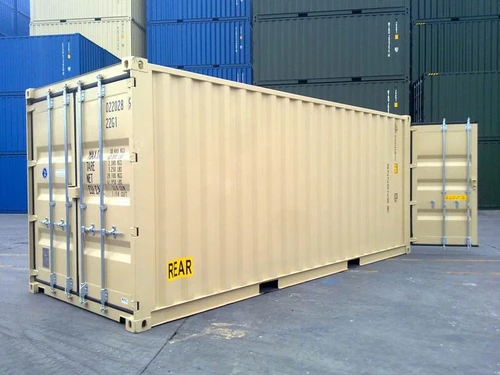
Standard containers have double doors at one end. That works fine for most shipping container shed buyers. But how you plan to use the space might point you to a different layout.
Standard end doors
Cheapest and most common layout for a shipping container shed. Put the things you use most near the doors and the seasonal stuff at the back. Our 20ft shipping containers range is mostly this layout.
Double door (doors at both ends)
Brilliant for a shipping container shed because nothing is ever buried at the back. Many owners split the box into two zones: mower and garden tools at one end, bikes or a workshop at the other. A new 20ft double door container is $3,700. More in our double door container guide.
Open side
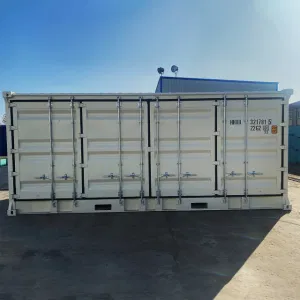
The whole long side opens up. Handy if the box sits along a fence and you can only reach it from the side, or if you want a covered workspace with the side open on dry days. The one trip 20ft open side is $5,200. See the open side container guide for ideas.
Personnel door, windows and roll-up doors
If you will be in and out many times a day, swinging two heavy cargo doors gets old. A normal-size steel door cut into the side is a popular upgrade, and windows bring light into a workshop. We handle these through our custom container modifications service before the box ships.
Do you need permission for a shipping container shed?
This depends entirely on where you live, and it is the one thing to sort out before you order. Rules come from local councils, city zoning offices, homeowner associations, landlords and sometimes the title deeds of your property. Here is how to approach it wherever you are.
- Look up the rules for outbuildings or accessory structures on your local authority’s website. Sheds often have size and height limits, and limits on how close to a boundary they can sit.
- Check whether containers are mentioned by name. Some places treat a container like any shed. Others have separate rules.
- Read your lease, HOA rules or deeds if they apply to you.
- If anything is unclear, phone or email the planning office with the size of the box and where you want to put it. Get the answer in writing.
An example: the height rule that catches people out
England is a useful example because its rules are published clearly. The government’s Planning Portal says outbuildings can usually go up without a planning application if they meet set conditions, including a single storey, a maximum eaves height of 2.5 metres, and a total height of no more than 2.5 metres if any part sits within 2 metres of the boundary (Planning Portal guidance on outbuildings).
Now look at the numbers. A standard container is 2.59 m tall, and a high cube is 2.90 m, before you put it on any kind of base. On a flat-roofed box the eaves height is effectively the full height. So in places with a 2.5 m rule, a shipping container shed sits just over the line. Many owners still get the go-ahead, but you should ask the council first rather than assume. Other countries have their own versions of these limits, which is exactly why we say check before you buy.
Building regulations are a separate question
Planning permission is about whether you can put the structure there. Building rules are about how it is built and used. In England, small detached buildings with no sleeping space usually fall outside building regulations if the floor area is under 15 square metres, and buildings between 15 and 30 square metres can also be exempt if they sit at least a metre from the boundary or are built mainly of non-combustible materials (Planning Portal on building regulations for outbuildings). A 20ft container has roughly 13.9 m² of floor inside. A 40ft has about 28 m². Again, your local rules may differ, so treat this as a picture of the kind of thing to ask about.
One more point: if you plan to sleep in it or turn it into a home office with wiring and plumbing, the rules usually get stricter everywhere. A plain storage shed is the simplest case.
Getting the ground ready for your shipping container shed
A shipping container shed carries its weight on the four corner castings. That is good news, because you do not need a full concrete slab. You need four solid, level points, plus something under the middle on a 40ft so the floor does not sag over time.
Base options that work
- Concrete pads or blocks: one under each corner, set level. The most common choice for a garden shipping container shed.
- Railway sleepers or heavy timber beams: laid on compacted stone. Cheap and easy, and they lift the floor off the ground for airflow.
- Compacted crushed stone: a level bed of hardcore with pads at the corners. Good for farms and yards.
- Existing concrete or tarmac: a driveway or yard slab is often fine as it is, as long as it is level and solid.
Whatever you choose, lift the box a little off the soil. A gap of 10 to 15 cm lets air move underneath and stops the floor and cross members sitting in wet ground, which links back to that point about weathering steel needing to dry out between rain.
Get your shipping container shed level. If one corner is low, the doors twist slightly and become hard to close and lock. A long spirit level or a cheap laser level will save you a lot of grief.
Delivery access
Most shipping container sheds arrive on a tilt-bed truck that slides the box off the back. That needs a straight run in, plenty of length behind the truck, and no low wires or branches overhead. If the spot is behind a house or over a wall, a truck with a crane arm can lift it over, but that needs a different vehicle and costs more. Our article on shipping container delivery lists the clearances and how to prepare, and our shipping and delivery policy explains how we arrange it worldwide.
Do a simple walk-round before the truck books in: measure gate widths, check for soft lawn the truck could sink into, and look up for cables. Send us photos if you are unsure. It is far better to sort it out on the phone than on delivery day.
Stopping condensation and rust in a shipping container shed
A shipping container shed does not let water in, but the steel does get cold at night. When warm, damp air inside meets a cold roof, water droplets form and can drip on your things. This is the one real downside of a steel shed, and it is easy to manage.
Simple steps that fix most damp
- Keep the vents clear. Containers have small vents high on the walls. Do not block them with boxes or tape.
- Add more vents if needed. A couple of extra louvre vents at opposite ends lets air move through.
- Do not store wet things. A soaking mower, damp tarps or wet firewood put a lot of moisture into the air.
- Use pallets and shelving. Keep cardboard, paper and fabric off the floor and away from the walls.
- Moisture absorbers. Cheap tubs of desiccant work well in a closed box.
- Insulate the roof. For a workshop or anything sensitive, insulating the ceiling and walls stops most condensation. Ask us about this as a modification.
Looking after the steel
Once a year, walk round your shipping container shed. Brush off any loose rust on scratches, dab on primer and a top coat, and clear leaves from the roof so water does not pool. Check that the door seals are clean and the locking bars move freely. Spray the hinges with a little grease. That is honestly the whole maintenance list for a shipping container shed.
Making your shipping container shed even more secure
A container is already much tougher than a timber shed, but a cheap padlock on an open hasp can be cut with bolt croppers in seconds. These upgrades close that gap.
- Lock box: a steel box welded over the hasp so bolt croppers cannot reach the padlock shackle. We can fit one before delivery.
- Good padlock: a closed-shackle or shrouded padlock made from hardened steel.
- Internal door bar or container bar lock: an extra lock across both doors.
- Battery door alarm or a camera pointed at the doors.
- Placement: face the doors toward the house or a lit area where people can see them.
Our secure storage containers article explains each layer and which locks are worth the money. Contractors protecting site tools will also like our construction storage container guide.
Fitting out a shipping container shed
An empty shipping container shed is a good start. A few hours of fitting out turns it into a shed you actually enjoy using.
Shelving and storage
Freestanding steel or timber shelving is the easiest way to organise a shipping container shed. Run it down one long wall and keep the other side clear for bulky items like mowers and wheelbarrows. Containers have lashing rings along the floor and sometimes the top rails. Use them to strap tall shelving so it cannot tip.
Pegboard or slatwall panels screwed to timber battens make a tidy tool wall. Do not drill straight into the corrugated walls unless you plan to seal every hole. Battens fixed with magnets or to the lashing points avoid holes altogether.
Lighting and power
The simplest lighting is battery LED strips or motion-sensor lights. For a workshop, a small solar panel on the roof with a battery can run lights and charge tools. Mains power needs a qualified electrician and may bring in local building rules, so check before wiring.
Floor
The factory floor of a shipping container shed is thick marine-grade plywood, strong enough for forklifts. For a cleaner finish, lay rubber matting or vinyl over it. A rubber mat under a workbench is kind on your legs and catches dropped parts.
Ramp
The container floor sits roughly 15 cm above its base, more if you raise it on sleepers. A short steel or timber ramp makes rolling a mower, bike or wheelbarrow in and out much easier.
Making a shipping container shed look good in a garden
Some people love the industrial look of a shipping container shed. Others want the box to fade into the garden. Both are easy.
- Paint: new and one trip containers can often be supplied in a range of colours. Dark green, grey and black blend into planting well. Use a paint made for metal and prime any bare spots first.
- Timber cladding: vertical boards fixed to battens on the sides make the box look like a smart garden building. Leave a gap behind for air.
- Planting: climbers on a trellis set a little away from the wall, or a row of tall grasses along the front, soften the lines.
- Roof garden: possible, but soil and water are heavy. Talk to us before you load the roof with anything.
- Canopy: a simple roof between two containers, or off one side, makes a covered work or seating area.
Shipping container shed ideas by type of user
Gardeners and allotment holders
A garden shipping container shed holds tools, a mower, compost bags, seed trays and a potting bench at the door end where the light is best. A 20ft one trip is ideal. Add a water butt fed from a gutter strip along the roof edge.
Cyclists and outdoor families
Wall-mounted bike hooks, a rack for helmets and boots, and shelves for camping gear, kayaks and paddleboards. Thieves love garden sheds full of bikes. A shipping container shed with a lock box is a different story.
DIY and hobby workshops
The classic workshop shipping container shed is a 20ft high cube with a personnel door, windows, insulation and a long bench down one side. Woodworkers, mechanics and model makers all use this setup. If you need even more space, a 40ft gives you a workshop at one end and storage at the other.
Smallholders and farms
Feed, tack, fencing gear, chemicals under lock, and a quad bike or small tractor. A 40ft used box is cheap floor space, and rodents cannot get at feed sacks. See our farm storage containers ideas.
Sports clubs, schools and community groups
A club shipping container shed holds goals, nets, line markers, mowers and kit. Clubs with a playing field often lose sheds to vandals and fire. Steel stands up to both much better.
Small businesses and home sellers
Stock for an online shop, a landscaper’s tools, an events company’s gear. A clean, dry, lockable shipping container shed at home saves paying monthly fees for a storage unit across town. Our storage containers for sale guide covers business storage in more depth.
Car and motorbike owners
A 20ft takes most small and mid-size cars with room for a bench. A 40ft can take a car plus all your parts and tools. Read our car storage container guide for fit sizes.
What to budget for beyond the shipping container shed itself
The box is the big cost, but a few other things go into the total. Prices for these vary a lot by country and supplier, so we have not put figures on them. Use this as a checklist when you get quotes.
- The container: from $1,000 for a used 20ft. See the price table above.
- Delivery: depends on distance and truck type. We quote this before you pay.
- Base: pads, sleepers or stone. Often the cheapest part if you do it yourself.
- Security: lock box and a good padlock.
- Ventilation: extra vents if you are storing anything that worries you.
- Fit-out: shelving, lights, ramp, floor mats.
- Modifications: personnel door, windows, insulation, paint colour.
- Permits: any council or HOA fees where they apply.
If money is tight, start with the container and a padlock and add the rest over time. A bare box is a working shipping container shed from day one. Our guide to cheap shipping containers has more tips on getting a sound box for less.
Common mistakes when buying a shipping container shed
- Not measuring access. The box fits the garden but the truck cannot reach it. Measure the route, not just the plot.
- Forgetting door swing. Each cargo door swings out about 1.2 m. Leave room in front.
- Setting it straight on soil. The base rots faster and the box can sink unevenly. Lift it on pads.
- Uneven corners. The doors bind. Level it before the truck leaves.
- Blocking vents. Damp follows.
- Buying the cheapest box for a show spot. A battered used box by the patio can annoy you for years. One trip costs a little more and looks far better.
- Skipping the planning check. A five-minute call can save a removal notice later.
- Cheap padlock. All that steel, defeated by a $5 lock.
How to order a shipping container shed from Prime Cargo Box
Buying a shipping container shed from us is straightforward, and we ship worldwide.
- Choose your size and condition. Browse all our containers or go straight to the 20ft range or the 40ft range.
- Pick extras. Lock box, extra vents, a side door, windows or a colour. Tell us in the order notes or contact us first.
- Send your delivery details. Address, a few photos of the spot and the access route, and any limits like low wires or a narrow gate.
- Get your delivery quote. We confirm the truck type and the total price.
- Pay and book. Our billing and payment policy explains the options.
- Prepare the base. Pads or sleepers level and in place before the truck arrives.
- Take delivery. The driver places the box. You check the doors open and close smoothly, then start loading.
If this is your first container, our step-by-step guide on how to buy a shipping container covers each stage in more depth, and types of shipping containers explains the other styles we sell.
Shipping container shed FAQs
How much does a shipping container shed cost?
From $1,000 for a used 20ft container, $1,550 for a one trip 20ft, and $2,900 for a one trip 40ft high cube at Prime Cargo Box. Delivery is quoted separately.
Is a shipping container shed better than a wooden shed?
For security, weather and lifespan, yes. It does not rot, pests cannot chew through it, and it is far harder to break into. A wooden shed is easier to put in a tight spot and usually needs no truck access.
What size shipping container shed do I need?
A 20ft suits most homes and gardens. Choose a 20ft high cube for a workshop with more headroom, and a 40ft for farms, vehicles or large amounts of gear.
Does a shipping container shed need a foundation?
No full slab is needed. Four solid, level corner supports such as concrete pads or sleepers on compacted stone are enough for a 20ft. Add mid supports on a 40ft.
Will my tools rust inside?
Not if you keep the vents clear, avoid storing wet items and use moisture absorbers. Insulating the roof stops most condensation in a workshop.
Do I need planning permission for a shipping container shed?
It depends on your location. Many areas limit the height of outbuildings near boundaries, and a standard container is 2.59 m tall. Check with your local planning office before you order.
Can you deliver a shipping container shed to my country?
Yes. We sell and deliver worldwide. Send us your address and photos of the site and we will quote the delivery.
Can I add a window or a normal door?
Yes. We fit personnel doors, windows, vents and lock boxes through our modifications service before the container ships.
How long does a shipping container shed last?
With a level base, clear vents and a touch-up of paint every so often, a container used as a shed can last for decades. A one trip or new box gives you the longest life.
Can I move it later?
Yes. Empty it, then a tilt-bed or crane truck can lift it onto a new spot or a new property.
About Prime Cargo Box
Prime Cargo Box sells new, one trip and used shipping containers to homeowners, farms, contractors and businesses around the world. Each container on our site has its own product page with photos, a condition grade and a clear price, and we help you choose a size, add the extras you need and plan delivery. Find out more about us.
Final word
A shipping container shed gives you a steel, lockable, weatherproof store that arrives ready to use and keeps going long after a timber shed would need replacing. Pick the size by your space and your stuff, go one trip if the box is on show, check your local rules, and set it level on four solid corners. Add a lock box and keep the vents clear, and that is it. For most homes a one trip 20ft at $1,550 is the right place to start, while a used 20ft at $1,000 suits a farm or yard. Browse our containers or ask for a delivery quote today.