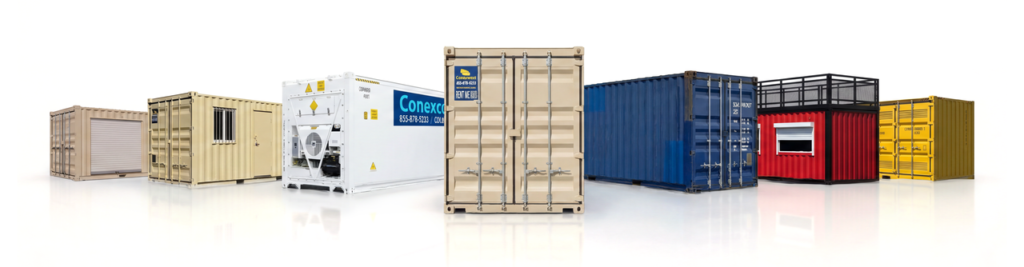
A construction storage container is a steel shipping container placed on a building site to lock up tools, materials and small plant. For most jobs, a used or one trip 20ft container is enough for a small crew’s tools. A 40ft is better when you also store materials, fixtures and fittings. An open side or double door container helps when you need to reach everything quickly.
Whatever size you pick, the container has to be wind and watertight, fitted with a proper lock, and set level on firm ground near the site entrance but out of the way of deliveries. At Prime Cargo Box, prices start at $1,000 for a used 20ft and $1,900 for a used 40ft, with delivery worldwide.
That’s the short answer. The rest of this guide covers how to size a construction storage container, which type suits which trade, security, site placement, condensation, safe storage of fuels and gas, buying versus renting, and which containers from our own stock we’d point you to. Prices and specs come from our listings, outside facts are linked to their sources, and anything that’s our opinion is marked as such.
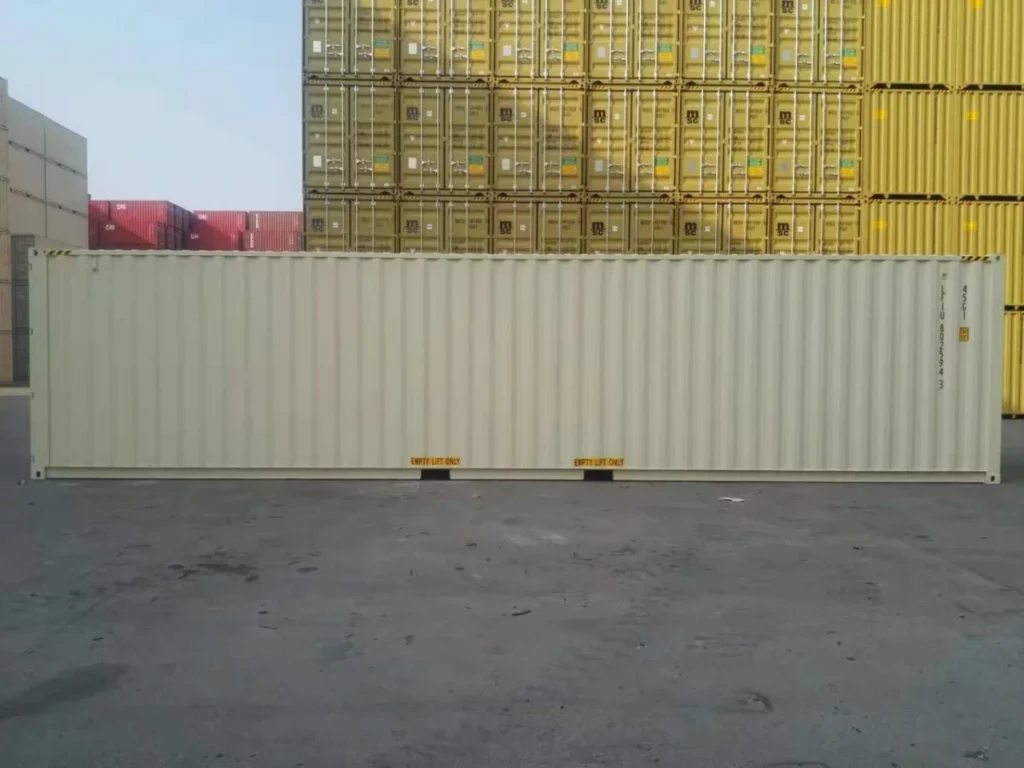
Table of Contents
Table of Contents
Construction storage container sizes at a glance
Here’s how we usually match a construction storage container to the job. Treat it as a starting point and check the numbers against your own kit.
| Job or crew | What goes inside | Construction storage container to look at | From our stock |
|---|---|---|---|
| Small trade crew, renovation or fit-out | Power tools, hand tools, ladders, a few days of materials | 20ft standard, used or one trip | Used 20ft, One trip 20ft |
| House build or medium commercial job | Tools plus materials, fixtures, small plant | 40ft standard or high cube | Used 40ft, Used 40ft high cube |
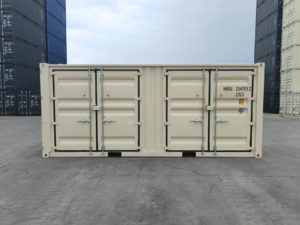
| Several trades sharing one store | Separate areas for each trade, quick access | Double door or open side | Used 40ft double door, Used 20ft open side |
| Long project or a contractor’s yard | Everything above, kept for years and moved between sites | One trip or new 20ft or 40ft | One trip 40ft, New 40ft |
The pairings are our recommendation, based on what we sell and the jobs buyers describe to us.
Worried about theft on site? Our guide to secure storage containers covers lock boxes, padlock grades and placement.
Why contractors use a construction storage container
Every site needs somewhere to lock things up at night, and that’s the job of a construction storage container. The alternatives are a van full of tools, a timber shed that’s easy to break into, or hauling everything home every evening. A steel construction storage container is strong, weatherproof, quick to deliver and easy to move to the next job. When the project ends it still has value, either as storage at your yard or for resale.
Theft is a real cost on building sites. A report from the US National Insurance Crime Bureau and the National Equipment Register counted 10,925 pieces of heavy equipment stolen in a single year, with only about 20 percent ever recovered. That report dates from 2013 and covers heavy equipment rather than hand tools, so treat it as an indication of the scale of the problem, not a current figure. Hand tools, cable, copper and fittings are even easier to carry away, and they’re what usually ends up in a construction storage container.
Containers aren’t burglar-proof. Our view is that a good container with a proper lock and sensible placement makes a site a much harder target than a shed or an open stack of materials.
What a standard container holds
Most construction storage container decisions come down to internal space. Typical published figures for a 20ft standard dry container are an internal length of 5.895 m, width of 2.350 m and height of 2.392 m, with a door opening 2.340 m wide and 2.292 m high and about 33 m³ of space. A 40ft standard is the same width and height at roughly twice the length. A high cube adds about one foot of height. Our shipping container dimensions guide has the full figures for every size we sell.
In practical terms:
- The door opening is a little narrower and lower than the inside. A full 8 by 4 sheet of plywood or plasterboard goes in flat or on edge without trouble.
- Most standard ladders and scaffold boards fit along a 20ft. Longer lengths of timber, steel or pipe need a 40ft.
- A pallet truck or small forklift can work inside, as long as you respect the floor rating. Ask us for the floor rating of any container.
20ft or 40ft for site storage?
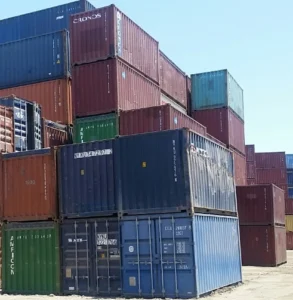
A 20ft construction storage container is easier to place on tight urban sites and costs less to buy and deliver. It needs a shorter run for the delivery truck and fits where a 40ft won’t. A 40ft gives you twice the floor area for less than twice the price. It’s the better choice when materials are being stored as well as tools, or when several trades share the store.
Two smaller containers can work better than one big one on some jobs. You can put one by the gate for tools and one near the work area for materials, or give each trade its own lockable box. Our 20ft vs 40ft shipping container comparison goes through the trade-offs in more detail.
Standard or high cube?
A high cube is about a foot taller inside. That matters if you stack materials high, store tall rolls or want to fit racking with more shelves. For simple tool storage, a standard height construction storage container is usually fine and a little cheaper. See our high cube vs standard container guide.
Choosing the right door layout
The way a container opens changes how a site uses it every day.
| Type | How it opens | Good for on site | Things to think about |
|---|---|---|---|
| Standard | Cargo doors at one end | Simple tool and material storage at the lowest price | Items at the back are hard to reach |
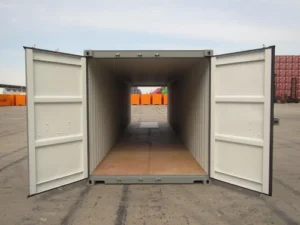
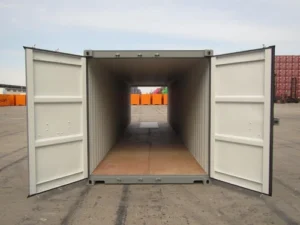
| Double door (tunnel) | Cargo doors at both ends | Long items, two access points, splitting the box between two trades | Costs more than a standard box |
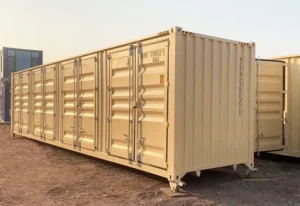
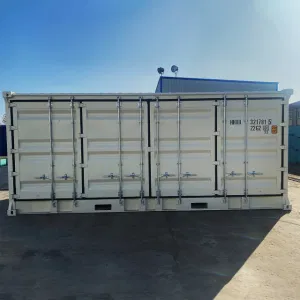
| Open side | Full-length side doors plus end doors | Fast access to everything, forklift loading from the side, a “shop counter” for a busy site | Heavier, costs more, more doors to secure |
| Open top | Removable roof, end doors | Crane loading of tall or heavy items | Less secure for day-to-day storage |
For most construction storage container buyers, a standard box is the best value. A double door earns its price when you store long materials or want two crews to share one box. An open side earns its price on busy sites where people are in and out all day. Our guides to the double door container, open side container and open top container go deeper.
Used, one trip or new?
A construction storage container takes knocks. It gets delivered, moved, hit by plant and loaded with heavy, dirty materials. That makes a good used container the best value for many contractors. It just needs to be wind and watertight, with doors that open and close properly and a sound floor.
- Used: the lowest price. Expect dents, surface rust and older paint. Fine for most sites.
- One trip: made new and shipped once with cargo. Near-new condition at a lower price than brand new. A good choice if the container will move between jobs for years or be seen by clients.
- New: the cleanest option, for branded site stores or long-term use.
Our one trip vs used shipping container guide explains the grades, and our cheap shipping containers article covers how to buy at the lower end without regret.
The CSC plate
Most shipping containers carry a CSC safety approval plate under the International Convention for Safe Containers. The plate shows the maximum gross weight, allowable stacking weight, month and year of manufacture, and, on containers still in shipping use, when the next examination is due. For a container used purely as site storage, the plate is mainly a useful way to check its age and ratings. You don’t need a current examination date just to store tools on land. Ask us if you need a cargo worthy unit for shipping later.
Security: make the container the hardest thing on site to break into
A construction storage container starts out strong, and that’s half the reason to buy one. The weak points are the locking bars and the padlock.
- Lock box. A steel shroud welded over the padlock area stops bolt cutters and angle grinders getting an easy angle. It’s one of the most useful upgrades for site containers.
- Padlock. Use a heavy, closed-shackle padlock that fits inside the lock box. A cheap padlock undoes the whole point of a steel box.
- Placement. Put the doors where they’re visible from the road or site cabin and where a vehicle can’t back right up to them.
- Lighting and cameras. A floodlight and a camera pointed at the doors help, especially on long jobs.
- Keep an inventory. Mark tools and record serial numbers. Recovery is far more likely when you can prove what’s yours.
We fit lock boxes and other modifications through our custom container modifications service. Ask when you order.
Placing a container on site
Where the construction storage container goes is decided before delivery day, not on it.
Ground and levelling
A construction storage container carries its weight through its four corner castings. Set it on firm, level ground. Hardcore, compacted gravel, concrete pads, sleepers or railway ties under each corner all work. A container that isn’t level twists slightly, and the doors start to bind. On soft ground after rain it can sink at one corner.
Access for delivery
The delivery truck needs room to get in, tip or lift the container, and get out. Overhead cables, trees, scaffold and parked plant all get in the way. Our shipping container delivery guide explains tilt-bed and side-lifter deliveries and how much space each one needs.
Position on site
- Close to the site entrance for easy deliveries, but not blocking it.
- Out of the way of cranes, excavations and later phases of work. Moving a loaded container mid-job is expensive.
- Doors facing where people will actually be working.
- Away from where water collects. Leave the doors on the higher side if the ground slopes slightly.
Permits and permissions
Rules on placing a container on a site or a public road vary a lot around the world. Some councils and cities want a permit if the container sits on the road or pavement, or stays a long time. Check with the local authority and your main contractor before delivery. We don’t give legal advice, so treat this as a reminder to ask, not an answer.
Keeping things dry: condensation in a site container
A construction storage container is watertight, but moisture can still form inside. Virginia Tech’s Center for Packaging and Unit Load Design explains that condensation forms when temperature swings push the air inside a container past its dew point. It names air, packaging, pallets and products as the moisture sources, and notes that green, undried pallets can hold more than ten pounds of water. Its advice includes ventilating when the outside air is drier, using desiccants, and choosing kiln-dried or non-wood pallets.
On a building site, that means:
- Don’t store wet timber, damp bags of plaster or muddy tools straight in the container if you can avoid it.
- Keep plaster, cement and other moisture-sensitive materials off the floor on pallets, ideally plastic or kiln-dried ones.
- Add vents, or ask us to fit them, if you store anything that hates damp.
- Use desiccant bags or tubs for sensitive items, and change them regularly.
- Consider an insulated or lined construction storage container for long winter jobs. Ask us about our modifications.
Storing fuel, gas and chemicals safely
A construction storage container is not automatically a safe place for petrol, diesel, gas bottles, paints and solvents. Rules differ around the world, so follow your local fire and workplace safety rules. US federal construction rules show the kind of limits involved. Under 29 CFR 1926.152, no more than 25 gallons of flammable liquids may be stored in a room outside an approved storage cabinet, and a single cabinet may hold no more than 60 gallons of Category 1, 2 or 3 flammable liquids. An enclosed steel box full of fumes is exactly what those rules are meant to prevent.
In practice:
- Keep fuel in approved cans, in an approved flammables cabinet or a separate, ventilated store.
- Store gas bottles upright, secured, and in a ventilated area. Many sites keep them in a separate cage outside the container.
- Never run generators, heaters or engines inside a closed container.
- Label everything and keep a fire extinguisher near the doors.
Organising the inside
A well-organised construction storage container saves time every morning. US workplace safety rules require stored materials stacked in tiers to be stacked, racked, blocked, interlocked or otherwise secured to prevent sliding, falling or collapse, which is sensible anywhere.
- Shelving along one wall for power tools, fixings and consumables.
- A clear aisle down the middle so nothing has to be moved to reach the back.
- Heavy items low and close to the doors.
- Long items on wall brackets or in a double door container.
- Lighting. Battery or solar lights make a big difference on winter afternoons.
- A sign-out sheet on the door for shared tools.
Container vs other site storage options
A construction storage container isn’t the only way to store things on site. Here’s how it compares with the usual alternatives, in our view:
| Option | Strengths | Weaknesses |
|---|---|---|
| Construction storage container | Steel, weatherproof, large, lockable, moves between jobs, keeps resale value | Needs a truck to deliver, needs firm ground and access |
| Timber or plastic shed | Cheap and quick to put up on small jobs | Easy to break into, not weatherproof for long, usually left behind |
| Steel jobsite tool chest | Very secure for hand and power tools, moves with a forklift | Small, holds tools but not materials |
| Work van | Tools go home with the crew | Loading and unloading every day, vans get broken into too |
| Off-site storage unit | Secure, nothing to deliver | Travel time every time you need something |
Many sites use a mix: a construction storage container for bulk tools and materials, plus a smaller steel tool chest inside it for the most valuable items. That gives two layers of locks for the things thieves want most.
Budgeting for a construction storage container
The purchase price is the biggest cost, but plan for the rest too:
- Delivery. Depends on distance, the type of truck and site access. We quote it before you buy.
- Ground preparation. Hardcore, blocks or sleepers under the corners on soft sites.
- Security extras. A lock box, a good padlock and lighting.
- Fit-out. Shelving, racking, vents and any electrics.
- Insurance. Check whether your contractor’s policy covers tools kept in a site container, and on what conditions. Some insurers ask for particular locks.
- Moving it. Each move between sites is another delivery charge.
- Permits. Where local rules require one.
Even with those extras, a used construction storage container usually costs less than many months of rented storage. That’s our view from talking to buyers. Run your own numbers with real quotes. Our shipping container prices guide explains what drives the purchase price.
Buying vs renting a construction storage container
Many contractors rent a construction storage container at first, then buy once they see how often they need it. Rough logic:
- Short, one-off job: renting may be cheaper and saves you finding somewhere to keep the container afterwards.
- Regular work or jobs lasting many months: buying usually works out cheaper over time, and you own an asset you can move between jobs or sell.
- A contractor’s yard: buying is almost always the better choice.
To compare, take the monthly rental quote plus delivery and collection, multiply by how many months a year you’d need a construction storage container, and compare that with our purchase price plus delivery. We can’t give you a rental figure because it varies so much by place, but the sum is easy to do with real quotes. Our shipping container prices guide covers what affects the price of buying.
A construction storage container for each trade
Different trades fill a site store in different ways. Here’s how we’d set up a construction storage container for some of the most common ones. These are suggestions from what buyers tell us, not rules.
Electricians
Cable drums, conduit, trunking, boxes of fittings and expensive meters and testers. Copper cable is a common theft target, so a construction storage container with a lock box and good lighting is worth the money. A 20ft with shelving down both walls works well. Keep cable drums near the doors on a simple axle rack so they can be pulled off without lifting.
Plumbers and heating engineers
Copper and plastic pipe in long lengths, fittings, boilers and cylinders still in their boxes. Long pipe is the awkward part. A 40ft, or a 20ft double door construction storage container, lets pipe lie flat along the length. Boilers and cylinders are valuable, so keep them at the far end, away from the doors.
Carpenters and joiners
Sheet materials, timber, doors, frames and power tools. Timber needs to stay dry and flat, so pallets or bearers on the floor and good ventilation matter. A high cube construction storage container gives room to stack sheets on edge with space above.
Groundworkers and civils crews
Breakers, compactors, small pumps, generators, hoses and heavy hand tools. Floor loading and easy access matter most. An open side container lets you get plant in and out with a forklift or pallet truck. Keep fuel for the plant outside the container in a proper store, as covered above.
Painters and decorators
Paint, solvents, dust sheets, rollers and access equipment. Paint and solvents fall under flammable storage rules in many places, so a separate approved cabinet is the safer choice. The rest fits easily in a 20ft construction storage container with shelving.
Shared store for a main contractor
When one construction storage container serves the whole site, a double door or open side layout stops everyone queueing at one door. Mark out zones for each trade and keep a sign-out sheet.
Construction storage containers we sell
Prices are in US dollars, before delivery, and correct when this was written. Click through for current prices, photos and full specs.
Standard 20ft containers
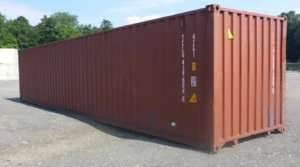
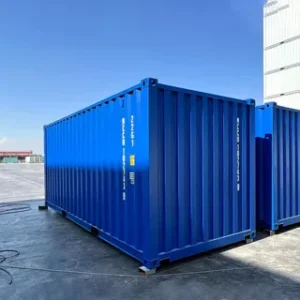
- Used 20ft shipping container: 20′ GP, wind and watertight, about 33.2 m³, $1,000. Our lowest-cost construction storage container.
- One trip 20ft shipping container: near new, Corten steel, marine plywood floor, CSC plated, $1,550.
- New 20ft shipping container: $2,400.
- Used 20ft high cube: about 2.69 m internal height, about 37.4 m³, $1,650.
- New 20ft high cube: $4,250.
Standard 40ft containers
- Used 40ft shipping container: 40′ GP, about 67.7 m³, $1,900. The lowest cost per cubic metre for site storage.
- One trip 40ft shipping container: near new, $3,200.
- New 40ft shipping container: $3,400.
- Used 40ft high cube: about 76 m³, $2,200.
- One trip 40ft high cube: $2,900.
- New 40ft high cube: $3,800.
Double door containers
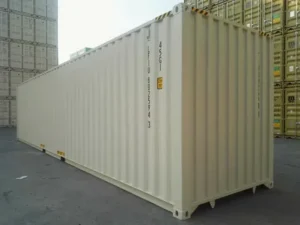
- Used 20ft double door: cargo doors at both ends, $1,950.
- One trip 20ft double door: $2,500.
- New 20ft double door: $3,700.
- Used 40ft double door: $1,150.
- One trip 40ft double door: $3,500.
- New 40ft double door: $4,900.
Open side containers
- Used 20ft open side: full-length bi-fold side doors, side opening about 5.70 to 5.82 m, $2,950.
- One trip 20ft open side: $5,200.
- New 20ft open side: $5,700.
- Used 40ft high cube open side: side opening about 11.56 m, $5,500.
- One trip 40ft high cube open side: $6,200.
Open top containers
For crane-loaded materials, our used 20ft open top ($2,600) and one trip 20ft open top ($3,150) come with tarpaulin and removable roof bows. Our used and one trip 40ft open top containers are priced on request. They’re less suited to day-to-day lockable storage, but useful on sites with tower cranes.
Three sites and the container we’d match to each
These are typical situations buyers describe to us, with the construction storage container we’d suggest for each.
The renovation or fit-out crew
Three or four trades on a house or shop fit-out, with tight access and a short programme. A used or one trip 20ft standard construction storage container fits on a driveway or in a corner of the yard, holds tools and a few days of materials, and costs very little. A lock box is worth adding.
The new-build housing site
Several plots, months of work, materials arriving in batches. A 40ft standard or high cube near the entrance takes deliveries. A 20ft double door near the work area holds tools and gives two trades a door each. Buying usually beats renting on a job this long, and both boxes move to the next site afterwards.
The busy commercial site
Many trades, lots of people in and out, a site manager who wants a store that works like a shop counter. A 40ft open side container lets the storekeeper see and reach everything, and forklifts can load pallets from the side. Pair it with a standard 40ft for bulk materials.
Turning a construction storage container into a site office or welfare unit
Many sites also need somewhere to sit, read drawings, eat lunch and dry off. A construction storage container can be split or converted to do some of that work. Common changes include:
- A personnel door cut into the side, so people don’t open the heavy cargo doors all day.
- Windows with security bars or shutters.
- Insulation and lining, so the space stays usable in winter and doesn’t drip with condensation.
- Electrical fit-out: sockets, lights and a consumer unit, installed by a qualified electrician.
- A partition, giving an office at one end and a secure tool store at the other.
We handle these through our custom container modifications service, and you’ll find converted units in our modified shipping containers category. Local rules for occupied site cabins can differ from rules for plain storage, so check what applies before you order a converted construction storage container.
Moving a construction storage container between sites
One of the best things about owning a construction storage container is that it moves with you. A few tips make each move smoother:
- Empty it, or load it lightly. Most delivery trucks are set up to carry an empty or lightly loaded container. Ask before you plan to move one full of materials.
- Tie down anything left inside. Shelving and loose items shift when the container is tilted onto a truck.
- Book the move early. Container trucks get busy at the end of a project.
- Check the new site first. Same rules as the first delivery: firm, level ground, clear access and no overhead obstructions.
Our delivery guide explains truck types and how much room each needs.
Looking after a site container
A construction storage container needs very little maintenance, but a few minutes a month keeps it working for years:
- Grease the door hinges and locking bars. Stiff doors are the most common complaint on older containers.
- Check the door seals. Replace torn rubber before water gets in.
- Touch up bare steel. Scrapes from plant and materials turn into rust if left.
- Keep the roof clear. Standing water, debris and snow load don’t help. Avoid storing materials on the roof.
- Check that it’s still level. Ground can settle, especially after wet weather.
- Clean out the floor. Mud, cement dust and spilled fluids damage the plywood over time.
How long does a construction storage container last?
There’s no fixed answer, because it depends on the climate, how the container is treated and its condition when you bought it. Corten steel containers are built for years of sea transport, and on land, as site storage, they usually last a long time with basic care. A used construction storage container that’s already done years at sea can still give many more years on a building site. A one trip or new unit gives you the longest working life. That’s our experience as a seller, not a measured figure, so look at the actual condition of any container before you buy.
Construction storage container buying checklist
- What will go inside: tools only, or materials too?
- 20ft or 40ft? Standard or high cube?
- Standard, double door or open side?
- Used, one trip or new?
- Wind and watertight, with doors that open and seal properly?
- Lock box, vents, shelving or lighting needed?
- Where exactly will it sit, and is the ground firm and level?
- Is there room for the delivery truck to get in and out?
- Any local permit needed?
- Where will it go after this job?
We’ll help with every question on this list. For a broader buying guide, see how to buy a shipping container, and our overview of the types of shipping containers.
Mistakes we see people make
These come from our own conversations with buyers, so treat them as experience rather than statistics.
- Putting the container where it’ll need moving. A box in the way of a later phase costs a second delivery.
- Skipping the lock box. A cheap padlock on a steel container is the easiest way in.
- Setting it on soft ground. One sunken corner and the doors won’t close.
- Storing fuel and gas inside with the tools. Keep them in a proper separate store.
- Buying too small. A 20ft that’s full on day one is a daily headache.
Other uses after the job
A construction storage container doesn’t stop being useful when the job ends. Many contractors move it to their yard for stock, use it on the next site, or convert it into a site office or welfare unit. Farmers, landscapers and small businesses buy used site containers for storage too. Our storage containers for sale, farm storage containers and conex box for sale guides cover those uses.
Getting ready for delivery day
A little preparation the week before means the construction storage container goes in the right place first time. This is the list we’d work through:
- Mark the spot. Spray paint or pegs at each corner, with the door end clearly marked.
- Lay the supports. Blocks, sleepers or a compacted pad under each corner, checked with a level.
- Clear the route. Move plant, skips and stacked materials out of the truck’s path, and check for overhead cables and branches.
- Tell the neighbours and the site team. A large truck may need the road or the site entrance for a short time.
- Have someone on site. The driver needs a person who knows exactly where the container should go and which way the doors should face.
- Have the lock ready. Fit the lock box and padlock the same day, so the construction storage container is never left open overnight.
Send us photos of the site entrance and the chosen spot before delivery and we’ll confirm the right truck. It’s much cheaper than a second visit.
Delivery worldwide
We arrange container delivery for customers in many countries. Tell us the site address, ground conditions and access, and we’ll quote delivery on each container you’re considering. Clear photos of the site entrance help us plan the right truck.
Construction storage container FAQs
What size construction storage container do I need?
A 20ft holds tools and some materials for a small crew. A 40ft suits house builds and bigger jobs where materials are stored too.
Is a used container good enough for a building site?
Yes, if it’s wind and watertight, the doors work and the floor is sound. Dents and surface rust don’t affect its use as site storage.
How do I make a site container more secure?
Fit a lock box and a heavy closed-shackle padlock, place the doors where they’re visible, and add lighting.
Can I store fuel in a construction storage container?
Only within local fire rules. In the US, for example, federal construction rules limit flammable liquids outside an approved cabinet to 25 gallons in a room. Separate, ventilated storage is usually safer.
Do I need a foundation?
No permanent foundation is needed for most sites, but the container must sit on firm, level ground with support under each corner.
How do I stop condensation in a site container?
Add vents, use desiccants, keep wet materials out, and keep sensitive goods off the floor on dry pallets.
Should I buy or rent?
Rent for a short one-off job. Buy if you need site storage regularly or for many months.
Do you deliver construction storage containers outside the US?
Yes, we deliver worldwide. Ask for a delivered quote.
Order your construction storage container
Tell us about the site, what you need to store and how long the job runs, and we’ll recommend a construction storage container that fits. Browse our 20ft shipping containers, 40ft shipping containers, used shipping containers, double door containers and open side containers, or see all our products. Questions? Contact us.
Sources and References
- SeaRates: 20 ft standard container dimensions
- Equipment World: NICB and NER heavy equipment theft report
- Marine Insight: Understanding the CSC plate
- Virginia Tech Center for Packaging and Unit Load Design: Moisture in Sea Containers
- 29 CFR 1926.152: Flammable liquids (Cornell LII)
- 29 CFR 1926.250: General requirements for storage (Cornell LII)