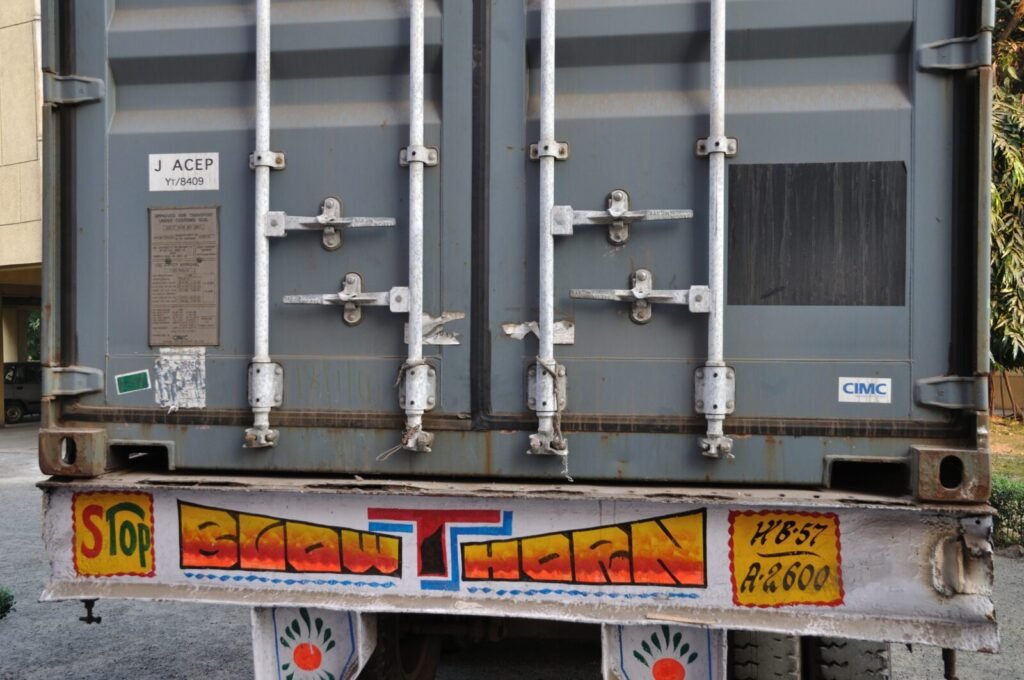
Double door boxes make great drive-through machinery sheds, as our guide to farm storage containers explains.
A double door container is a steel shipping container with a full set of cargo doors at both ends instead of just one. People also call it a tunnel container, because with both ends open you can see, walk or drive a pallet truck straight through it. We sell the double door container in 20ft and 40ft sizes, new, one trip and used, from $1,150 for a used 40ft double door container up to $4,900 for a new 40ft tunnel unit, and we ship worldwide.
If you store things that move in and out, the second set of doors changes how the box works. Nothing is ever more than half the length away from a door, you can keep two kinds of stock apart, and air can run right through on a hot day. This guide covers what you get, what it costs compared with a one-door box, which size and grade to pick, and how to set it up so both ends keep opening easily for years.
Table of Contents
Quick answers
- Cheapest double door container we list: the used 40ft double door container at $1,150.
- Cheapest 20ft: the used 20ft tunnel container at $1,950.
- Best value near-new: the one trip 20ft double door container at $2,500, or the one trip 40ft at $3,500.
- Factory new: the new 20ft at $3,700, the new 40ft standard double door at $3,900 and the new 40ft double door container at $4,900.
- Capacity: about 32.8 m³ in a 20ft and about 67 m³ in a 40ft, almost the same as a one-door box.
- Delivery: worldwide, quoted to your address.
What is a double door container?
Most shipping containers have doors at one end only. The other end is a solid steel wall. A double door container replaces that end wall with a second door frame, two more doors, another four locking bars and another set of rubber gaskets. Everything else stays the same: the corrugated Corten steel walls and roof, the marine plywood floor, the corner castings and the outside size.
So it is still a proper ISO container. The outside dimensions follow ISO 668, the international standard for freight container sizes and ratings, which means it fits the same trailers, twist locks and lifting gear as any other box. New and one trip units carry a safety approval plate under the International Convention for Safe Containers (CSC), so they can go to sea with cargo as well as sit on your site as storage.
Double door, tunnel, DD: same thing
You will see this box sold under a few names. Tunnel container, double ended container, DD container and “doors both ends” all mean the same layout. In trade listings you might also see it written as 20DD or 40DD. Do not mix it up with a “double door” that only means the normal pair of doors at one end. Every container has two door leaves at the door end. What makes a tunnel box different is that it has two door ends.
How the doors work
Each end is built like a normal container door end. There are two door leaves, each with two vertical locking bars. You lift the handles, turn the bars to release the cams at top and bottom, and swing the doors out. The right-hand door usually has to open first because its gasket overlaps the left one. Close them in the reverse order. Each end has its own lock box or padlock point, so you can secure both ends separately.
Because both ends now have doors, there is no solid end wall to stiffen the frame. Factories make up for that with a full door frame at each end, which is very strong. That is why a tunnel box weighs a little more than a one-door box: roughly 2,350 to 2,500 kg empty for a 20ft and 3,660 to 3,900 kg for a 40ft, against about 2,200 kg and 3,700 kg for typical standard units.
Why buy a double door container?
The honest answer: because you will open it a lot. If you fill a box once and leave it, a standard container does the same job for less. Our storage containers for sale guide covers that kind of storage. But if goods go in and out every week, a second door end pays for itself in time and frustration.
Nothing is stuck at the back
In a one-door box, whatever goes in first ends up behind everything else. To reach it you unload half the container, or you leave an aisle down the middle and lose a third of your floor. With doors at both ends, the furthest item is never more than half the length from a door.

In a standard 40ft, the far corner is about 12 m from the doors. In a 40ft tunnel box it is about 6 m from the nearest door. In a 20ft the drop is from about 5.8 m to about 2.9 m. Halving the walk does not sound dramatic until you are carrying a toolbox in the rain.
Two stores in one box
Put a partition wall in the middle and you have two separate lock-ups, each with its own doors. That is handy for two trades on one site, a business and a household sharing a yard, or keeping chemicals and fuel well away from food or stock. Without a partition you can still split the box by use: fast-moving stock at one end, seasonal stuff at the other.
Load one end, unload the other
If goods arrive at one side of your yard and leave from the other, a tunnel box works as a pass-through. Forklift or pallet truck in at one end, out at the other, no turning inside. This is the classic use in warehouses, depots and at events where kit comes off one truck and goes onto another.
Air flow
With both ends open you get a through draught. In hot weather that makes a real difference to anyone working inside, and it helps dry out a box after rain or cleaning. It will not replace proper vents for long-term storage of damp-sensitive goods, but it helps.
Long items
A 40ft tunnel unit lets you feed pipe, timber or steel in from one end and push it out the other, which is easier than backing long lengths out of a dead end. If you need even easier access along the whole side, an open side container is the next step up.
Double door container sizes and specifications
These are the figures from our own listings. Containers vary a little between factories, so we confirm the exact numbers on your quote and the ratings are printed on the CSC plate of your unit.
| Specification | 20ft double door container | 40ft double door container |
|---|---|---|
| External size | 6.06 x 2.44 x 2.59 m (20 x 8 x 8 ft 6 in) | 12.19 x 2.44 x 2.59 m (40 x 8 x 8 ft 6 in) |
| Internal length | approx. 5.84 m | approx. 11.98 to 12.03 m |
| Internal width | approx. 2.35 m | approx. 2.35 m |
| Internal height | approx. 2.39 m | approx. 2.39 m |
| Door openings (each end) | approx. 2.34 m wide x 2.28 m high | approx. 2.34 m wide x 2.28 m high |
| Cubic capacity | approx. 32.8 m³ (1,160 cu ft) | approx. 67 m³ (2,370 cu ft) |
| Tare weight | approx. 2,350 to 2,500 kg | approx. 3,660 to 3,900 kg |
| Max gross weight | typically 30,480 kg | 30,480 or 32,500 kg depending on build |
| Payload | approx. 28,100 kg | approx. 26,600 to 28,800 kg |
| Doors | two leaves at each end, four locking bars per end | two leaves at each end, four locking bars per end |
| Floor | marine plywood | marine plywood, approx. 28 mm |
Notice the door opening is the same at both ends and the same as a normal container: about 2.34 m wide and 2.28 m high. The second door end gives you another way in, not a bigger one. If your problem is getting something wide or tall through the doors, look at the sizes on our shipping container dimensions guide, or consider an open side or open top box.
Notice too that the volume barely changes. A standard 20ft holds about 33 m³ and a 40ft about 67.7 m³. You lose almost nothing by adding the second door end.
Double door containers we sell right now
Prices are in US dollars before freight and delivery. They change as stock moves, so the product page always has the live price. Every unit is wind and watertight, and on used boxes we check that both ends open, close, lock and seal.
Used 40ft double door container: $1,150
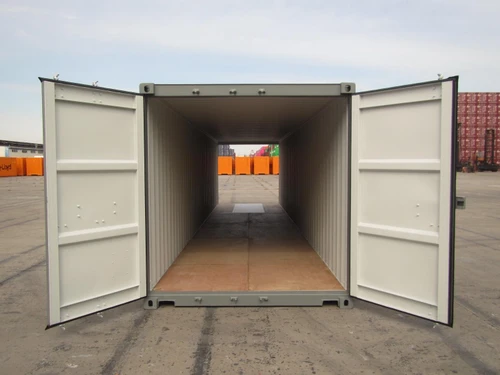
The used 40ft double door container is the lowest priced box in this range and gives you the most space per dollar. It has worked in shipping before, so expect dents, faded paint and some surface rust. What matters is underneath: sound floor, solid frame and both door ends working.
Short spec: 40 x 8 x 8 ft 6 in (12.19 x 2.44 x 2.59 m); cargo doors at both ends; approx. 67 m³; tare approx. 3,660 to 4,000 kg; used, wind and watertight, both ends checked.
At the time of writing this is listed lower than our used 20ft tunnel box, which is unusual. Prices for used stock move with what comes in, so check the product page for the current figure before you plan around it.
Used 20ft double door container: $1,950
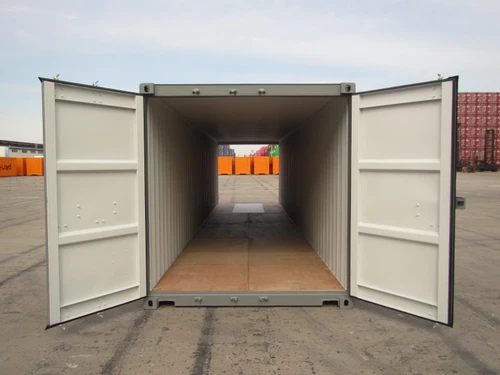
The used 20ft double door container suits smaller yards, farms and site compounds where a 40ft will not fit. Used tunnel boxes are less common than standard ones, so good 20ft units do not hang around.
Short spec: 20 x 8 x 8 ft 6 in (6.06 x 2.44 x 2.59 m); cargo doors at both ends; approx. 32.8 m³; tare approx. 2,350 to 2,600 kg; used, wind and watertight, both ends checked.
One trip 20ft double door container: $2,500
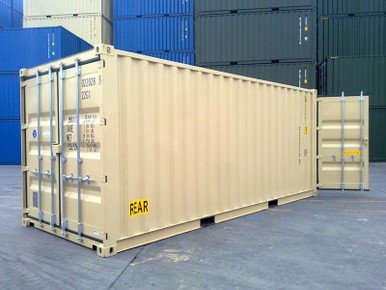
This is the grade we recommend most often. A one trip box has carried a single load from the factory and then been sold. You get straight panels, factory paint and both sets of door hardware in near-new shape, at well under the price of new. The one trip 20ft double door container is a sensible buy for anyone who wants it to look tidy and last.
Short spec: 20 x 8 x 8 ft 6 in; doors at both ends; approx. 32.8 m³; tare approx. 2,350 to 2,500 kg; max gross 30,480 kg; Corten steel; marine plywood floor; CSC plated.
One trip 40ft double door container: $3,500
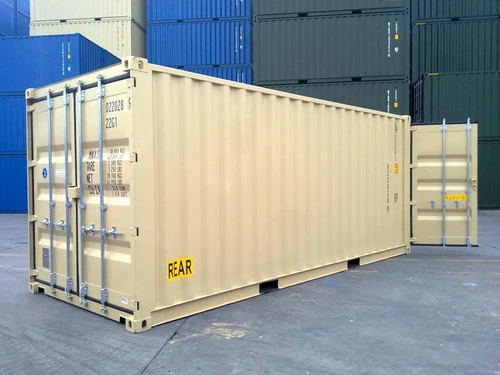
The one trip 40ft double door container is the pick for depots, builders and event firms that want a long pass-through store in near-new condition.
Short spec: 40 x 8 x 8 ft 6 in (12.19 x 2.44 x 2.59 m); doors at both ends; approx. 67 m³; tare approx. 3,660 to 3,900 kg; max gross 30,480 to 32,500 kg; Corten steel; CSC plated.
New 20ft double door container: $3,700
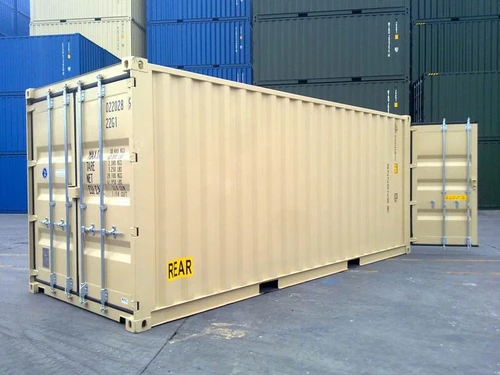
The new 20ft double door container has never carried cargo. No old logos, no handling marks. Buy new when customers will see the box every day, for a kiosk, a cafe or a branded site office.
Short spec: 20 x 8 x 8 ft 6 in; doors at both ends; internal approx. 5.84 x 2.35 x 2.39 m; approx. 32.8 m³; max gross 30,480 kg; CSC plated.
New 40ft standard double door container: $3,900
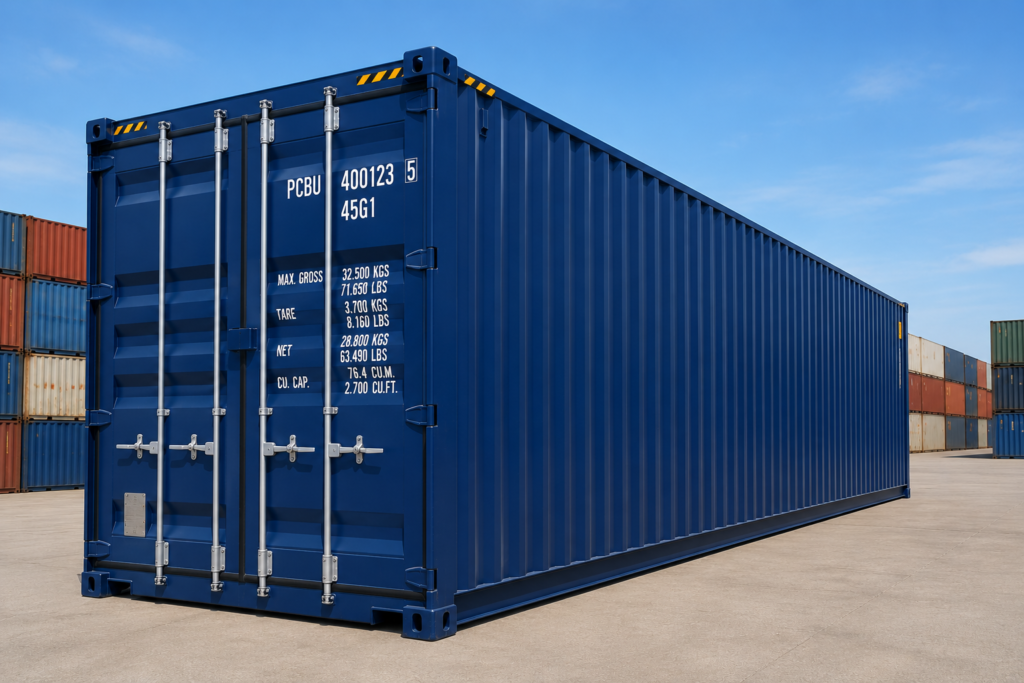
The new 40ft standard double door shipping container is a brand new 8 ft 6 in tall forty with doors at both ends, finished in marine grade paint.
Short spec: 40 x 8 x 8 ft 6 in; internal 12.03 x 2.35 x 2.39 m; door openings 2.34 x 2.28 m; 67.7 m³; empty weight 3,700 kg; max payload 26,780 kg; max gross 30,480 kg; 28 mm marine plywood floor.
New 40ft double door container: $4,900
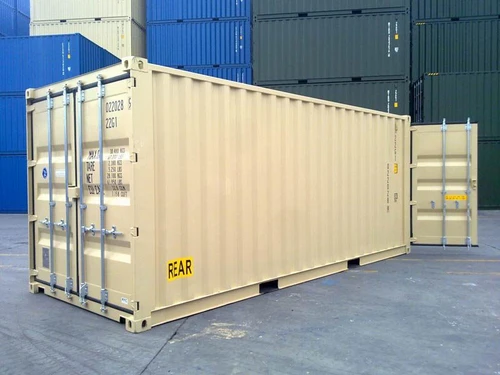
Our second new forty, the new 40ft double door container, may come with a 32,500 kg gross rating depending on the build, which matters if you plan to ship heavy cargo in it. If you only need storage, compare it with the $3,900 unit above and ask us which build is in stock.
Short spec: 40 x 8 x 8 ft 6 in; doors at both ends; approx. 67 m³; tare approx. 3,660 to 3,900 kg; max gross 30,480 or 32,500 kg; Corten steel; CSC plated.
See them all together in the double door containers category, or browse 20ft shipping containers and 40ft shipping containers for other layouts.
How much does a double door container cost?
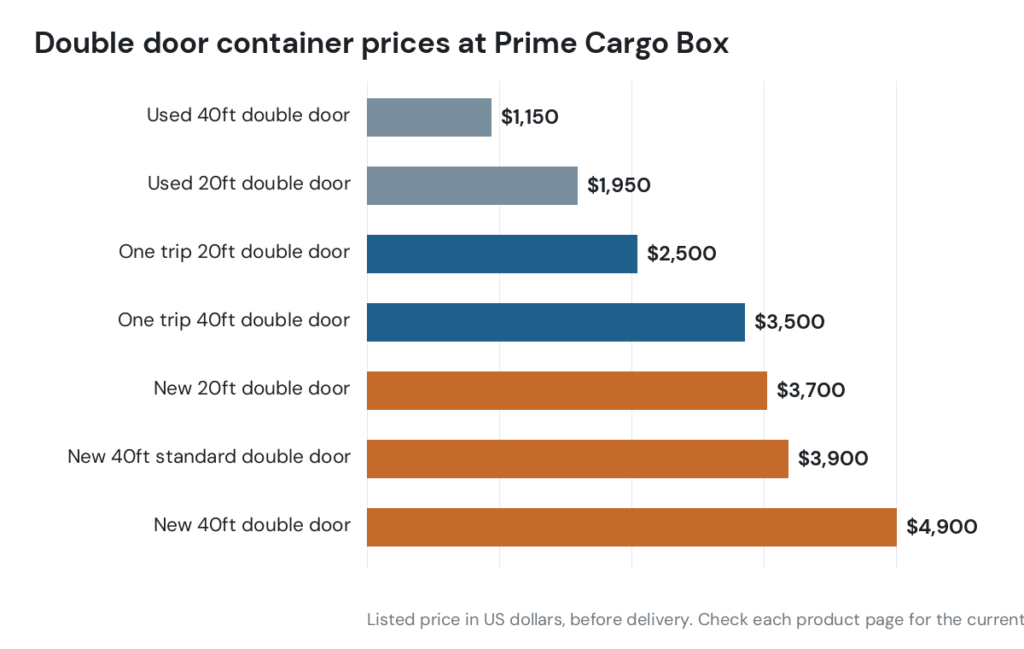
Across our current listings, a tunnel container costs $1,150 to $4,900 before delivery. Here is how that compares with one-door boxes in the same grade:
| Size and grade | Standard (one door end) | Double door container | Difference |
|---|---|---|---|
| Used 20ft | $1,000 | $1,950 | +$950 |
| One trip 20ft | $1,550 | $2,500 | +$950 |
| Used 40ft | $1,900 | $1,150 | -$750 at time of writing |
| One trip 40ft | $3,200 | $3,500 | +$300 |
| New 40ft | $3,400 | $3,900 to $4,900 | +$500 to +$1,500 |
The standard prices come from our used 20ft, one trip 20ft, used 40ft, one trip 40ft and new 40ft listings. On a 40ft the premium for the second door end is small, often a few hundred dollars. On a 20ft it is bigger because the extra door frame is a larger share of the build. The used 40ft tunnel box is the odd one out and is currently cheaper than a one-door used forty, which is about stock on hand rather than anything wrong with it.
Why pay more at all? The second end needs a full door frame, two door leaves, four locking bars, hinges, cams and gaskets. Factories also build fewer tunnel boxes than standard ones, so used stock is thinner.
Delivery is on top. It depends on distance, the truck your site needs and, for export orders, freight and import charges at your end. Our shipping container prices guide explains how the total adds up, and the cheap shipping containers guide has tips for keeping it down.
Double door container vs other options
| Container | Access | Best for | Watch out for |
|---|---|---|---|
| Standard container | Doors at one end | Fill-and-leave storage, lowest price | Items at the back are hard to reach |
| Double door container | Doors at both ends | Regular access, pass-through loading, two stores in one | Same door size as standard, both ends need clear space |
| Open side container | Full long side plus end doors | Daily picking along the whole length, shop fronts | Costs more, heavier, needs very level ground |
| Open top container | Removable roof plus end doors | Tall loads lowered in by crane | Tarpaulin roof, not for everyday picking |
| High cube container | Doors at one end, extra 30 cm height | Tall racking and machines | Same reach problem as standard |
Double door container vs standard container
If the box will be filled and left, buy a standard one. If you will be in it every week, buy the tunnel box. That is really the whole decision. One more thing to think about: two door ends only help if you can get to both ends. If one end will be against a fence, a wall or another container, you have paid for doors you cannot open. Our guide to the types of shipping containers compares every layout if you are still deciding.
Double door container vs open side container
An open side container opens along almost the whole long side, about 5.8 m on a 20ft and 11.5 m on a 40ft. That is far more access than a tunnel box gives you, and it is the better choice for retail fronts or racking you pick from all day. It also costs more: our one trip 20ft open side container is $5,200, against $2,500 for the one trip 20ft double door. For most storage and pass-through jobs, the tunnel box gives you most of the benefit for half the price.
Double door container vs open top container
An open top container is for loading from above by crane. It solves a different problem. If your goods go in by hand, pallet truck or forklift, the tunnel box is the right tool.
Double door container vs high cube
A high cube gives you about 30 cm more height but still has doors at one end only. Our tunnel units are standard height (8 ft 6 in). If you need both height and two-end access, ask us about availability, since high cube tunnel boxes are less common.
Best uses for a double door container
Building sites
A tool store gets opened first thing in the morning and locked last thing at night. Put hand tools and consumables at one end and bulky kit at the other, and two crews can get what they need without waiting for each other. Or partition it and give each trade their own end.
Warehouses and depots
Pass-through loading is the main reason depots buy tunnel boxes. Goods in at one end, out at the other, first in first out. It works well for overflow stock, returns and seasonal lines.
Farms
Feed and seed at one end, tools and fencing at the other. On a farm the box often sits between a yard and a field, so having a door facing each way saves a lot of walking.
Event and hire companies
Kit comes back from one job and goes out to the next. With doors at both ends, you can unload returned gear at one end while loading the next order at the other.
Shops, kiosks and cafes
Open one end to customers as a serving front and use the other end as the staff and stock door. A new 20ft tunnel container is a good starting point, and our container modification team can add counters, lighting, power and shelving before delivery.
Workshops
A small workshop gets light and air from both ends, and long workpieces can pass straight through. Add a bench along one wall and lighting, and you have a useful space.
Garden and household storage
Bikes, mowers and garden kit at one end, boxes and seasonal stuff at the other. A 20ft tunnel box is a common upgrade for people who have outgrown a garden shed.
Exporting cargo
Shippers who need to load at one end and pull goods out at the other, or who want to stow cargo for two consignees in one box, use tunnel containers for sea freight too. Check that the CSC plate is valid and that your payload fits the gross rating.
New, one trip or used double door container?
| Grade | What you get | Price range on our listings | Best for |
|---|---|---|---|
| New | Never used, no marks | $3,700 to $4,900 | Branded or customer-facing projects, longest life |
| One trip | One voyage, near new | $2,500 to $3,500 | Most buyers, tidy and long lasting |
| Used | Years in service, visible wear | $1,150 to $1,950 | Yards, farms, sites where looks do not matter |
Condition matters slightly more on a tunnel box than on a one-door box, because there are two sets of hinges, cams and gaskets to wear out. A one trip unit has both in near-new shape. A used unit is still a good buy, but expect to grease both ends more often and maybe adjust a sticky door. Our one trip vs used shipping container comparison explains the grades in more detail, and the used shipping containers and new shipping containers categories show what is in stock.
20ft or 40ft double door container?
Pick the 20ft if your site is small, if the box will be moved between locations, or if about 33 m³ is enough. It is easier to deliver, easier to place and cheaper to move later.
Pick the 40ft if you have room and need the space. You get about twice the volume, and on our current listings the price difference between a 20ft and 40ft tunnel box is small. The 40ft also makes better use of the two-door layout, because the reach saving is 6 m rather than 3 m. Our 20ft vs 40ft shipping container guide covers the site and delivery side of that choice.
Setting up a double door container on site

Leave clear space at both ends
This is the mistake people make most. The doors swing outward, so you need about 2.5 m of clear ground in front of each end just to open them fully, and more if a pallet truck or forklift will work there. Plan the position so neither end faces a wall, a fence or a slope. If space is tight on one side, a standard box may be the better buy.
Get it level
Containers sit on their four corner castings. If the ground is uneven, the frame twists slightly and the doors stop lining up. You will notice it first as doors that are hard to lock. With doors at both ends, a twist shows up at both ends. Use a concrete pad, compacted gravel, concrete blocks or railway sleepers under the corners, and check with a level before loading. A slight fall of a few centimetres along the length helps rain run off the roof.
Delivery access
The truck needs a straight approach, firm ground and overhead clearance. A 40ft on a tilt-bed or side-lifter needs a lot of room to manoeuvre. Our shipping container delivery guide has the clearances and a pre-delivery checklist, and our shipping and delivery policy explains how we arrange delivery around the world.
Forklift and pallet truck use
If you plan to drive through, check the floor rating, keep the floor dry and make sure operators are trained. The OSHA guidance on powered industrial trucks is a free and practical reference on safe forklift use wherever you work. Use a container ramp at the door sill rather than bumping over the edge.
Planning the inside layout
The way you lay out the inside decides whether you get the full benefit of two door ends. A few layouts work well.
Central aisle, racking both sides
Run shelving along both long walls and leave a clear aisle of about 1 m down the middle, end to end. Internal width is about 2.35 m, so shelves around 60 cm deep on each side leave roughly 1.15 m to walk. Everything is reachable from one end or the other, and the aisle doubles as a route for a hand trolley.
Pallet lanes
If you store pallets, a 20ft takes about 10 to 11 standard euro pallets on the floor and a 40ft about 23 to 25, depending on pallet size and how you place them. With doors at both ends you can load lane by lane from each side and keep the oldest stock nearest the exit end.
Split by zone
Use the middle as a dividing line. One half for things you use daily, one half for things you use monthly. Mark the floor with paint or tape so everyone puts things back in the right half. It sounds fussy, but it stops the slow drift where everything ends up in a pile in the middle.
Partitioned box
A steel or timber partition turns one tunnel box into two lock-ups. Put it wherever suits you, not just in the centre. A 40ft split at about 4 m and 8 m, roughly one third and two thirds, works well when one user needs more space than the other.
Whichever layout you pick, keep the heaviest items low and near the doors, and leave the door sills clear so the doors can close fully. If you want more background on how these boxes are built and rated, this overview of intermodal containers is a good place to start.
Security for a double door container
Two door ends means two places to lock. Treat each end as its own front door.
- Fit a lock box at each end. It covers the padlock so it cannot be cut easily with bolt croppers.
- Use closed-shackle padlocks, which leave very little shackle exposed.
- If you only use one end day to day, consider a bar lock across the other end so it stays shut.
- Place the box so both ends are visible from a building or a road, or fit a light.
- On a building site, a partition with separate locks lets you give each trade access to only their end.
The steel and locking bars on a tunnel box are the same as on any standard container, so it is just as secure once both ends are locked properly.
Checking a double door container on delivery
Run through this list when the box lands. It takes about fifteen minutes.
- Open and close both door ends fully. Each door should swing freely and the bars should lock without forcing.
- Check all eight locking bars engage their cams at top and bottom.
- Look along every gasket for splits or gaps. On a bright day, close both ends, stand inside and look for daylight.
- Walk the floor and check for soft spots, especially near the sills where forklifts run.
- Look at the corner castings and door frames for damage from lifting.
- Find the CSC plate and note the gross weight, tare and stacking rating.
If anything is wrong, send us photos and we will sort it out. Our refund and returns policy sets out how that works.
Modifying a double door container
The two-end layout makes some conversions easier. Common additions are:
- A partition wall with its own lock to make two separate stores
- Shelving or racking along both long walls with a central aisle running end to end
- Roller shutter or personnel door fitted in one end for daily use
- Vents, insulation and lining for workshops, offices or kiosks
- Lighting, sockets and a consumer unit
- Window or serving hatch cut into one long wall
Our custom container modifications page shows what we can fit. It is usually cheaper and neater to have the work done before delivery than on your site.
Looking after a double door container
Containers are made from weathering steel (Corten), which forms a tight rust layer that slows further corrosion. That makes them low maintenance, not no maintenance. On a tunnel box, both door ends need the attention.
- Grease the hinges and locking bar cams at both ends every few months, more often near the sea.
- Clean the gaskets and treat them with a rubber protectant once a year.
- Open the end you rarely use at least once a month so it does not seize.
- Keep the roof clear of standing water and leaves.
- Touch up scratches with zinc primer and paint before rust spreads.
- Check the base is still level after a wet season.
For a sense of how professionals judge container condition, the Institute of International Container Lessors (IICL) publishes the inspection and repair criteria used across the leasing industry.
Mistakes to avoid
- Placing one end against a wall. You lose the whole point of the box. Plan for clear space at both ends before you order.
- Expecting bigger doors. The openings are the same size as a standard container. Measure your largest item.
- Buying used without checking both ends. We check both ends on our used units, but if you buy elsewhere, test every door.
- Ignoring the end you do not use. Doors left shut for a year can seize. Open them regularly.
- Forgetting the second lock. An unlocked back door makes the front lock pointless.
How to buy a double door container from Prime Cargo Box
Choose your size and grade from the product pages above, add it to your cart or ask for a quote, and give us your delivery address. We confirm the unit, its plate figures and the delivered price. For orders going abroad we handle export documents and show local duties separately.
If this is your first container, our step-by-step guide on how to buy a shipping container walks through payment, inspection and delivery. You can also browse all cargo containers for sale, our standard shipping containers, or the full range on our products page.
Double door container FAQ
What is a double door container used for?
Mainly for storage you open often, pass-through loading, and splitting one box into two stores. It is popular on building sites, farms, depots and with event companies.
Is a tunnel container the same as a double door container?
Yes. Tunnel container, double ended container and DD container all describe a box with cargo doors at both ends.
How much does a double door container cost?
On our current listings, $1,150 to $4,900 before delivery, depending on size and grade. One trip 20ft units are $2,500 and one trip 40ft units are $3,500.
Are the doors bigger than a standard container?
No. Each end has a standard opening of about 2.34 m wide and 2.28 m high.
Does a double door container hold less than a standard one?
Barely. A 20ft holds about 32.8 m³ and a 40ft about 67 m³, very close to standard boxes of the same size.
Is a double door container weaker without an end wall?
No. The second end has a full steel door frame, which is very strong. New and one trip units carry a CSC plate with stacking and gross ratings like any other container.
Can I ship cargo in a double door container?
Yes, if it has a valid CSC plate and is in sound condition. Load and secure cargo as you would in any dry container.
How much space do I need?
The box footprint plus about 2.5 m clear at each end for the doors, more if a forklift will work there.
Do you deliver worldwide?
Yes. We quote freight, export documents and local delivery for your address. Use our contact page and tell us where it is going.
Ready to order your double door container?
If you open your storage every week, load with a pallet truck, or want two stores in one box, the second set of doors is worth the small extra cost. For most buyers it comes down to the one trip 20ft double door container at $2,500 or the one trip 40ft at $3,500. On a tight budget, the used 40ft at $1,150 and the used 20ft at $1,950 do the same job with a bit more wear.
Browse the full double door containers range, or contact our team with your size, site and destination and we will send a delivered price.
Photos: Biswarup Ganguly (CC BY 3.0) and IPLManagement (CC BY-SA 4.0), via Wikimedia Commons.