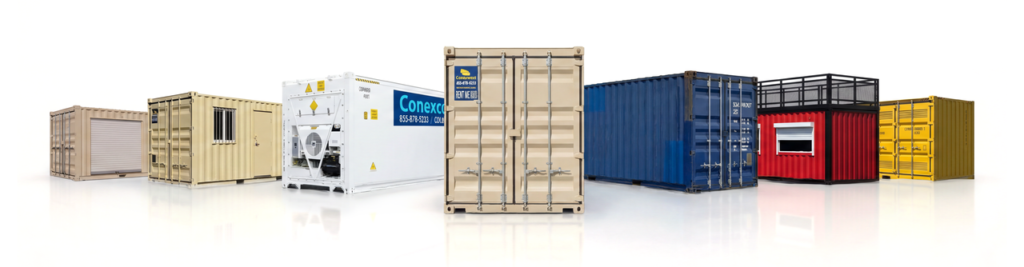
Standard shipping container dimensions are set by international agreement, which is why a 20 foot box from one factory lines up with every other 20 foot box in the world. Outside, a 20ft container measures 20 ft long, 8 ft wide and 8 ft 6 in high (6.06 x 2.44 x 2.59 m). A 40ft container is 40 ft long with the same width and height (12.19 x 2.44 x 2.59 m). A high cube adds one foot of height, taking it to 9 ft 6 in (2.90 m).
Inside, you lose a little to the steel walls, the floor and the roof. A standard 20ft gives you about 5.90 x 2.35 x 2.39 m and roughly 33 cubic metres of space. A standard 40ft gives about 12.03 x 2.35 x 2.39 m and roughly 67 cubic metres. A 40ft high cube gives about 76 cubic metres.
This guide lists the shipping container dimensions for every common size and type we sell, inside and out, with door openings, volumes, weights and pallet counts. Each size links to live products, so once you know which box fits your site and your cargo, you can order it straight from the page.
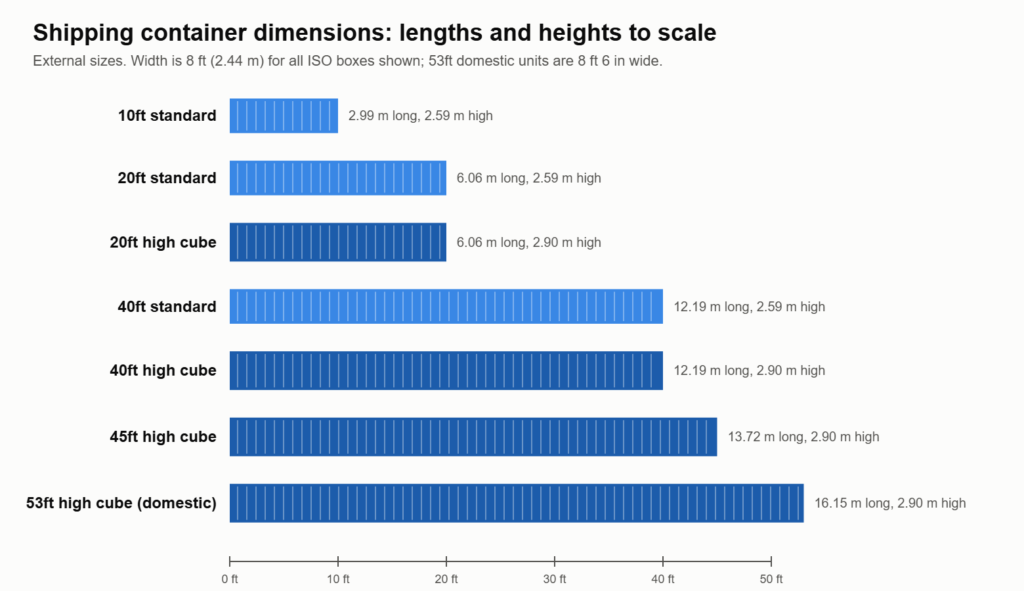
Shipping container dimensions at a glance
These are typical figures for steel dry containers. The outside sizes are fixed by standard. Inside sizes, weights and volumes vary slightly between manufacturers, so treat them as close guides rather than exact numbers. The exact figures for any box are painted on its door. Once you know the size, our guide explains how to buy a shipping container step by step.
| Size | Outside (L x W x H) | Inside (L x W x H) | Volume |
|---|---|---|---|
| 10ft standard | 2.99 x 2.44 x 2.59 m | about 2.83 x 2.35 x 2.39 m | about 16 m³ |
| 20ft standard | 6.06 x 2.44 x 2.59 m | about 5.90 x 2.35 x 2.39 m | about 33 m³ |
| 20ft high cube | 6.06 x 2.44 x 2.90 m | about 5.90 x 2.35 x 2.70 m | about 37 m³ |
| 40ft standard | 12.19 x 2.44 x 2.59 m | about 12.03 x 2.35 x 2.39 m | about 67 m³ |
| 40ft high cube | 12.19 x 2.44 x 2.90 m | about 12.03 x 2.35 x 2.70 m | about 76 m³ |
| 45ft high cube | 13.72 x 2.44 x 2.90 m | about 13.56 x 2.35 x 2.70 m | about 86 m³ |
| 53ft high cube (domestic) | 16.15 x 2.59 x 2.90 m | varies by builder | about 110 m³ |
In feet and inches, the outside of a 20 footer is 20′ x 8′ x 8’6″, a 40 footer is 40′ x 8′ x 8’6″, and a high cube of either length is 9’6″ tall. Inside, a standard box gives about 19’4″ x 7’8″ x 7’10” for a 20ft and 39’5″ x 7’8″ x 7’10” for a 40ft. A high cube gives about 8’10” of headroom. For storage capacity in real terms, see our storage containers for sale guide.
The shared outside sizes come from the international standards for intermodal containers, which let ships, trains, trucks and cranes handle any box without special equipment. That is also why a container from our yard will fit the same chassis, twist locks and stacking frames as one at a port on the other side of the world.
Why shipping container dimensions are standard
Before containers, cargo was loaded piece by piece into ships’ holds, and every port handled it differently. Standard shipping container dimensions changed that. Because every box shares the same width, the same corner fittings and a small set of lengths and heights, a crane in one country can lift a container packed in another, stack it on a ship, set it on a train and drop it on a truck chassis without anyone opening it.
For a buyer, that standardisation brings three practical benefits:
- Everything fits everything. Twist locks, chassis, stacking cones and lifting gear are all made to the same corner positions.
- You can resell easily. A standard 20ft or 40ft is always in demand, because it fits every system built around those sizes.
- Planning is predictable. Once you know the shipping container dimensions for one 40 footer, you know them, within a few centimetres, for nearly every 40 footer.
The few exceptions, such as 53ft domestic units or custom-built boxes, are made for specific markets and do not move through the ocean system the same way.
Shipping container dimensions in feet and metres
Container sizes are named in feet, but many buyers outside North America plan in metres. This conversion table covers the figures most people need.
| Measurement | Imperial | Metric |
|---|---|---|
| Outside width (all ocean boxes) | 8 ft | 2.44 m |
| Outside height, standard | 8 ft 6 in | 2.59 m |
| Outside height, high cube | 9 ft 6 in | 2.90 m |
| Inside width | about 7 ft 8 in | about 2.35 m |
| Inside height, standard | about 7 ft 10 in | about 2.39 m |
| Inside height, high cube | about 8 ft 10 in | about 2.70 m |
| Inside length, 20ft | about 19 ft 4 in | about 5.90 m |
| Inside length, 40ft | about 39 ft 5 in | about 12.03 m |
| Door width | about 7 ft 8 in | about 2.34 m |
| Door height, standard / high cube | about 7 ft 6 in / 8 ft 5 in | about 2.28 m / 2.58 m |
Why inside and outside dimensions differ
The outside size tells you how much ground the container takes up and whether a truck can reach your site. The inside size tells you what fits. The gap between them comes from three things:
- Walls: corrugated steel sheet plus the corner posts. Each side loses about 4 to 5 cm.
- Floor: a steel frame of cross members topped with thick marine plywood or hardwood. This takes roughly 15 to 20 cm off the height.
- Roof and doors: the roof panel and the door frame at one end take off a few more centimetres of height and length.
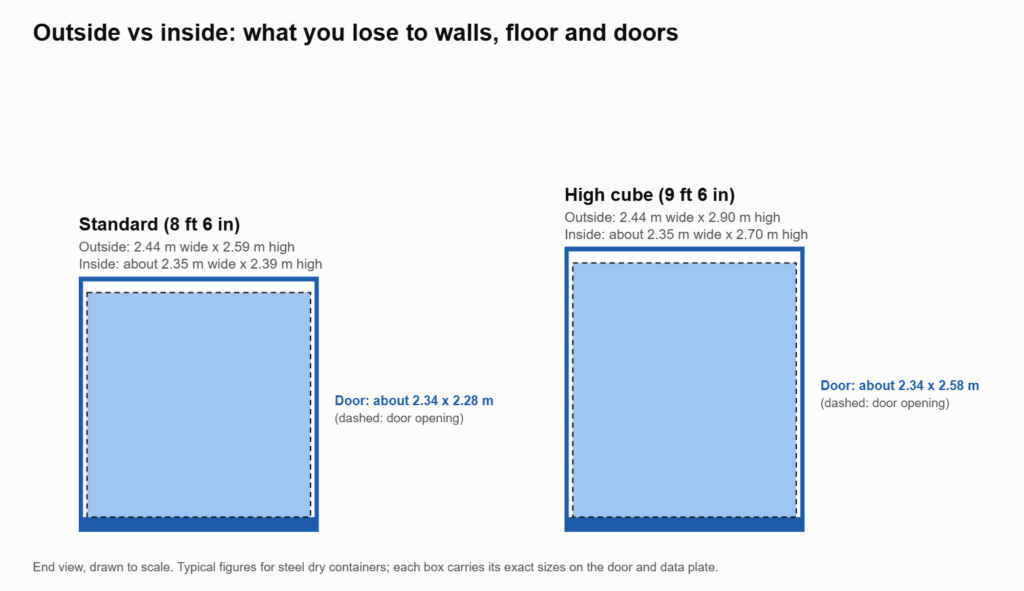
The door opening is the tightest point of all. On a standard box it is about 2.34 m wide and 2.28 m high, so an item that fits inside on paper may still not pass through the doors. Always measure the door opening when you plan to load something large such as a vehicle, a machine or tall racking.
20ft shipping container dimensions
The 20 footer is the most common size for storage and the easiest to place on a home or small business site. Here are the typical shipping container dimensions for a standard 20ft and a 20ft high cube.
| Specification | 20ft standard | 20ft high cube |
|---|---|---|
| Outside length | 20 ft / 6.06 m | 20 ft / 6.06 m |
| Outside width | 8 ft / 2.44 m | 8 ft / 2.44 m |
| Outside height | 8 ft 6 in / 2.59 m | 9 ft 6 in / 2.90 m |
| Inside length | about 5.90 m | about 5.90 m |
| Inside width | about 2.35 m | about 2.35 m |
| Inside height | about 2.39 m | about 2.70 m |
| Door opening (W x H) | about 2.34 x 2.28 m | about 2.34 x 2.58 m |
| Volume | about 33 m³ / 1,170 cu ft | about 37 m³ / 1,310 cu ft |
| Floor area (inside) | about 13.9 m² / 150 sq ft | about 13.9 m² / 150 sq ft |
| Typical tare (empty) weight | about 2,200 to 2,300 kg | about 2,300 to 2,500 kg |
| Typical max gross weight | 30,480 kg on many units | 30,480 kg on many units |
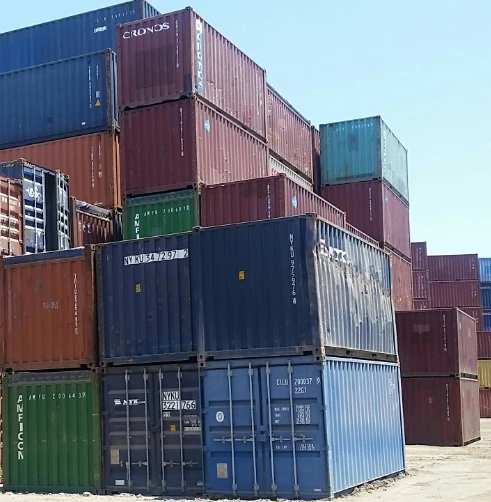
A standard 20ft container holds about the contents of a one or two bedroom home, or roughly 10 standard pallets on the floor. If you want one, our used 20ft shipping container is the budget pick, the one trip 20ft shipping container is close to new, and the new 20ft shipping container suits conversions. For the taller version, see the used 20ft high cube and one trip 20ft high cube.
Many 20 footers also have forklift pockets in the base, two slots along each long side that let a forklift lift an empty box. Forty footers usually do not, because they are too long to balance on forks.
40ft shipping container dimensions
A 40 footer gives twice the length of a 20ft with the same width and height. These are the typical shipping container dimensions for a standard 40ft and a 40ft high cube. It is the standard choice for bulk storage, large conversions and export cargo.
| Specification | 40ft standard | 40ft high cube |
|---|---|---|
| Outside length | 40 ft / 12.19 m | 40 ft / 12.19 m |
| Outside width | 8 ft / 2.44 m | 8 ft / 2.44 m |
| Outside height | 8 ft 6 in / 2.59 m | 9 ft 6 in / 2.90 m |
| Inside length | about 12.03 m | about 12.03 m |
| Inside width | about 2.35 m | about 2.35 m |
| Inside height | about 2.39 m | about 2.70 m |
| Door opening (W x H) | about 2.34 x 2.28 m | about 2.34 x 2.58 m |
| Volume | about 67 m³ / 2,390 cu ft | about 76 m³ / 2,700 cu ft |
| Floor area (inside) | about 28.3 m² / 305 sq ft | about 28.3 m² / 305 sq ft |
| Typical tare (empty) weight | about 3,700 to 3,800 kg | about 3,800 to 4,000 kg |
| Typical max gross weight | 30,480 kg, some newer units 32,500 kg | 30,480 kg, some newer units 32,500 kg |
Our 40 footers include the used 40ft shipping container, the 40ft one trip shipping container and the new 40ft shipping container. If you need the extra height, the used 40ft high cube, one trip 40ft high cube and new 40ft high cube share the same footprint with an extra foot of headroom. Our 20ft vs 40ft shipping container guide helps if you are still deciding between the two lengths.
High cube shipping container dimensions
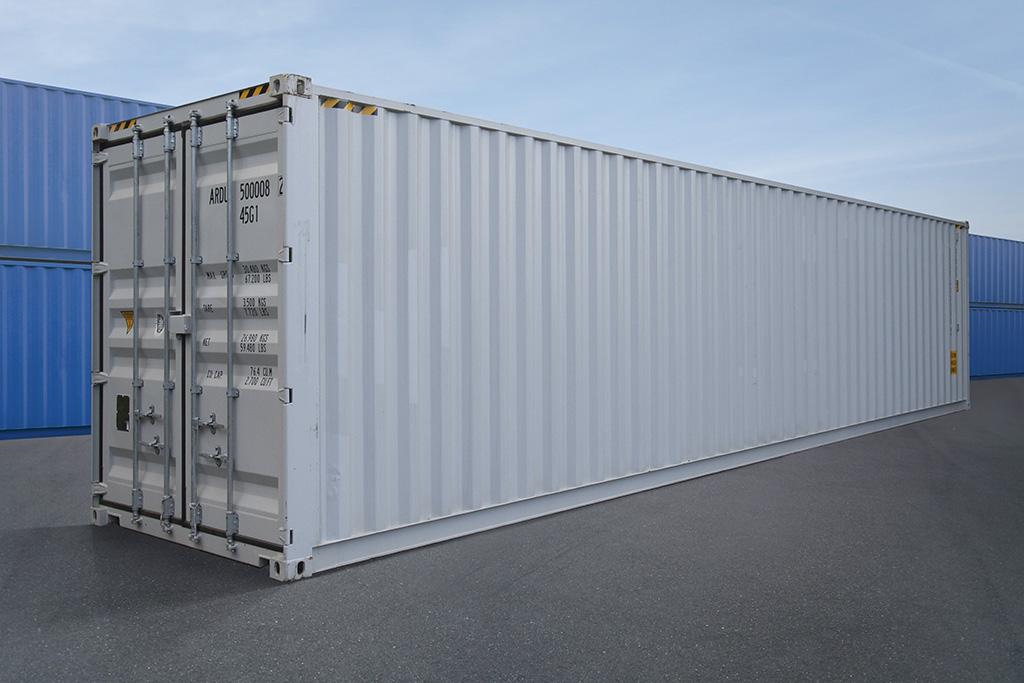
A high cube is exactly the same length and width as a standard box but stands 9 ft 6 in tall instead of 8 ft 6 in. Inside, that lifts the ceiling from about 2.39 m to about 2.70 m, and the door opening from about 2.28 m to about 2.58 m high. On a 40 footer the volume rises from roughly 67 to 76 cubic metres.
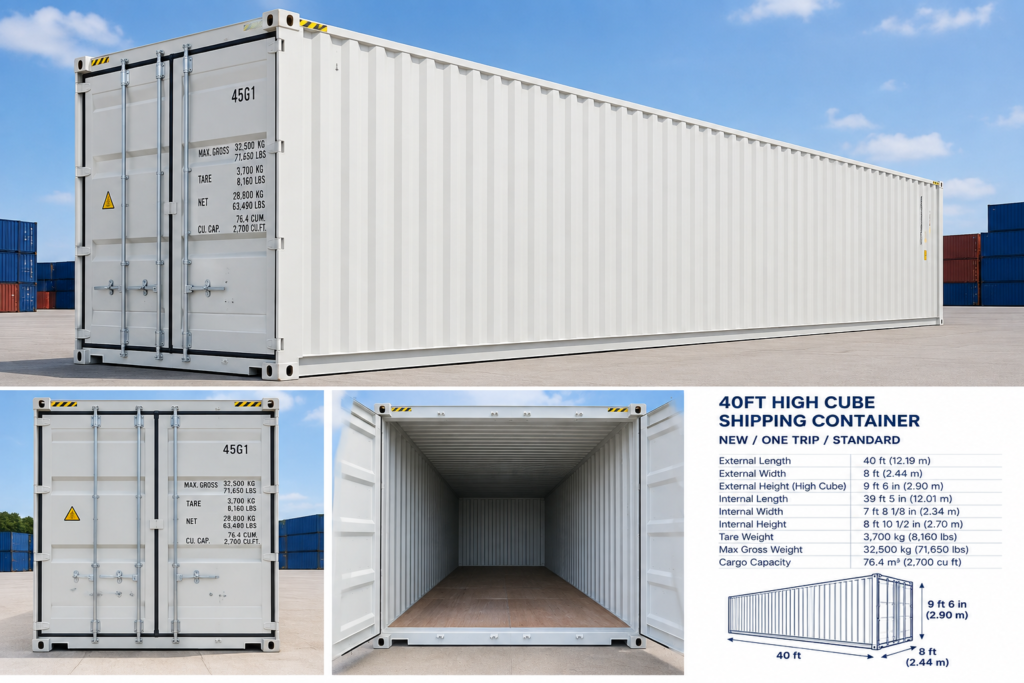
You can usually spot a high cube from a distance by the yellow and black hazard stripes along the top rail, and up close by its size code on the door. The door below belongs to a 40ft high cube. Its code, 45G1, tells you it is 40 feet long and 9 ft 6 in tall, and the panel lists its own weights: a maximum gross weight of 30,480 kg, a tare of 3,840 kg, a payload of 26,640 kg and a capacity of 76.4 cubic metres.
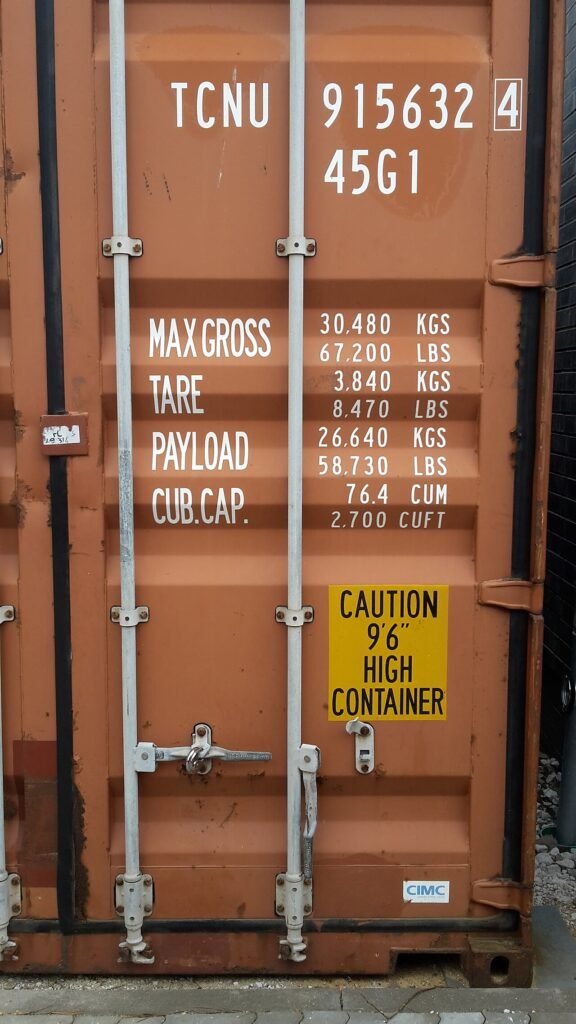
Those painted figures are the ones that count for your box. Two containers of the same size can differ by a few hundred kilograms in tare weight depending on the factory and the year they were built.
High cubes make sense for tall machinery, stacked pallets, racking and any conversion where people will work inside under an insulated ceiling. Our high cube vs standard container comparison goes into the trade-offs, and the 40ft high cube containers category lists every unit we have.
10ft, 45ft and 53ft container dimensions
10ft containers
A 10 footer has the same width and height as a standard 20ft, just half the length: about 2.99 x 2.44 x 2.59 m outside and about 2.83 x 2.35 x 2.39 m inside, giving around 16 cubic metres. They suit small yards, shop fronts and tight spaces. They are made in smaller numbers, so availability varies. See our 10ft shipping containers page, or our DUOCON containers, which join two 10 footers into one 20ft frame.
45ft high cube containers
A 45 footer is 13.72 m long, 2.44 m wide and 2.90 m tall, with about 86 cubic metres inside. Most have extra corner fittings at the 40 foot positions so they can sit on top of 40 foot stacks. They give the most space of any ocean container, but they need a longer truck and a longer clear run at your site. Our 45ft high cube containers page has the details.
53ft domestic containers
The 53 footer is a North American domestic size that moves mainly by road and rail rather than by sea. It is 16.15 m long, 2.59 m (8 ft 6 in) wide and 2.90 m tall, with close to 110 cubic metres of space. Because it is wider and longer than ocean boxes, it sits outside the ocean standards. See our 53ft high cube containers page if you need this size.
Shipping container dimensions for specialist types
Containers with extra doors, open roofs or refrigeration share the same outside sizes as standard boxes, but their internal space changes. Here is what to expect.
| Type | Outside sizes | How the inside changes |
|---|---|---|
| Double door (tunnel) | Same as standard 20ft or 40ft | Almost no change; the second door set sits in the end frame |
| Open side | Same as standard 20ft or 40ft high cube | Inside width can be slightly less near the side door posts |
| Open top | Same as standard 20ft or 40ft | Usable height set by the roof bows; tall loads go in from above |
| Refrigerated (reefer) | Same as standard 20ft or 40ft high cube | Insulation and the cooling unit cut length, width and height |
Reefer container dimensions
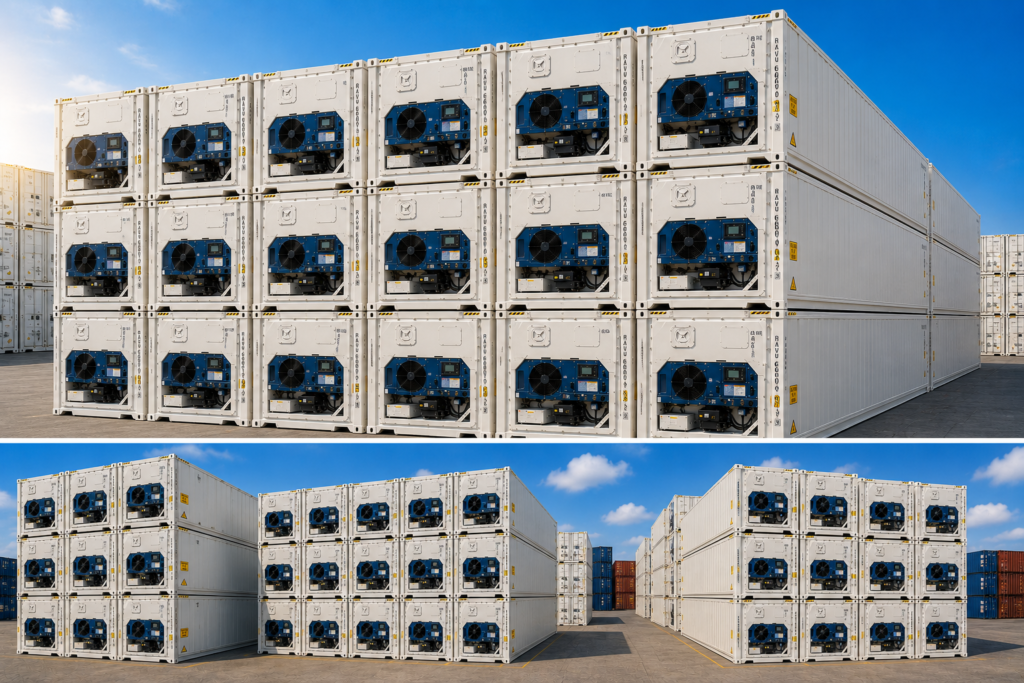
Of all the shipping container dimensions in this guide, reefers lose the most space because of their insulated walls and the refrigeration machine at one end. As a rough guide, a 20ft reefer gives about 5.44 x 2.29 x 2.27 m inside (about 28 cubic metres), while a 40ft high cube reefer gives about 11.58 x 2.29 x 2.55 m (about 67 cubic metres). Loads must also stay below the red load line painted inside, so air can circulate over the cargo.
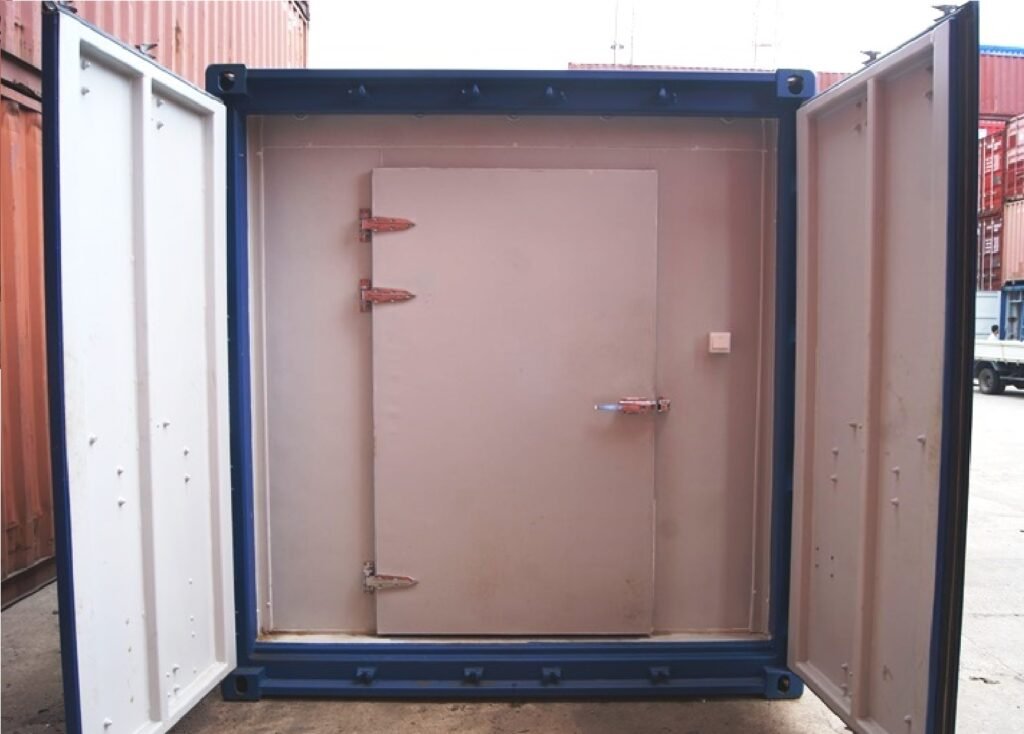
Our range includes the one trip 20ft reefer, the used 20ft reefer, the one trip 40ft high cube reefer and the used 40ft high cube reefer. Our guide to buying a reefer container explains power needs and what to check, and the refrigerated container overview covers how the cooling system works.
Open top and open side dimensions
Open tops keep the steel walls and floor of a standard box, but the roof is a tarpaulin over removable bows, which lets you load taller items by crane. Carriers publish detailed figures for their own equipment; the 40ft open top specification from Hapag-Lloyd is a good example of the figures carriers publish for this type of box. We sell the one trip 20ft open top, the used 20ft open top and a new 40ft open top.
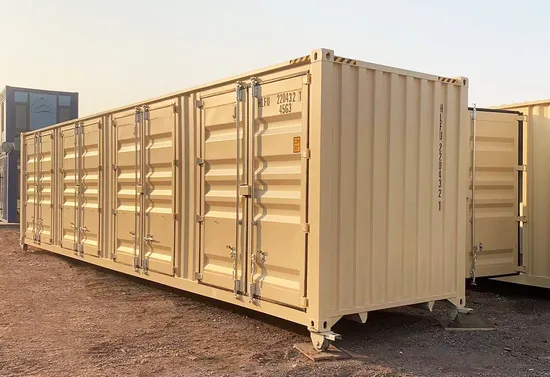
Open side containers replace one long wall with folding doors, so you get the full length of the box as an opening. Our one trip 20ft open side container and 40ft open side high cube are popular for pop-up shops and workshops.
How to read the size code on a container
Every ocean container carries a four-character size and type code next to its ID number. The first character gives the length, the second gives the height and width, and the last two give the type. The system is part of the ISO 6346 standard, which also covers the owner code and serial number registered through the BIC code system.
| Code | What it means |
|---|---|
| 22G1 | 20ft standard dry container, 8 ft 6 in high |
| 25G1 | 20ft high cube dry container, 9 ft 6 in high |
| 42G1 | 40ft standard dry container |
| 45G1 | 40ft high cube dry container |
| L5G1 | 45ft high cube dry container |
| 22R1 | 20ft refrigerated container |
| 45R1 | 40ft high cube refrigerated container |
| 22U1 / 42U1 | 20ft / 40ft open top container |
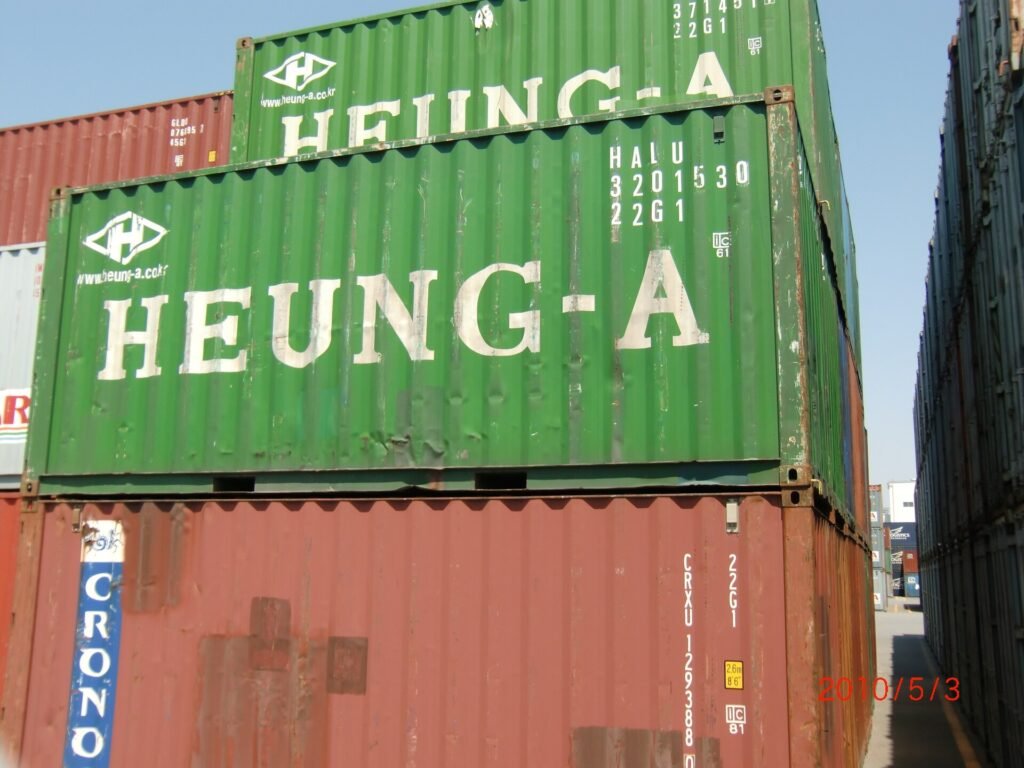
If a seller tells you a box is a high cube, the code should start with 25 or 45. It is a quick way to confirm shipping container dimensions before you pay, even from a photo.
Container weights: tare, payload and max gross
Size is only half of the story. If you plan to ship cargo or lift a loaded box, the weight figures on the door matter just as much as the shipping container dimensions.
- Tare weight: the weight of the empty container. Typically about 2,200 to 2,300 kg for a standard 20ft and about 3,700 to 3,900 kg for a 40ft.
- Payload (net weight): the most cargo the box can carry. It is the max gross weight minus the tare.
- Max gross weight: the container plus its cargo. Many 20ft and 40ft units are rated at 30,480 kg, and some newer boxes are rated higher.
A 20ft container often has a payload close to that of a 40ft, even though it holds half the volume. That is why heavy, dense cargo such as stone, metal or machinery usually ships in 20 footers, while light, bulky cargo goes in 40 footers or high cubes. Road weight limits in your country can be lower than the container’s own rating, so check local rules before you load a box to its maximum.
The safety approval plate on the door, required under the International Convention for Safe Containers, confirms the box’s approved maximum gross weight and stacking strength. If you plan to ship your own goods, make sure that plate is current.
How many pallets fit? Shipping container dimensions in practice
Pallet counts are one of the most practical ways to use shipping container dimensions. The inside width of about 2.35 m is the limiting factor, because it only fits two standard pallets side by side with a little room to spare.
| Container | Standard pallets (1200 x 1000 mm or 48 x 40 in) | Euro pallets (1200 x 800 mm) |
|---|---|---|
| 20ft standard or high cube | about 10, single stacked | about 11, single stacked |
| 40ft standard or high cube | about 20 to 21, single stacked | about 24 to 25, single stacked |
Exact numbers depend on how you turn the pallets and how much overhang the load has. A high cube does not add floor space, but its extra height can let you stack pallets two high where a standard box would not. The EUR-pallet page lists the common European pallet sizes if you work with mixed pallet types.
What fits inside common container sizes?
Shipping container dimensions on a page are hard to picture, so here is how the main sizes work out in real life.
- 10ft: garden equipment, bikes, a small workshop bench, seasonal stock for a shop.
- 20ft standard: the contents of a one or two bedroom home, one car with room for boxes, or about 10 pallets of goods.
- 20ft high cube: the same as a 20ft standard plus taller items such as racking, upright fridges or stacked furniture.
- 40ft standard: the contents of a three or four bedroom home, two small cars, or around 20 pallets.
- 40ft high cube: everything a 40ft holds plus headroom for tall machinery, mezzanine shelving or a finished office ceiling.

The door opening is the limit for anything bulky. A vehicle, a boat on a trailer or a piece of plant must clear about 2.34 m of width and 2.28 m of height on a standard box, or about 2.58 m of height on a high cube.
How much space you need on site
For site planning, the shipping container dimensions that matter are the outside length and width: 20 x 8 ft for a 20 footer and 40 x 8 ft for a 40 footer. Leave extra room around it so the doors can open fully and you can walk around the box. The doors swing outward, so plan for clear space in front of them about as wide as the container itself.
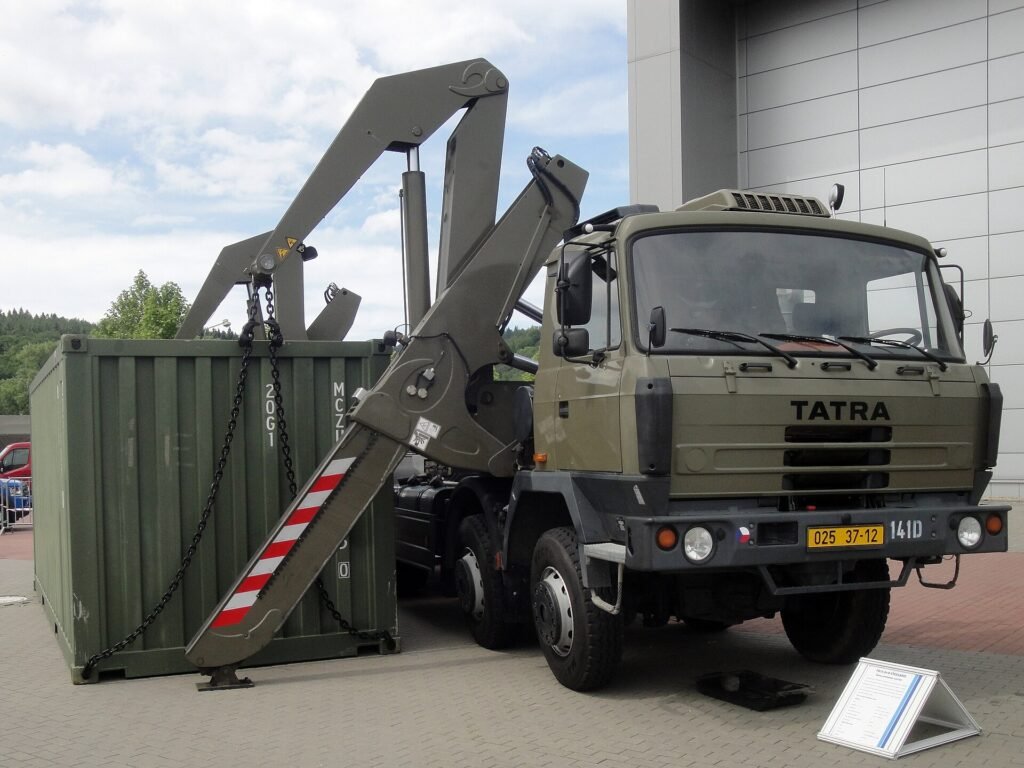
Delivery needs more room than the box. A tilt-bed truck needs a long, straight approach and overhead clearance well above the container’s own height while it tips the box off. Our shipping container delivery guide explains how to measure your site, what ground preparation works, and how side-lifter trucks help on tighter sites.
How to measure a container yourself
Listed shipping container dimensions are a reliable guide, but if you are fitting something tight, measure the actual box. It takes ten minutes with a tape measure and a helper.
- Read the door first. The size code, weights and capacity are painted on the right-hand door. That tells you the type before you start.
- Measure the door opening. Measure the clear width between the door frame posts and the clear height from the floor to the header. This is the smallest point you have to get cargo through.
- Measure the inside length along the floor from the doors to the front wall.
- Measure the inside width between the walls. Measure at the corrugation peaks, which stick in further than the valleys.
- Measure the inside height from the floor to the roof at the centre and near the doors, where roof cross members may sit lower.
- Note any intrusions such as lashing rings, vents or a reefer machine, which can catch on wide items.
Planning a conversion around container dimensions
If you are turning a container into an office, workshop, studio or small home, the inside shipping container dimensions shrink again once you add insulation, wall lining, flooring and services. As a rough example, 75 mm of insulation and lining on each side wall brings the inside width of a standard box from about 2.35 m down to about 2.20 m. Adding a ceiling and a raised floor can take 15 to 20 cm off the height.
That is why most conversion buyers choose a high cube. Starting from 2.70 m of inside height, you still have a comfortable room after the ceiling goes in, while a standard box can start to feel low. Our modified shipping containers range covers doors, windows, insulation, power and HVAC, and our custom container modifications page explains what we can fit before delivery. A new or one trip unit with straight walls makes the fit-out easier, so look at our new 40ft high cube or one trip 20ft high cube as starting points.
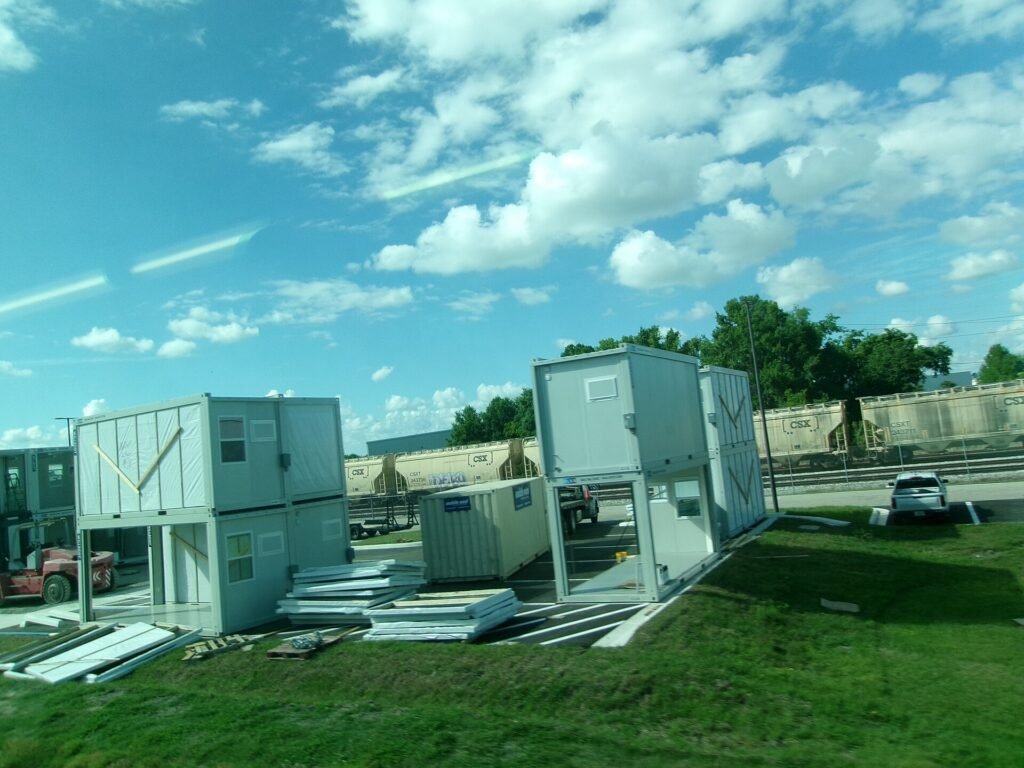
Check local building rules before you plan a room inside a container. Some areas set minimum ceiling heights for occupied spaces, which may rule out a standard height box once it is lined.
Will a car fit in a shipping container?
Usually, yes. Most family cars are well under 2 m wide, and the door opening on a standard container is about 2.34 m wide and 2.28 m high. A 20ft container takes one car with some space to spare for boxes, and a 40ft takes two small cars nose to tail. Large pickups, vans with roof racks and lifted 4x4s need checking against the door height, and a high cube gives more room overhead.
Leave enough space beside the car to open a door and get out, or plan to push the vehicle in. Lashing rings along the floor rails let you strap a vehicle down if the container will be moved.
How to choose the right size
Most people pick a size in one of three ways. Use whichever matches your situation.
- Start from your site. Measure the space you have, then subtract room for the doors and for walking around the box. If 40 feet will not fit, the decision is made.
- Start from your cargo. List the biggest items and check them against the door opening and inside height. Then estimate the volume of everything else and compare it with the volumes in the table above, leaving 10 to 20 percent spare for easy access.
- Start from your use. Storage sheds and site stores usually suit a 20ft. Bulk storage and export usually suit a 40ft. Offices, workshops and anything with people inside usually suit a high cube.
If the choice is close, the larger box is usually better value per cubic metre. Our shipping container prices guide shows how the cost per cubic metre works out for each size, and our types of shipping containers guide covers which door layout suits which job.
Do used containers have the same dimensions?
Yes. A used box keeps the shipping container dimensions it was built with. Years at sea do not change the frame size, so a used 40ft still fits the same chassis and stacking points as a new one. What can change is the usable space inside:
- Dents in the side walls can push inward a few centimetres in places. That rarely matters for storage but can catch wide pallets.
- Replaced or patched floors may sit a little higher or lower than the original boards.
- Bent door bars or hinges can stop the doors from opening fully, which reduces the clear opening.
When you buy used, look at photos of the walls, floor and doors and ask whether the box is wind and watertight or cargo worthy. Our used 40ft shipping container and used 20ft shipping container listings explain the grade we supply. If the exact inside space matters to you, a one trip unit such as the one trip 40ft high cube gives you straight walls and a clean floor.
Stacking and height clearance on site
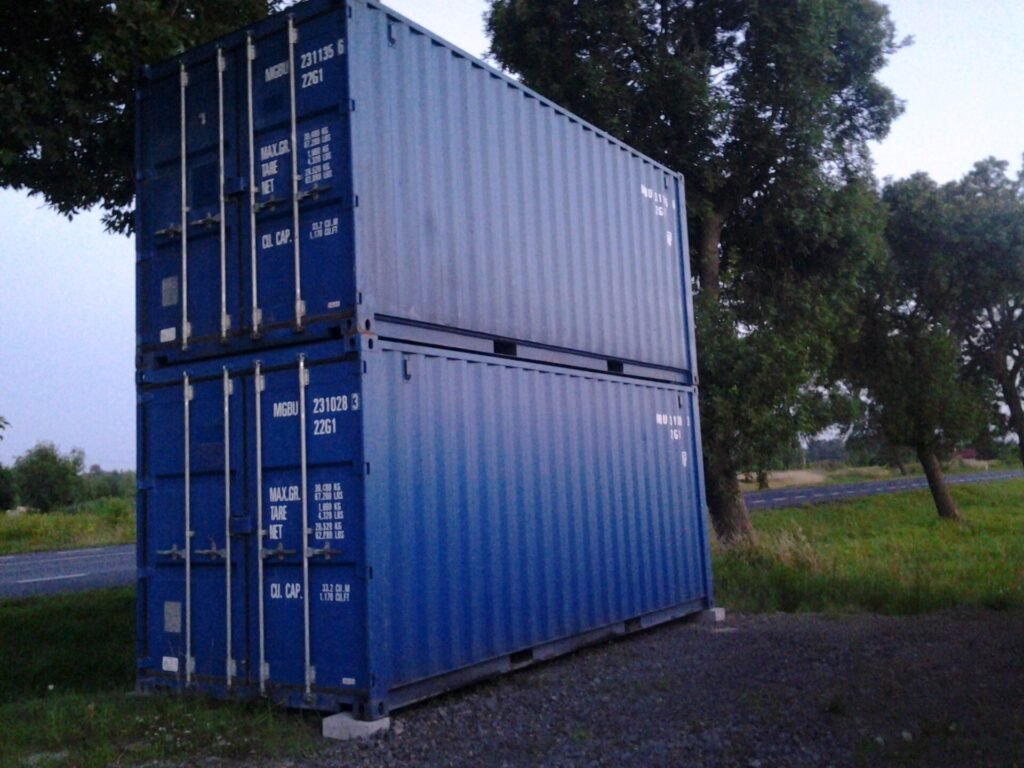
Containers are built to stack, and on a storage yard two boxes on top of each other doubles the space on the same footprint. Two standard boxes stand 5.18 m tall and two high cubes 5.79 m, so check for overhead cables, trees and planning limits before you stack. Stacking on site also needs the right lifting equipment and corner locks, so it is usually a job for the delivery crew or a crane hire company rather than a weekend project.
For a single box, remember that the delivery truck tips the container up as it slides it off, so the overhead clearance needed during delivery is far higher than the container’s own height. The delivery guide covers this step by step.
Mistakes people make with container sizes
- Using outside sizes to plan the load. Plan cargo with the inside shipping container dimensions and the door opening, not the outside sizes.
- Forgetting the doors. The doors need clear space to swing open. A box tucked against a fence or wall can become impossible to open.
- Assuming every 40ft is a high cube. Check the size code or the height on the listing. The one foot difference matters for racking and conversions.
- Ignoring weight. A box packed with dense cargo can exceed road limits long before it is full.
- Forgetting reefer space. Insulation takes a real bite out of the inside, so a 20ft reefer holds noticeably less than a 20ft dry box.
Buy a container in the size you need
Once you know the shipping container dimensions that suit your site and cargo, the rest is choosing the condition. Here is where each size sits in our range, with links to the live listings.
| Size | Used | One trip | New |
|---|---|---|---|
| 20ft standard | Used 20ft | One trip 20ft | New 20ft |
| 20ft high cube | Used 20ft HC | One trip 20ft HC | New 20ft HC |
| 40ft standard | Used 40ft | One trip 40ft | New 40ft |
| 40ft high cube | Used 40ft HC | One trip 40ft HC | New 40ft HC |
| 20ft double door | Used | One trip | New |
| 40ft double door | Used | One trip | New |
Not sure about condition? Used boxes are wind and watertight with cosmetic wear, one trip boxes have made a single voyage, and new boxes have never carried cargo. Our guide to one trip vs used shipping containers explains the grades, and our used shipping containers and new shipping containers pages list every unit by condition. You can also browse every size and type on our categories page.
Each product page lists the full specifications for that unit, so you can check the inside size, door opening and weights before you order. If you need a size we do not show, such as a 10ft, 45ft or 53ft, contact our team and we will tell you what we can source.
Frequently asked questions about shipping container dimensions
What are the dimensions of a 20ft shipping container?
Outside, a standard 20ft container is 20 ft long, 8 ft wide and 8 ft 6 in high (6.06 x 2.44 x 2.59 m). Inside it is about 5.90 x 2.35 x 2.39 m, with roughly 33 cubic metres of space.
What are the dimensions of a 40ft shipping container?
Outside, a standard 40ft container is 40 ft long, 8 ft wide and 8 ft 6 in high (12.19 x 2.44 x 2.59 m). Inside it is about 12.03 x 2.35 x 2.39 m, with roughly 67 cubic metres of space.
How tall is a high cube container?
A high cube is 9 ft 6 in (2.90 m) tall outside, one foot taller than a standard box. Inside it gives about 2.70 m of headroom.
How wide is a shipping container inside?
Most steel dry containers are about 2.35 m (7 ft 8 in) wide inside. Refrigerated containers are narrower, at about 2.29 m, because of their insulation.
How big is the door opening on a shipping container?
On a standard container the door opening is about 2.34 m wide and 2.28 m high. On a high cube it is about 2.34 m wide and 2.58 m high.
How many square feet is a shipping container?
A 20ft container covers 160 sq ft of ground outside and has about 150 sq ft of floor inside. A 40ft covers 320 sq ft outside and has about 305 sq ft of floor inside.
How much does an empty shipping container weigh?
A standard 20ft typically weighs about 2,200 to 2,300 kg empty, and a 40ft about 3,700 to 3,900 kg. The exact tare weight is painted on each container’s door.
Are all shipping containers the same width?
All standard ocean containers are 8 ft (2.44 m) wide outside. The main exception is the 53ft domestic container used in North America, which is 8 ft 6 in wide.
Is a 40ft container exactly twice as long as a 20ft?
Not quite. A 40ft is 12.19 m long and a 20ft is 6.06 m, so two 20 footers are about 7.6 cm shorter than one 40 footer. That small gap lets two 20ft boxes sit in a 40ft slot on a ship with room for the connecting fittings.
Do high cube containers cost more?
Usually a little. On a used 40ft the difference is often only a few hundred dollars, which is why many buyers choose the taller box. Our shipping container prices guide compares the figures.
Where can I find the exact dimensions of a specific container?
Check the door. Every ocean container shows its size code, maximum gross weight, tare and payload, and usually its cubic capacity, painted on the right-hand door. Our product pages also list the specifications for each unit we sell.
Choosing your container
Shipping container dimensions are simpler than they first look. The outside sizes are fixed: 8 ft wide, 8 ft 6 in or 9 ft 6 in tall, and 10, 20, 40 or 45 ft long for ocean boxes. Inside, plan around about 2.35 m of width, 2.39 m or 2.70 m of height, and a door opening a little smaller than that. Check the weights if you are shipping cargo, leave room for the doors and the delivery truck, and pick the size that fits both your site and your load.
When you are ready, browse our 20ft shipping containers, 40ft shipping containers and 40ft high cube containers, or ask us for a delivered quote.
Cover photo: Hubert.Knop (CC BY-SA 3.0)