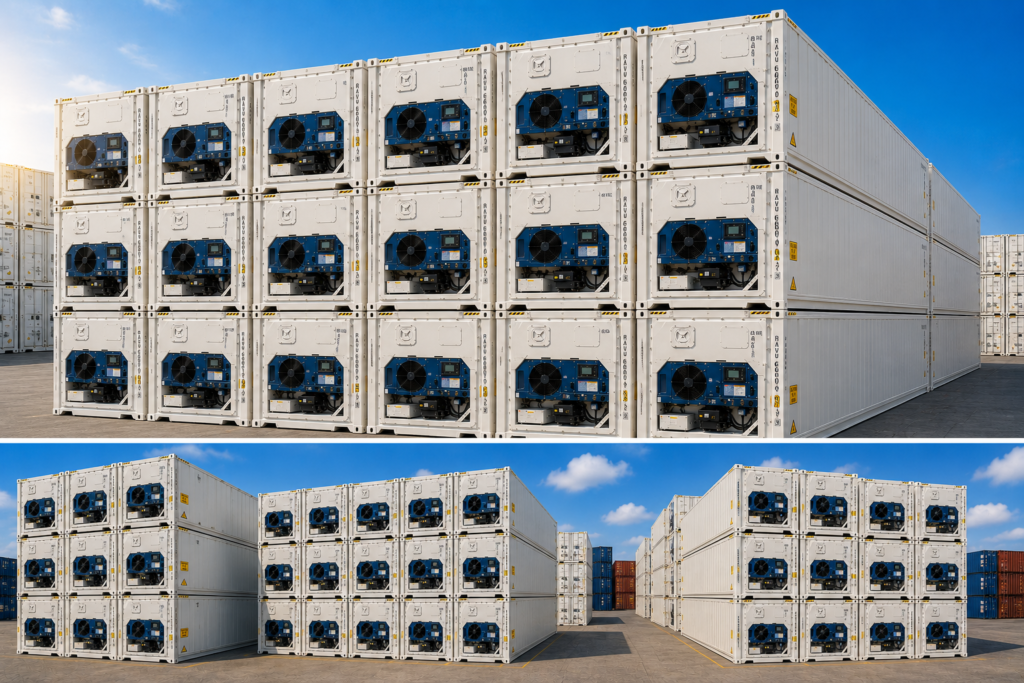
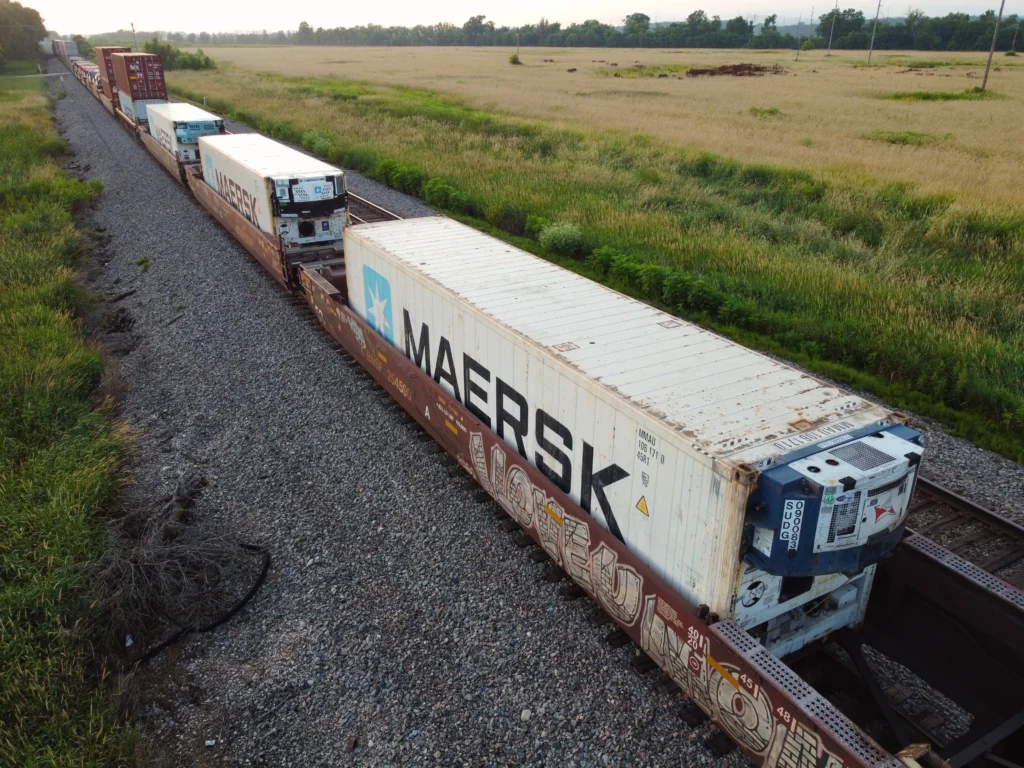
A cold storage container is a refrigerated shipping container, often called a reefer, bought outright and used on land as a walk-in chiller or freezer. Ours hold any set point from -30 °C to +30 °C. At Prime Cargo Box a used 20ft cold storage container costs $5,800, a one trip 20ft is $6,200 and a one trip 40ft high cube is $8,500, before delivery. It arrives as one sealed, insulated steel box with the refrigeration unit already built into the end wall. Set it level, plug it into the right power supply, set the temperature, and you have working cold storage the same day.
This guide is for restaurants, caterers, farms, butchers, fish traders, grocers, breweries, florists, event companies and food banks who need more cold space and do not want to build a cold room. It covers prices, sizes, power, running costs, set points, loading and the mistakes that cost people stock. Every price links to a unit we sell now, so you can go from reading to ordering without hunting around.
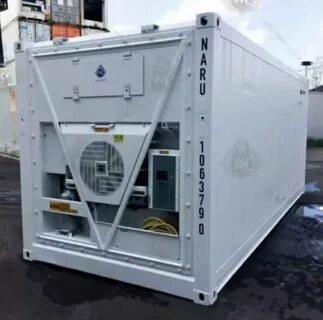
Table of Contents
Cold storage container: the short answers
- Temperature range: about -30 °C to +30 °C, so one box can be a chiller, a freezer or a cool store.
- Cheapest way in: a used 20ft reefer at $5,800, refrigeration unit fully working.
- Best value for most businesses: a one trip 20ft at $6,200. Near-new machinery for a small premium.
- More space: a one trip 40ft high cube at $8,500 gives well over twice the room of a 20ft.
- Power: three-phase, normally 380 to 460 volts. This is the first thing to check on your site.
- Foundation: none needed. Level, firm ground with solid support under each corner.
- Planning time: sort power, access and a level base before the truck comes. Everything else is quick.
Cold storage container prices
A cold storage container costs more than a dry box because you are buying a refrigeration machine as well as a steel shell. The price moves with three things: size, condition, and how old the refrigeration unit is. Here is our current range. Delivery is quoted separately once we know where the unit is going.
| Container | Condition | Price | Good fit for |
|---|---|---|---|
| 20ft reefer | Used, fully working | $5,800 | Small restaurant, butcher, market trader |
| 20ft reefer | One trip | $6,200 | Caterer, grocer, farm shop |
| 20ft refrigerated | New | $11,500 | Long-term site, newest machinery |
| 40ft high cube reefer | Used, fully working | $7,800 | Produce farm, wholesaler, food bank |
| 40ft high cube reefer | One trip | $8,500 | Distribution, large kitchens, events |
| 40ft refrigerated | New | $14,900 | High-value stock, maximum service life |
Prices change with stock, so the product page is always the final word. You can see the full line-up on our refrigerated containers for sale page or in the refrigerated shipping containers category. For a sense of how reefer prices compare with dry boxes, read our guide to shipping container prices.
One way to look at the cost: a 40ft one trip unit at $8,500 gives you around 67 cubic metres of cold space. A fixed cold room of that size means a building, a contractor, insulated panels, a separate refrigeration system and usually weeks of work. A cold storage container skips all of that and can move with you if you change sites.
What a cold storage container actually is
From the outside it looks like any shipping container. Inside, it is a different machine.
The insulated box
The walls, roof, floor and doors are filled with polyurethane foam between an outer steel skin and an inner lining, usually stainless steel or aluminium. The doors close on thick gaskets to keep warm air out. International rules for these boxes are set out in ISO 1496-2, the standard for the specification and testing of thermal containers, which is why a reefer from one maker fits and stacks like a reefer from another.
The refrigeration unit
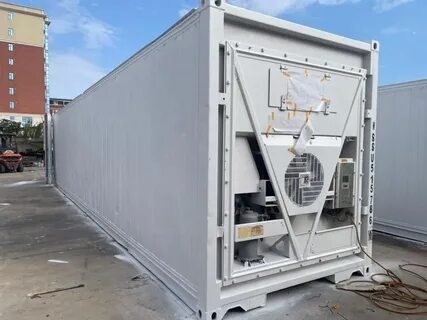
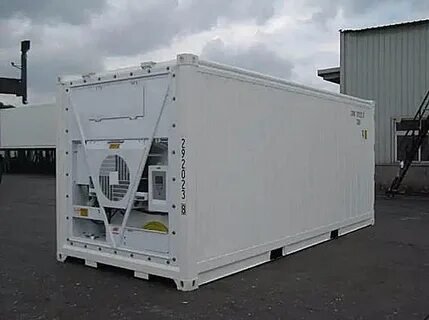
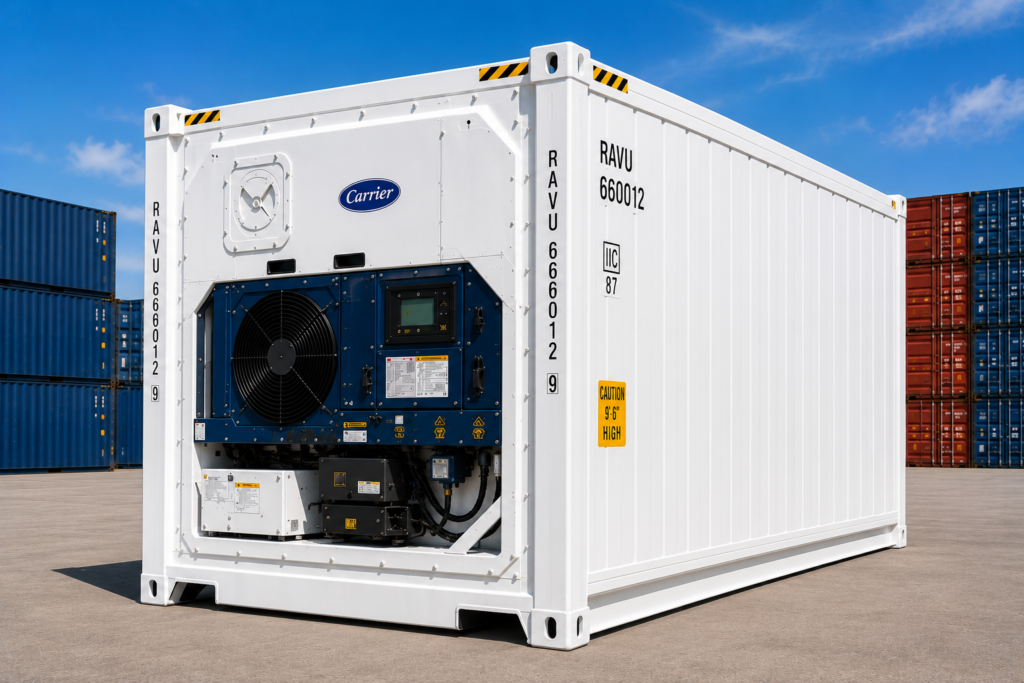
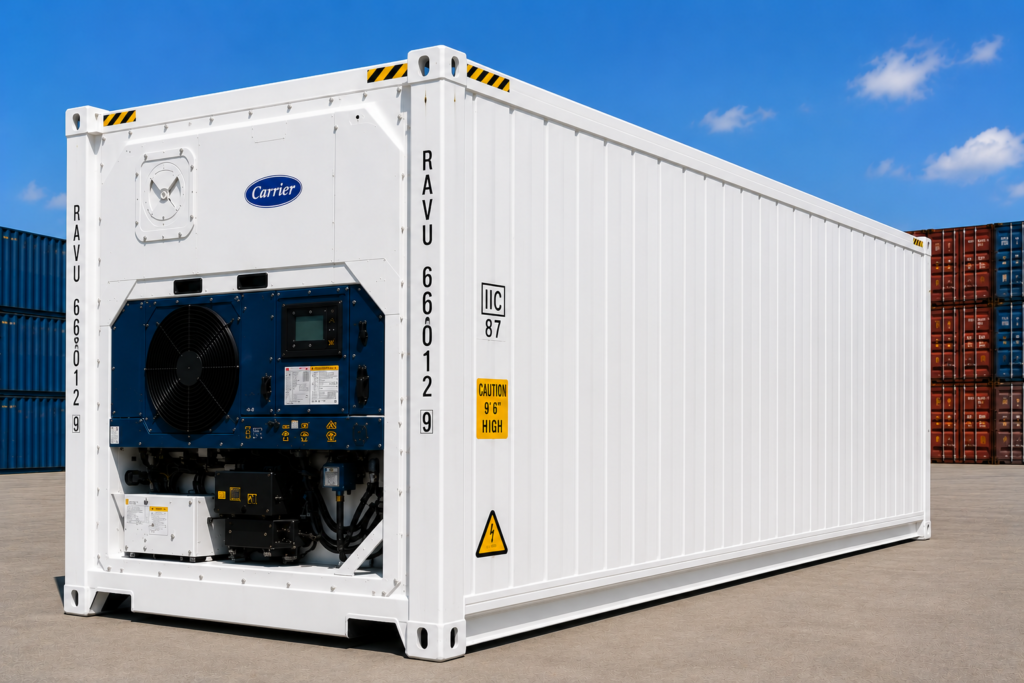
The machinery sits in one end wall: compressor, condenser, evaporator, fans and a digital controller. Units come from makers such as Carrier, Thermo King and Daikin. Carrier’s service manual for its PrimeLINE range describes these as self-contained, all-electric units with both cooling and heating, running on nominal 380/460 volt, three-phase, 50/60 Hz power (Carrier Transicold PrimeLINE manual, introduction). The heating part matters more than people expect. In a cold climate a cold storage container can keep stock above freezing as well as below a set limit.
The T-bar floor and airflow
The floor is aluminium with T-shaped rails. Cold air from the unit is pushed along under the cargo through the gaps in the floor, rises up through the load and returns to the unit across the top. That airflow is the whole trick. Block it and parts of the box run warm, even with the controller showing the right number.

Who buys a cold storage container
Almost any business that handles food, drink or plants ends up short of cold space at some point. These are the buyers we see most often.
Restaurants, hotels and caterers
Kitchens run out of walk-in space fast, especially during busy seasons. A 20ft cold storage container behind the building takes deliveries, bulk stock and prepared food, and frees up the kitchen fridges for service. Caterers use them as a base for big events and weddings.
Farms and produce growers
Getting heat out of fruit and vegetables soon after harvest helps them keep. A cold storage container on the farm lets growers hold produce for better prices, supply farm shops, and avoid rushing everything to market at once. Our farm storage containers guide covers dry storage alongside this.
Butchers, meat processors and fish traders
Chilled carcass meat and fresh fish need steady temperatures. A frozen-mode cold storage container works as a large freezer for bulk stock, bait or by-catch.
Grocers, wholesalers and food banks
Extra capacity for deliveries, promotions and holiday peaks. Food banks and charities use a cold storage container to accept donated fresh and frozen food they would otherwise have to turn away.
Breweries, distilleries and drinks firms
Beer, cider and soft drinks keep better cool. A 40ft holds a lot of kegs and pallets, and a chilled box at a festival site means cold stock all weekend.
Florists and nurseries
Cut flowers and plant material last longer chilled. Growers use a cold storage container to hold stock before markets and big flower holidays.
Events, festivals and disaster response
A cold storage container can be dropped in a field and run on a generator. That makes it useful for festivals, film sets, construction camps and relief work.
Pharmaceutical and lab storage
Some buyers use reefers for medicines and samples. If you do, treat the container as a starting point. You will need your own validation, temperature mapping and monitoring to meet the rules that apply to your products. We can supply the box; the compliance plan has to be yours.
Why buy a cold storage container instead of building or renting
Food lost to poor storage is a real cost, not a theory. The Food and Agriculture Organization of the United Nations estimates that around 14 percent of the world’s food is lost after harvest and before it reaches retail, including during storage and transport (FAO, The State of Food and Agriculture 2019). The same report points to poor storage, technical breakdowns and bad temperature management as causes. For a business, every spoiled pallet is money in the bin. Reliable cold space pays for itself by stopping that.
Versus building a cold room
- Speed: a cold storage container arrives ready. A built cold room needs design, building work and commissioning.
- No building needed: it sits outside on a yard, car park or field.
- Moveable: lease ends or you change sites, the box goes with you.
- Resale value: reefers hold value. A fixed cold room is worth little if you leave.
- Where a cold room wins: very large capacity, multiple temperature zones in one building, or a design that has to sit inside an existing warehouse.
Versus renting
Renting makes sense for a few weeks or one event. If you need cold space for more than a season or two, monthly rent soon adds up to the price of a used unit, and at the end you own nothing. Buying a cold storage container also means you control the condition, the set point and the maintenance.
Versus a dry container with an air conditioner
People do try this. A normal steel container has no insulation, so it gains heat fast in the sun and a domestic air conditioner struggles to hold low temperatures, let alone freezing. It can work for a cool store for things like wine or chocolate in a mild climate. For food safety temperatures, a purpose-built reefer is the right tool. If you only need dry storage, our storage containers for sale are far cheaper.
Cold storage container vs other cold storage options
Here is a plain comparison of the main ways businesses add cold space. It is based on how each option is built and used, not on any particular brand.
| Option | Set-up time | Typical capacity | Moveable | Best for |
|---|---|---|---|---|
| Cold storage container (bought) | Same day once power is ready | About 28 m³ (20ft) or 67 to 71 m³ (40ft) | Yes, by truck | Extra cold space for months or years |
| Rented reefer | Same day | Same as above | Yes | One event or a short peak |
| Built cold room | Weeks to months | Any size | No | Permanent, very large or multi-zone storage |
| Commercial upright fridges and chest freezers | Same day | Small per unit | Yes, by hand | Small top-ups inside a building |
The point most people miss is the cost per cubic metre. A row of commercial fridges looks cheap until you add up how many you would need to match one 20ft cold storage container, and how much floor and wall space they take inside your building. Once you need more than a few cubic metres of extra cold space, a cold storage container is usually the simpler and cheaper route.
Chiller or freezer: setting a cold storage container
One of the best things about a cold storage container is that you choose the job. The same box can be a chiller in summer and a freezer in winter, or a cool store for produce that dislikes cold.
For food, the basic targets used by food safety agencies are a fridge at 40 °F (4 °C) or below and a freezer at 0 °F (-18 °C) or below (FoodSafety.gov cold food storage charts). Your local food rules may set their own limits, so check those too.
| Use | Typical set point | Notes |
|---|---|---|
| Chilled food (meat, dairy, prepared food) | 4 °C or below | Run a degree or two under your limit to allow for door openings |
| Frozen food | -18 °C or below | Ice cream and some seafood are often stored colder; follow your supplier’s spec |
| Fresh fruit and vegetables | Varies by crop | Some produce is damaged by cold; check the right temperature for each crop |
| Drinks, beer, wine | Cool, above freezing | Set to the producer’s recommendation |
| Flowers and plants | Cool, above freezing | Varies widely by variety |
Mixed loads need care. Produce that gives off ethylene can speed up ripening in other fruit and flowers stored with it, and strong smells move into dairy. If you need two very different temperatures, two smaller boxes usually beat one big one.
20ft or 40ft cold storage container?
Reefer walls are thicker than dry container walls because of the insulation, so a cold storage container has less space inside than a dry box of the same size. Here are the working numbers for our stock.
| Container | Outside (L x W x H) | Inside (L x W x H, approx.) | Volume (approx.) | Floor pallets* |
|---|---|---|---|---|
| 20ft reefer | 6.06 x 2.44 x 2.59 m | 5.46 x 2.29 x 2.26 m | 28 m³ | about 8 |
| 40ft high cube reefer | 12.19 x 2.44 x 2.90 m | 11.56 x 2.29 x 2.55 m | 67 to 71 m³ | about 18 |
*Our own calculation from the inside floor size, using 1.2 m x 1.0 m pallets placed two abreast. Different pallet sizes and loading patterns will change it.
When a 20ft cold storage container is enough
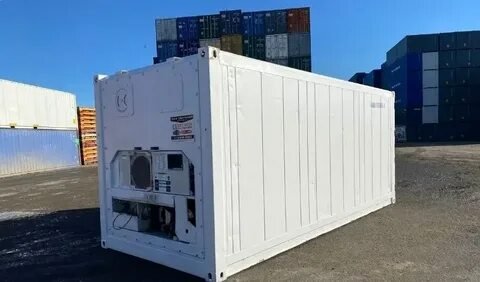
Restaurants, cafes, butchers, small caterers and farm shops usually start here. It fits in a single parking bay or tight yard, needs less power, and is easier to deliver. If your current walk-in is full and you need to roughly double it, a 20ft is often the answer.
When to go 40ft
Produce farms, wholesalers, food banks, breweries and anyone moving pallets in bulk. The extra height of the high cube helps with stacked pallets, and you get well over twice the volume for not much more money. You need around 12 metres of level ground plus room for the delivery truck. Our 20ft vs 40ft comparison and our page on shipping container dimensions go further.
How we would size a cold storage container for common businesses
These are example scenarios to show how we think about sizing, not stories about real customers. Use them as a starting point and then tell us your actual volumes.
A busy restaurant short of walk-in space
The kitchen walk-in is full by Thursday and deliveries come twice a week. The owner wants to buy in bulk and hold more prepared food. A 20ft cold storage container set as a chiller at 2 to 3 °C, placed by the back door, takes the overflow and the bulk orders. If the restaurant also stores a lot of frozen stock, a second 20ft set as a freezer is cleaner than trying to split one box.
A fruit and vegetable grower
The farm harvests more than it can sell in a day and loses produce in hot weather. A 40ft high cube cold storage container holds around 18 pallets on the floor, enough to hold a harvest for a few days and sell when prices suit. Different crops like different temperatures, so the grower sets the box for the main crop and keeps cold-sensitive produce elsewhere.
A food bank or community kitchen
Donors offer chilled and frozen food the charity cannot accept for lack of space. A used 40ft cold storage container at $7,800 adds a lot of capacity on a tight budget. Set as a freezer, it can take bulk frozen donations; set as a chiller, it takes fresh produce and dairy.
An event or festival company
Bars and food stalls need cold stock for a long weekend in a field with no mains power. A 20ft or 40ft cold storage container running on a generator, pre-cooled the day before, keeps drinks and food cold for the whole event and goes back to the yard afterwards.
A butcher or fish trader
Chilled hanging space plus a big freezer for bulk buys. Two 20ft units, one chilled and one frozen, give clean separation and mean a fault in one box does not take out all the stock.
New, one trip or used cold storage container?
With a dry box, condition is mostly about looks. With a cold storage container it is about the machinery and the insulation, so it matters more.
- Used: has worked in shipping for years. The box has dents and wear, but the refrigeration unit is fully working when sold. Best value if you are on a budget and can arrange a local refrigeration technician for servicing.
- One trip: built new and used for one voyage. The machinery is near new, the insulation has had little wear, and the gaskets are soft. This is the sweet spot for most businesses.
- New: never carried cargo. Newest refrigeration unit, best insulation, longest working life. Choose this when stock values are high or you want the least maintenance worry.
We explain the wider trade-offs in one trip vs used shipping container. If you want the detailed checklist of what to inspect on a reefer before paying, read our guide to buying a reefer container.
Power: what your site needs to run a cold storage container
This is where most problems come from, so get it sorted early.
Three-phase power
Marine reefer units are built to run on three-phase power, normally 380 to 460 volts. Many commercial and farm sites already have it. Most homes and small shops do not. Carrier notes that some of its units can take an optional autotransformer to run on 190/230 volt three-phase supplies, which helps in certain countries, but single-phase household power is not enough on its own.
The plug and cable
The unit comes with a heavy power cable and an industrial plug. Your electrician fits a matching socket on a dedicated supply with the right protection. Tell us your voltage and frequency before you order and we will confirm the unit matches. Always use a qualified electrician for this. It is not a DIY job.
No three-phase? Use a generator
Shipping lines run reefers on trucks and trains with diesel generator sets, and you can do the same on land. A generator suits events, remote farms and building sites. It costs more to run than grid power, so it is best for short-term or off-grid use.
Solar and hybrid set-ups
Some off-grid buyers pair a cold storage container with solar panels, batteries and an inverter that produces three-phase power. It can work, but the system has to be sized properly for the unit’s start-up and running load. Get a specialist to design it.
Running costs of a cold storage container
We will not give you a single kilowatt-hour figure, because honest numbers depend on too many things. A cold storage container in a shaded yard in a mild climate, opened twice a day, uses far less than the same box in full sun at 40 °C with the door open every ten minutes. Here is what drives the bill and how to work out your own figure.
What pushes power use up
- Lower set point: a freezer at -18 °C works harder than a chiller at 4 °C.
- Hot weather and direct sun: the box gains heat through the walls and roof.
- Door openings: every opening lets warm, damp air in.
- Warm product: loading food that has not been cooled first.
- Dirty condenser or worn seals: the unit runs longer to do the same job.
- Older machinery: newer units are generally more efficient.
How to estimate your own cost
The sum is simple: average power draw in kW, multiplied by hours, multiplied by your electricity price. As an illustration only, with made-up numbers: if a unit averaged 3 kW over a day, that is 72 kWh. At a tariff of $0.20 per kWh, that would be $14.40 a day. Your real draw could be higher or lower. The best way to know is to fit a kWh meter on the supply and read it after the first week of normal use.
Simple ways to cut the bill
- Put the cold storage container in shade, or build a simple roof over it with an air gap.
- Fit strip curtains inside the doors so less cold air falls out each time you open up.
- Plan stock trips so the doors open less often.
- Keep the condenser coil clean and the area around the unit clear.
- Set the temperature no lower than you need.
- Pre-cool product before it goes in.
Setting up a cold storage container on site
Ground and base
Like any container, a cold storage container carries its weight on the four corners. Concrete pads, sleepers on compacted stone, or an existing concrete yard all work. It must be level, both for the doors and so the defrost water drains properly. A reefer is heavier than a dry box because of the machinery and insulation, so do not skimp on the corners.
Leave room for the unit to breathe
The refrigeration unit pulls in air and blows hot air out from the condenser. Keep the machinery end clear of walls, hedges and stacked pallets so it can dump that heat. A unit that keeps breathing its own hot air will struggle in summer.
Access and delivery
Plan a straight path for the delivery truck and space to set the box down with the doors where you want them. Think about where forklifts or pallet trucks will work. Our guide to shipping container delivery covers truck types and clearances, and our shipping and delivery policy explains how we arrange delivery around the world.
Ramp and loading
The floor sits above ground level. A steel loading ramp lets pallet trucks roll in and out. Some buyers set the box next to a raised dock for level loading.
Pre-cool before you load
Run the empty cold storage container down to its set point before stock goes in. A reefer is designed to hold a temperature, not to chill a box full of warm food quickly. Cool product first, then load it into a cold box.
Loading a cold storage container so it actually stays cold
Most temperature problems in a working reefer come from how it is loaded, not from the machine.
- Keep the floor clear. Never lay flat sheets, cardboard or plastic over the T-bar floor. Air needs to move up through it.
- Do not load above the line. Reefers have a red load line near the top of the walls. Stay below it so air can return to the unit.
- Leave a gap at the doors and at the unit end. Do not jam stock against the evaporator panel.
- Stack on pallets. It keeps product off the floor and lets air move.
- Use vented packaging for produce. Sealed boxes trap heat.
- Keep raw and ready-to-eat food apart and follow your local hygiene rules.
- First in, first out. Label pallets with dates and rotate stock.
Monitoring and alarms
If your cold storage container holds stock worth more than the box, monitoring is not optional. The FAO report mentioned above names technical breakdowns and poor temperature management as reasons food is lost even where storage exists. You want to know about a fault before it costs you a full load.
- Controller log: reefer controllers record temperatures. A technician can download the data.
- Independent data logger: a cheap logger inside the box gives you your own record for food safety checks.
- Remote alarm: wireless sensors that send a text or app alert if the temperature drifts or the power drops.
- Daily checks: a quick look at the display and a note in a log book, the old-fashioned way. It still works.
Looking after a cold storage container
A reefer needs more care than a dry box, but not much more than any commercial fridge.
- Clean the condenser coil every few months, more often on dusty farms.
- Check door gaskets for tears and keep them clean. Warm air leaks are expensive.
- Keep defrost drains clear so water does not build up inside.
- Clean the inside with food-safe products. The stainless or aluminium lining wipes down easily.
- Annual service by a refrigeration technician who knows container units. Carrier, Thermo King and Daikin all have service networks in many countries.
- Look at the outside once a year. Touch up scratches and clear the roof.
Plan for the unit, not just the box. A well-kept refrigeration unit can run for many years, and parts for the major brands are widely available because shipping lines rely on them.
Permits, inspections and neighbours
Rules differ from country to country and even town to town, so check these with your local authority before the unit arrives.
- Planning or zoning: some areas treat a cold storage container as a temporary structure, others as a building. Commercial and farm land is usually simpler than residential land.
- Food business rules: if you sell or serve food, your food inspector may want to know about new storage. Keep temperature records from day one so you have them ready.
- Electrical sign-off: a new three-phase socket normally needs to be installed and certified by a licensed electrician.
- Noise: the condenser fan and compressor make noise, much like a commercial air conditioner. If the box sits near houses, point the machinery end away from them and avoid the boundary right next to a bedroom window.
- Fire and access: keep exits and fire routes clear, and do not block access for emergency vehicles.
A five-minute call to the local office before you order a cold storage container can save a lot of trouble later.
Security for a cold storage container
Stock in a cold store is valuable and easy to sell. Treat the doors like any other container: a lock box over the hasp, a hardened padlock, and lighting or a camera on the doors. Our secure storage containers guide explains which locks are worth paying for. On building sites and events, our construction storage container article has more site security tips.
Questions to ask before you buy any cold storage container
Whether you buy from us or someone else, get clear answers to these before you pay.
- Is the refrigeration unit fully working, and has it been tested? Ask what temperature it pulled down to before sale.
- What make and model is the unit, and what year? This tells you about parts and service support near you.
- What voltage, phase and frequency does it run on? Match it to your site supply.
- What condition are the door gaskets and the inner lining? Torn gaskets and damaged lining cost you power.
- Is the insulation sound? Ask about dents, repairs and any damp patches in the walls.
- Does it come with the power cable and plug? Some used units arrive without them.
- What is included in the price, and what is delivery? Get the full figure in writing.
A seller who cannot answer these is a seller to walk away from. Every cold storage container we sell is listed with its condition and a working refrigeration unit, and we are happy to answer all of the above before you order.
Common mistakes when buying a cold storage container
- Not checking power first. The unit arrives and the site only has single-phase supply. Check before you order.
- Buying too small. Cold space fills quickly. If you are between sizes, the bigger box is usually the better buy.
- Parking it in full sun with no shade. Higher bills and harder work for the unit.
- Blocking the condenser. Putting the machine end against a wall.
- Covering the T-bar floor. Warm spots and spoiled stock.
- Loading warm product. A reefer holds cold. It is not a blast chiller.
- No alarm. A power cut on Friday night, found on Monday morning.
- Skipping servicing. A dirty coil and worn seals shorten the unit’s life.
- Using a dry container with an air conditioner for food. It will not hold safe temperatures reliably.
How to order a cold storage container from Prime Cargo Box
Buying a cold storage container from us is straightforward, and we deliver worldwide.
- Pick size and condition. Browse the refrigerated containers range or all our containers.
- Tell us your power supply. Voltage, phase and frequency, or that you plan to use a generator.
- Send site details. Address, photos of the spot and the access route, and any limits like narrow gates or low wires.
- Ask for extras. Lock box, strip curtains, a ramp or other custom container modifications.
- Get your delivery quote. We confirm the truck type and total price.
- Pay and book. Our billing and payment policy lists the options.
- Prepare the base and power. Level corners and a socket fitted by your electrician before the truck arrives.
- Take delivery and pre-cool. Plug in, set the temperature, let it pull down, then load.
Questions before you order? Contact us with what you want to store and how much, and we will tell you straight which unit fits. If you also need dry storage on the same site, our types of shipping containers guide and how to buy a shipping container cover the rest of our range.
Cold storage container FAQs
How much does a cold storage container cost?
At Prime Cargo Box, a used 20ft cold storage container is $5,800, a one trip 20ft is $6,200, a used 40ft high cube is $7,800 and a one trip 40ft high cube is $8,500. New units start at $11,500. Delivery is quoted separately.
How cold can a cold storage container get?
Our units hold set points from about -30 °C to +30 °C, so they can work as a freezer, a chiller or a cool store.
What power does a cold storage container need?
Three-phase power, normally 380 to 460 volts. Some units can be fitted to run on 190 to 230 volt three-phase. Where there is no suitable supply, a generator set can run it.
Can I run a cold storage container on normal household power?
Not directly. Standard single-phase household supply is not enough for a marine reefer unit. Talk to an electrician about a three-phase supply or plan to use a generator.
How much does it cost to run?
It depends on set point, climate, sun, door openings and the age of the unit. Multiply the average kW draw by hours and your electricity price. A kWh meter on the supply gives you a real figure after a week.
Do I need a foundation?
No. Level, firm ground with solid support under each corner is enough. Keep it level so the doors seal and defrost water drains.
Is a cold storage container safe for food?
Yes, when set and run correctly. Keep chilled food at 4 °C or below and frozen food at -18 °C or below, monitor temperatures, and follow your local food safety rules.
Can it be a chiller and a freezer?
Yes, but not at the same time. You set one temperature for the whole box. For two zones, use two units.
How long does a cold storage container last?
The steel box lasts for decades. The refrigeration unit lasts many years with regular cleaning and annual servicing. New and one trip units give you the longest life.
Do you deliver a cold storage container to my country?
Yes. We sell and deliver worldwide. Send us your address, power details and site photos for a delivery quote.
About Prime Cargo Box
Prime Cargo Box sells new, one trip and used shipping containers, including refrigerated units, to businesses, farms and organisations around the world. Each product page has photos, a condition grade and a clear price, and we help you match the unit to your stock, your power supply and your site. Read more about us.
Final word
A cold storage container gives you a walk-in chiller or freezer that arrives ready to run, holds anything from -30 °C to +30 °C, and moves with your business. Check your power first, pick the size by how much you need to store, and choose one trip if you want near-new machinery without paying new prices. Put it in shade, keep the floor and condenser clear, pre-cool before loading and fit an alarm. For most kitchens and shops, a one trip 20ft at $6,200 is the right starting point, while farms and wholesalers usually get more for their money from a one trip 40ft high cube at $8,500. See all our refrigerated containers or ask for a delivery quote today.