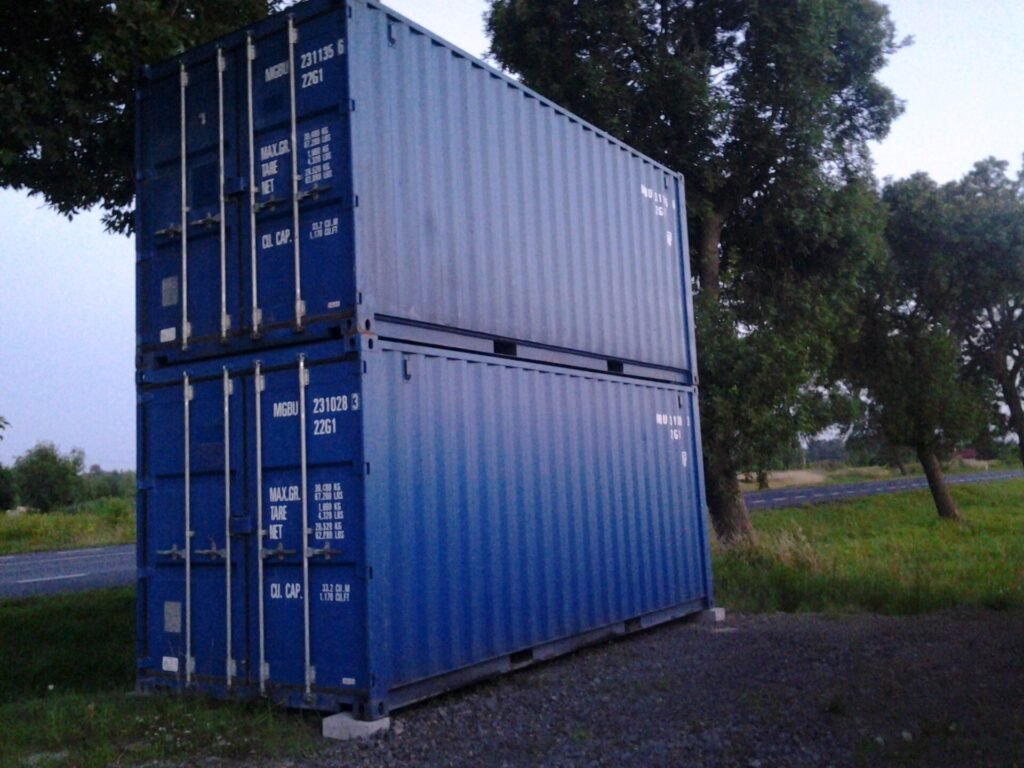
Farm storage containers are steel shipping containers bought outright and set down on a farm to keep feed, machinery, tools and produce dry, locked and away from rodents. At Prime Cargo Box a one trip 20ft container starts at $1,550, a one trip 40ft high cube is $2,900, and a brand new 40ft high cube is $3,800. You place it on level ground, open the doors and start using it the same day, with no foundations, no planning a barn and no builder to wait on.
This guide is written for farmers, smallholders, ranch managers, orchard and vineyard owners, and anyone who runs land and needs secure storage that lasts. It covers which sizes fit which jobs, why a near-new box is usually the better buy for farm use, how to stop condensation ruining feed, how to place a container on soft ground, and what a typical order costs from start to finish. Every price in it comes from our live product pages, and every photo of a container below shows the kind of near-new stock we actually ship.
Farm storage containers in one minute
If you only read one section, read this one. These are the answers farmers ask us for most often.
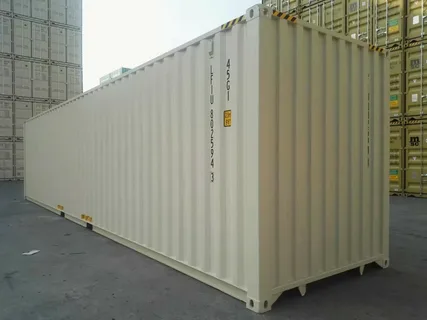
- Best all-round size: a 40ft high cube. It gives about 76 cubic metres of space and the extra 30 cm of height lets a compact tractor with a cab, a stacked pallet of feed or a tall mower deck fit through the doors.
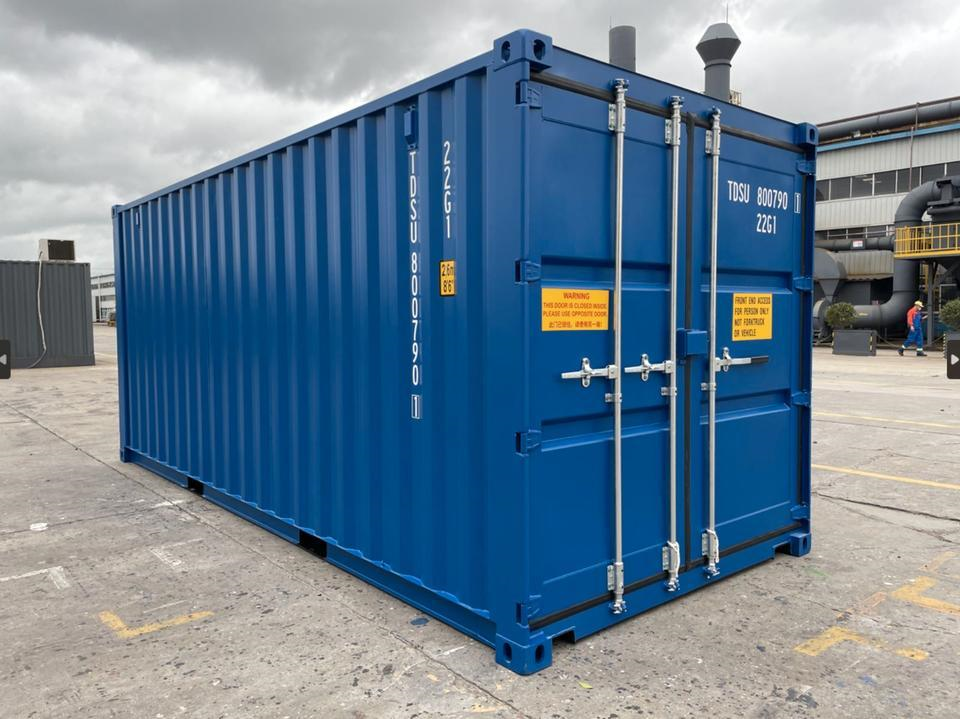
- Best for a small farm or yard: a 20ft container. It holds 8 to 10 pallets, fits beside a shed and can be moved later with a tilt-bed truck.
- Best condition for farm use: one trip. The box has made a single voyage, so the paint, seals and floor are close to new, but it costs far less than factory new.
- Best for machinery: a double door container or an open side container, so you can drive in at one end and out at the other, or load along the full length.
- Best for produce: a refrigerated container that holds anything from 0 °C for fruit to -25 °C for meat.
- What not to store inside: fuel, gas bottles and concentrated pesticides. Keep those in purpose-built bunded stores, as farm safety rules require in most countries.
Prices for the most popular farm storage containers
The table below lists the boxes farmers buy most often from us. Prices are in US dollars before delivery and match what you will see in the shop today. Follow any link to see photos, door markings and the full spec of that exact container.
| Container | Condition | Price | Best farm job |
|---|---|---|---|
| 20ft standard | One trip | $1,550 | Tools, tack, seed, small feed store |
| 20ft standard | New | $2,400 | Farm shop stock, workshop |
| 20ft high cube | One trip | $2,950 | Quad bikes, tall shelving |
| 40ft high cube | One trip | $2,900 | Feed, hay bales, mixed storage |
| 40ft standard | One trip | $3,200 | Bagged fertiliser, packaging |
| 40ft standard | New | $3,400 | Long-term dry store |
| 40ft high cube | New | $3,800 | Main farm store for decades |
| 40ft double door | One trip | $3,500 | Drive-through machinery shed |
| 40ft open side | New | $6,200 | Implements, side loading |
| 20ft reefer | One trip | $6,200 | Fruit, vegetables, dairy |
| 40ft reefer | One trip | $8,500 | Bulk produce, meat, packhouse |
For a wider picture of how prices move between grades and sizes, our shipping container price guide breaks down each step, and the guide to cheap shipping containers explains where you can save without buying a box that leaks.
For a deeper look at locks and lock boxes, see our guide to secure storage containers.
Why farmers are switching to farm storage containers
A timber shed or a pole barn has served farms for generations, so it is fair to ask why so many growers and livestock keepers now buy steel boxes instead. The short answer is that farm storage containers solve the four problems that ruin stored goods on a farm: rodents, weather, theft and time.
Rats and mice cannot chew through steel
A single pair of rats can spoil far more feed than they eat, because they foul sacks with urine and droppings. Rodents chew through timber, plastic and even thin sheet cladding. A shipping container is built from corrugated Corten steel, the floor sits on steel cross members, and the doors close onto rubber gaskets. When the doors are shut there is no gap a mouse can use. This alone is why many dairy and poultry farms keep all bagged feed, mineral licks and bedding in farm storage containers rather than in an open barn.
Built to survive the open ocean
Containers are designed to ride on the deck of a ship through storms, salt spray and stacking loads of many tonnes. A farm yard is an easy life by comparison. The standards behind this strength are set by the ISO 668 container standard and the BIC container register, which is why a container from any major factory has the same corner castings, door gear and roof strength. A one trip box that meets these standards will keep rain and snow out for 25 years or more with basic care.
Lock it and leave it
Farm storage containers lock with steel bars. Farms are spread out and often empty for hours at a time. Quad bikes, chainsaws, welders, fencing tools and even diesel-powered pumps are easy targets. A container gives you a steel door, heavy locking bars and the option of a lock box that covers the padlock so it cannot be cut with bolt croppers. Compare that with a shed door held by a hasp and three screws.
No foundations, no long build
Building a new barn means drawings, concrete, steel, roofing and often months of waiting. Farm storage containers arrive finished. You need level, firm ground and a few hardwood sleepers or concrete pads under the corners. The truck lowers it into place and you are loading it within the hour. If you change the layout of the yard later, the box can be lifted and moved, which a barn never can.
It holds its value
Well kept farm storage containers resell well. A good container is a portable asset. Farms that buy a one trip box and look after it often sell it years later for a good share of what they paid. That makes farm storage containers a far safer spend than a building you can never move or sell on separately.
Why near-new beats cheap used boxes on a farm
Used farm storage containers are cheaper, and for some jobs they are fine. But farmers ask more of a container than most buyers. Feed and seed must stay bone dry, machinery must stay rust free, and the box often sits in an exposed field where wind drives rain at the doors. That is why most buyers of farm storage containers end up with one trip or new stock.
Here is what you gain with a near-new box:
- Tight door seals. Old gaskets go hard and crack, letting in rain and dust. One trip seals are still soft and close fully.
- Clean floor. Marine plywood floors in used boxes may have absorbed oil or chemicals from past cargo. A one trip floor has carried a single load and is clean enough for feed sacks.
- Fresh paint. Factory paint protects the steel. Once it chips, rust starts, and on a farm with damp ground that rust spreads fast.
- Easy doors. Near-new locking gear moves freely, which matters when you are opening the doors twice a day in the cold.
- Longer life. A one trip box starts its farm life with almost all its working years ahead of it.
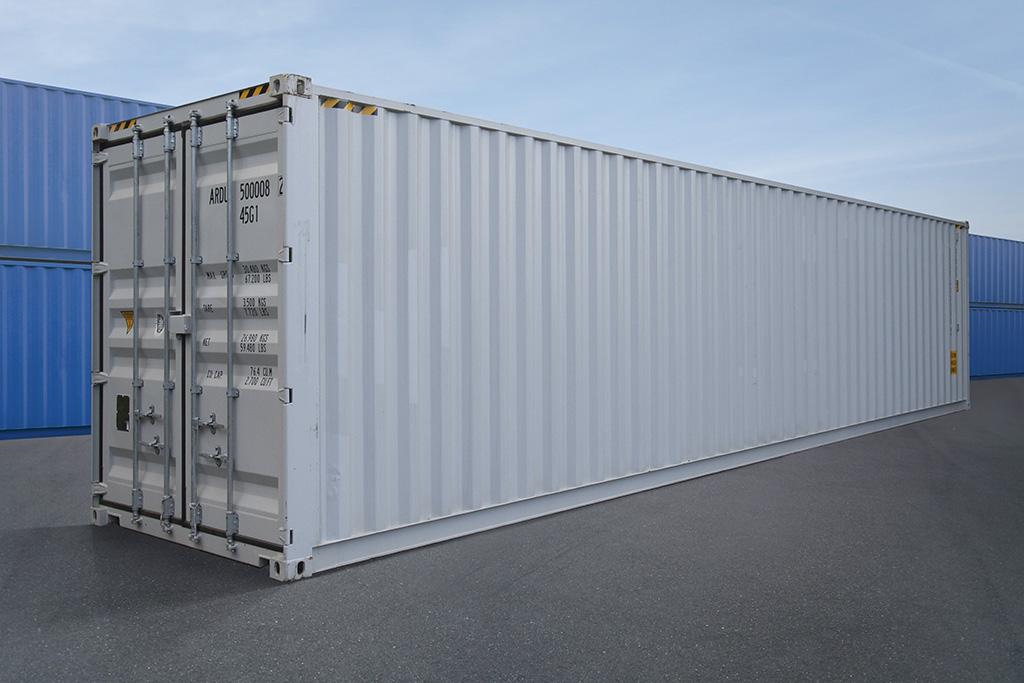
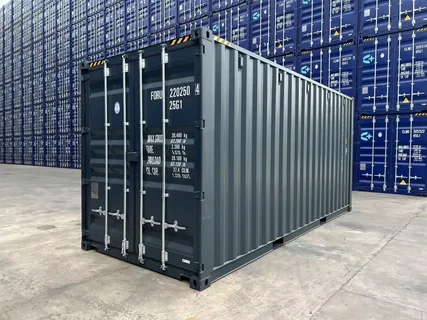
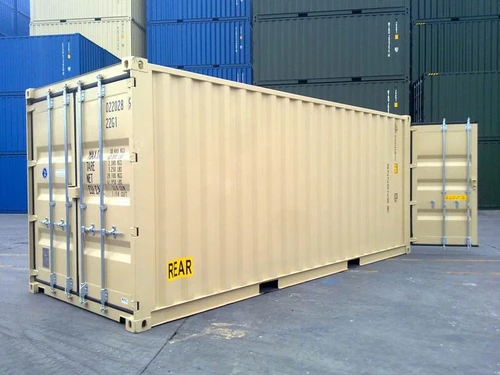
Our comparison of one trip and used containers goes deeper into the trade-off, and if you want the very best, see our guide to new shipping containers for sale. The photos in this post are all of near-new stock so you can see the finish you should expect.
Choosing the right size of farm storage containers
Size is the first decision when buying farm storage containers, and the one most often got wrong. A box that is too small fills up in a season; a box that is too long may not fit the space between buildings or the turning circle of the delivery truck. Here is how the common sizes compare for farm work. For exact measurements, see our full shipping container dimensions guide.
| Size | Inside length | Inside height | Door opening height | Volume | Pallets |
|---|---|---|---|---|---|
| 20ft standard | 5.90 m | 2.39 m | 2.28 m | 33 m³ | 10 |
| 20ft high cube | 5.90 m | 2.69 m | 2.58 m | 37 m³ | 10 |
| 40ft standard | 12.03 m | 2.39 m | 2.28 m | 67 m³ | 21 |
| 40ft high cube | 12.03 m | 2.69 m | 2.58 m | 76 m³ | 21 |
20ft farm storage containers
A 20ft box is the workhorse of small farms. It fits beside a stable block, behind a farm shop or at the corner of a field. It holds a ride-on mower, a quad bike and racking for tools, or around eight tonnes of bagged feed on pallets. Because it is short, it can be moved later with a standard tilt-bed truck. See our full range of 20ft shipping containers or read the 20ft vs 40ft comparison.
40ft farm storage containers
A 40ft box doubles the floor space for not much more money. On a working farm this is often the better buy because storage needs grow every year. A 40ft unit can hold a full winter’s supply of feed, or be split inside with a partition so one end holds feed and the other holds tools. Browse our 40ft shipping containers to compare grades.
Standard or high cube?
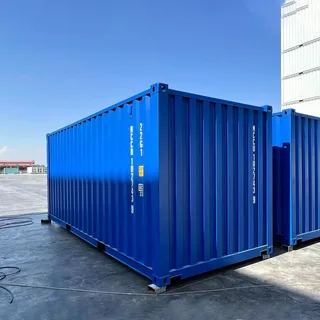
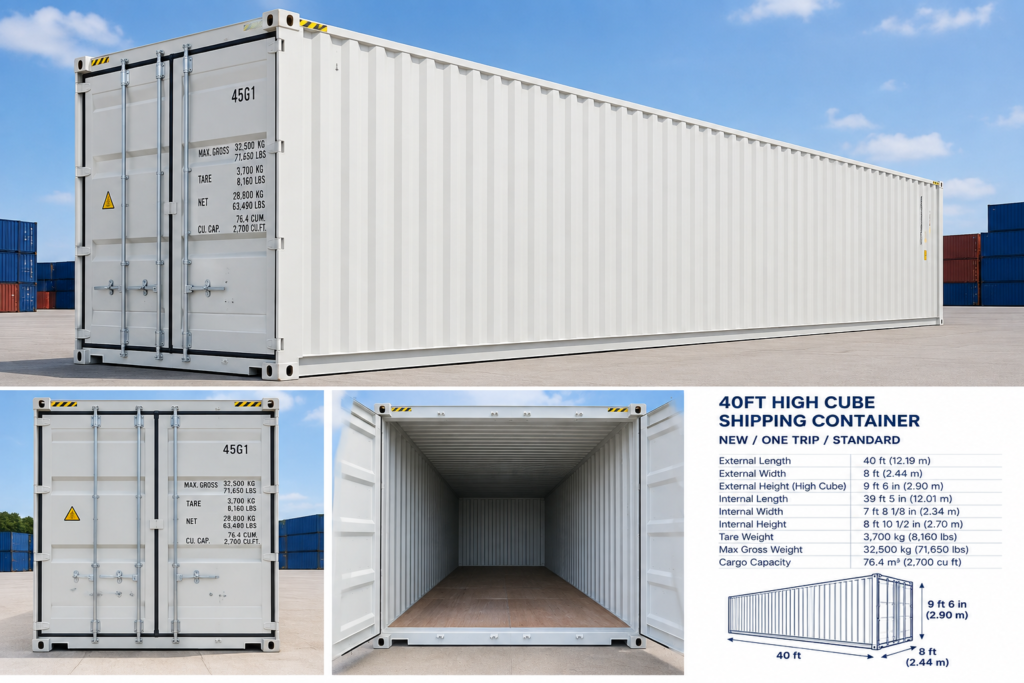
A high cube is 30 cm taller than a standard box. That sounds small, but it decides whether a compact tractor with a cab, a stack of three pallets or a tall shelving unit will fit. For most farms the high cube is worth the small extra cost. Our high cube vs standard container guide lists the exact heights, and you can see every high cube option in the 40ft high cube category. The one trip 40ft high cube at $2,900 is the single most popular container we sell to farms, because it costs less than a one trip 40ft standard box while giving more room.
What fits inside: real farm loads
It helps to plan farm storage containers around the loads you actually move. The figures below are typical and based on the sizes above.
| Load | 20ft standard | 20ft high cube | 40ft high cube |
|---|---|---|---|
| 25 kg feed sacks on pallets (40 per pallet) | About 400 sacks | About 400 sacks, stacked higher | About 840 sacks |
| Small square hay bales | About 230 | About 260 | About 540 |
| Quad bike or UTV | 2 units | 2 units with roll cage | 4 to 5 units |
| Compact tractor without cab | 1 if under 2.25 m tall | 1 with cab | 2 with cab |
| Saddles and tack | A full tack room for 10 horses | Same with higher racks | Tack room plus feed store |
Always measure your tallest machine, including any roll bar, mirrors or exhaust stack, and compare it with the door opening height rather than the internal height. The door frame is about 11 cm lower than the ceiling.
Twelve ways farms use storage containers
Farm storage containers are versatile. Below are the jobs we see most often, with the box that suits each one.
1. Animal feed store
Feed is the most common load in farm storage containers. It is expensive and easy to ruin. A dry, sealed box stops rats, birds and damp. Put pallets on the floor so sacks never touch the steel, and keep the oldest stock nearest the door so it is used first. A one trip 20ft or 40ft high cube is ideal.
2. Machinery and implement shed
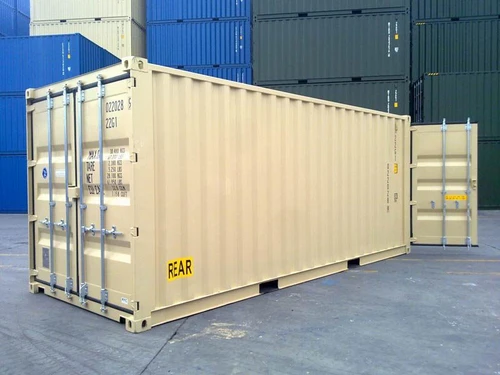
Mowers, harrows, seed drills, sprayers (empty and cleaned) and hedge cutters last far longer out of the rain. A 40ft double door container lets you drive a tractor in one end and out the other with no reversing. Read more in our double door container guide.
3. Workshop
Some of the most useful farm storage containers are workshops. Many farms turn a container into a workshop with a bench, a vice, shelving and a power supply. Our container modification service can add windows, a personnel door, lighting and electrics before delivery.
4. Tack room
Saddles and bridles cost thousands and are a common theft target. A locked container with saddle racks and a dehumidifier keeps leather supple and secure. A 20ft one trip box is the usual choice for livery yards.
5. Seed and grain sack store
Seed must stay dry and cool to keep its germination rate. Sacked grain or seed on pallets stores well in a vented, insulated box. Bulk loose grain is a different matter and belongs in a silo or a purpose-built grain store, because loose grain pushes outward on walls and doors.
6. Fertiliser store
Bagged fertiliser keeps well in a dry container. Follow local rules on ammonium nitrate storage, keep the box locked, and keep it away from fuel and heat. In many countries this kind of security is a legal requirement, so a lockable steel box is a simple way to meet it.
7. Cold store for fruit, vegetables and dairy
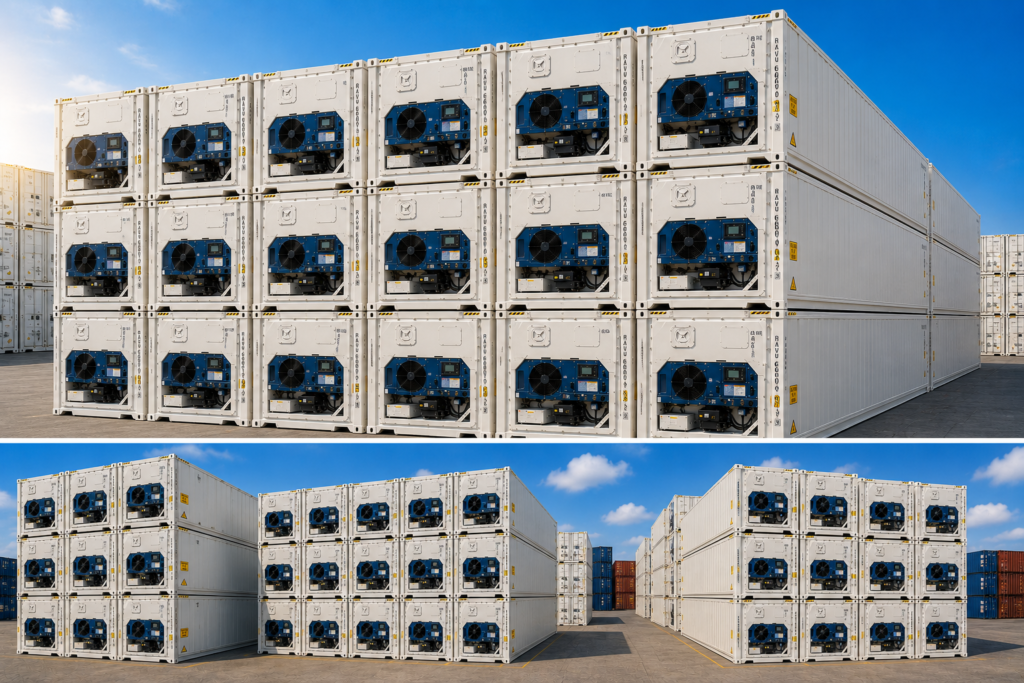
A reefer turns a harvest into something you can sell over weeks rather than days. Growers use them to chill apples, potatoes, berries, cut flowers and cheese. See the refrigerated containers page and our guide to buying a reefer container for power needs and set points.
8. Farm office or site cabin
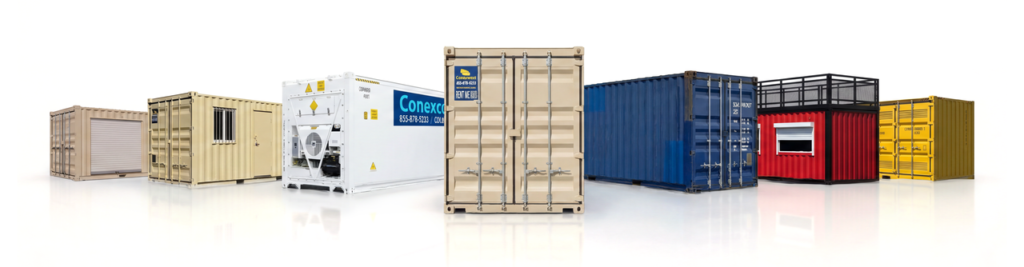
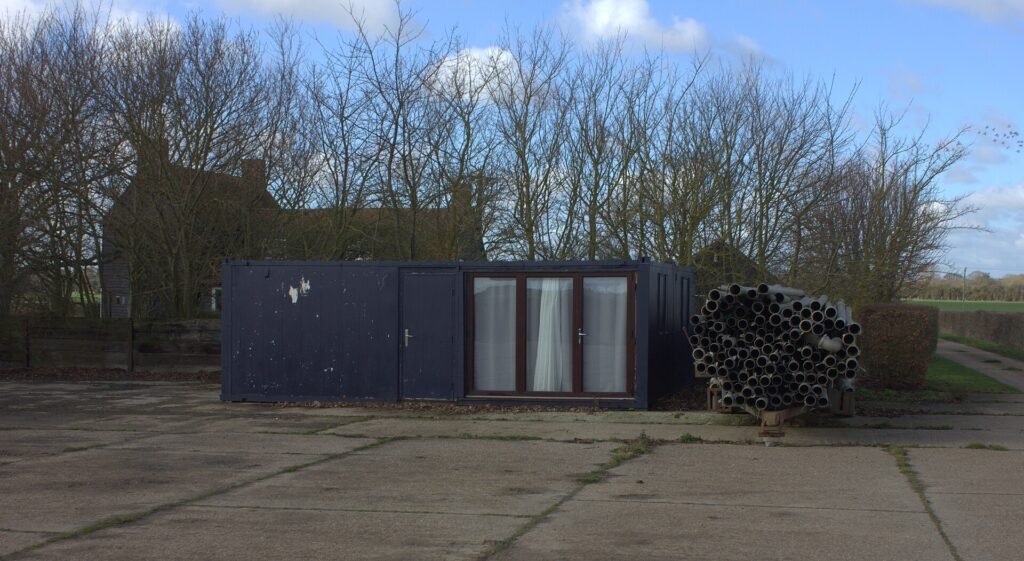
With insulation, a window and a door, a container makes a quiet office for paperwork, a staff break room or a lambing watch room. The photo below shows a farm container that has been fitted out with windows and a door for this purpose.
9. Farm shop and honesty stall
A small box at the farm gate with a hatch cut into the side makes a secure shop for eggs, honey and vegetables. It can be locked at night and moved if the road layout changes.
10. Hay and bedding store
Small bales and bagged shavings stay clean and dry. Keep hay well ventilated and never store damp bales in a closed box, because damp hay heats up and can catch fire. A side-opening container is easier to load bales into along its length.
11. Vineyard and orchard store
Picking crates, pruning tools, irrigation fittings and bird netting can all go into one box near the rows. Many growers keep a box at each end of a large block to save walking.
12. Emergency and spare parts store
Fence posts, wire, gate hinges, water trough parts, pump spares and veterinary supplies (non-medicinal) stay ready for when something breaks. Shelving along one wall and a clear label on each bay saves hours in busy seasons.
A simple layout plan for a farm container
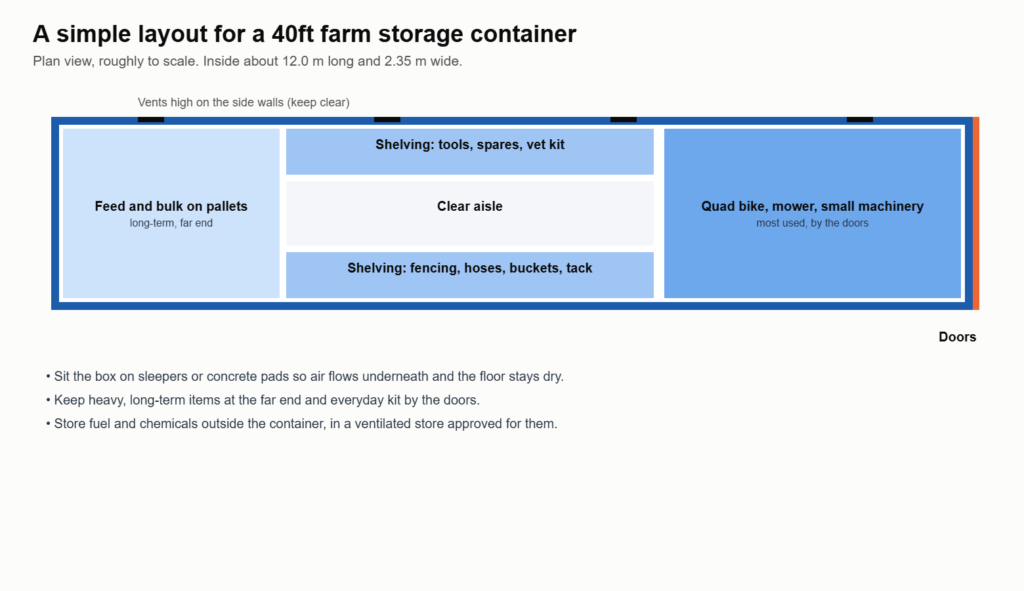
A well-planned interior doubles how useful a box feels. The diagram below shows a 40ft high cube laid out for a mixed farm. Heavy feed sits on pallets near the doors where a pallet truck or forklift can reach it. Tools and spares live on shelving along one side wall. Machinery parks at the back on the bare floor. Air vents sit high at each end. Fuel and chemicals stay in a separate, bunded store outside the box.
Three rules make any layout work:
- Keep a clear walkway of at least 90 cm down the middle so you can reach every item without moving others.
- Put the heaviest loads low and near the doors. It is safer to lift and the floor spreads the weight across the cross members.
- Leave a gap between stored goods and the walls. A 5 to 10 cm gap lets air move and stops condensation from soaking into sacks.
Stopping condensation in farm storage containers
Condensation is the main complaint we hear about containers on farms, and it is easy to prevent. Steel cools quickly at night. When warm, damp air inside the box touches the cold roof, water forms and drips. On a farm, damp air comes from wet feed, sweating produce, muddy machinery and the ground itself.
Here is what works, in order of cost:
- Ventilation. Every container has small vents. Adding two or four larger vents, one high at each end, lets moist air escape. This is the cheapest fix and often enough on its own.
- Raise goods off the floor. Pallets stop sacks wicking up moisture and let air flow underneath.
- Don’t load wet items. Let machinery drain and dry before it goes in, and never store damp hay.
- Moisture absorbers. Container desiccant bags hang from the lashing rings and soak up water. They are cheap and easy to replace.
- Anti-condensation roof coating. A sprayed coating on the inside of the roof stops drips.
- Insulation. Spray foam or panels stop the steel getting cold in the first place. Worth it for seed, tack and offices.
The AHDB grain storage guide is a helpful free resource on keeping stored crops dry and free from pests, and much of its advice on moisture and hygiene applies just as well to sacks kept in a container.
Where to place farm storage containers
Good placement makes the box last longer and keeps it useful every day.
Pick firm, level ground
Farm storage containers rest on their corners. The four corner castings carry the load. Set each one on a hardwood sleeper, a concrete pad or a block on compacted hardcore. The box must be level, or the doors will bind and won’t close fully. A spirit level on the floor and a check of both door gaps is enough. On clay or soft ground, dig out the topsoil under each corner and fill with compacted stone before placing pads.
Keep it off wet ground
Lifting the box 10 to 15 cm off the ground lets air circulate underneath and stops the steel sitting in puddles. Avoid low spots where water gathers in winter.
Leave room to open the doors
Plan at least 3 metres clear in front of the doors for opening and loading, more if you will drive machinery in. For a double door box, plan the same at both ends.
Think about access in all seasons
A spot that is easy to reach in summer may be a mud bath in February. Place the box near a hard track, so feed deliveries and the tractor can reach it all year.
Mind overhead lines and trees
The delivery truck needs clear overhead space to tilt its bed or swing a crane. Power lines and low branches near the drop spot are a common reason for delays.
Delivery to farms and rural sites
Delivering farm storage containers down a rural track is usually simpler than people expect, but a few checks save a wasted trip. Our shipping container delivery guide explains every truck type, and our delivery policy sets out what we cover.
- Tilt-bed trucks slide the box straight onto the ground. They need a straight run of about 30 metres for a 20ft box and 45 metres for a 40ft box, plus firm ground.
- Crane or side-lifter trucks can lift the box over a fence or into a tight yard, and set it down exactly on its pads.
- Track width and gates. The truck needs about 3.5 m of width and 4.5 m of height clearance. Measure any gate the truck must pass through.
- Soft fields. Heavy trucks sink in wet grass. If you can, place the box beside a hard track, or plan delivery for a dry spell.
- On-farm help. A tractor with a chain can tow a stuck truck free, but agree on this with the driver before he sets off down the track.
Security for farm storage containers
Rural theft costs farmers heavily, and isolated stores are an easy target. The NFU Mutual rural crime report tracks how quads, tools and machinery are among the most stolen items on farms. Farm storage containers are already stronger than most sheds, and a few simple steps make them much harder to break into still.
- Fit a lock box. A welded steel cover around the padlock stops bolt croppers from reaching the shackle.
- Use a closed-shackle padlock with a high security rating.
- Add a container bar lock that clamps across both locking bars.
- Place it in sight of the house or a yard camera where possible.
- Mark your tools and machinery with a farm ID so stolen items can be traced.
- Keep a record of the container number printed on the door, which is unique to your box.
Double door and open side boxes for machinery
For machinery, door design matters as much as size.
Double door containers
Doors at both ends turn a container into a drive-through shed. You drive the tractor and trailer in at one end and out at the other, with no tight reversing. Air also flows end to end when both doors are open, which helps dry out a box after wet work. Choose the one trip 20ft double door at $2,500, the one trip 40ft double door at $3,500 or the new 40ft double door at $4,900. Browse all of them in the double door category.
Open side containers
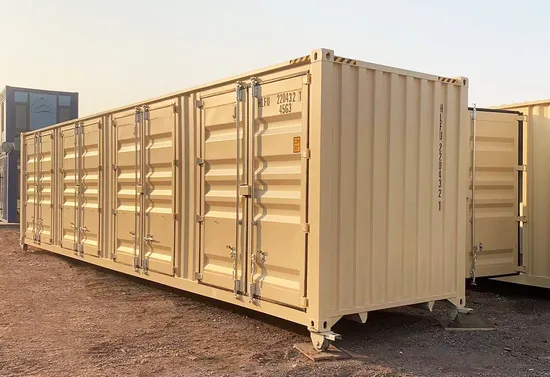
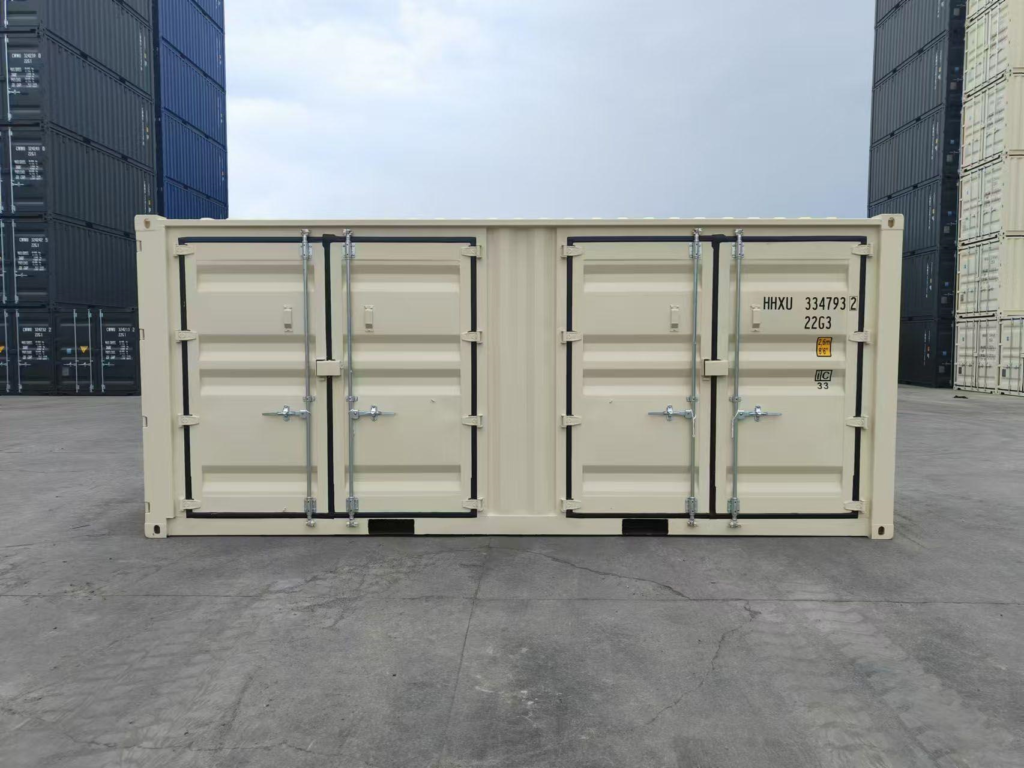
One long wall folds open, giving access along the full length of the box. That is ideal for implements that are wide rather than tall, like harrows, rollers and toppers, and for loading pallets of feed with a forklift from the side. Look at the 20ft open side at $5,700 and the 40ft open side at $6,200, and read the open side container guide.
Open top containers
For loads that must go in from above, like tall machinery or bulk bags lifted by a telehandler, an open top box with a removable tarp roof works well. See the open top container page and our open top guide.
Cold storage: reefers for growers and livestock farms
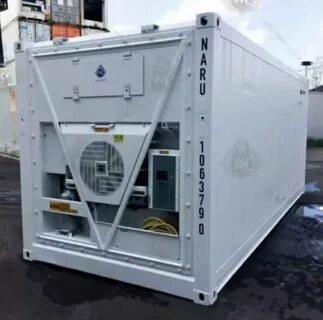
A refrigerated container is the most valuable of all farm storage containers for growers who sell fresh produce. It holds a precise temperature between about -25 °C and +25 °C, so the same box can chill fruit in autumn and keep frozen meat in winter. The FAO training manual on preventing post-harvest losses explains why careful cooling and handling after picking keeps produce fresh for longer, and a reefer is one of the simplest ways to do that on a farm.
- Power: a reefer runs on three-phase power, usually 380 to 460 V. A single-phase farm supply needs a converter or a generator set.
- Sizes: the one trip 20ft reefer at $6,200 suits a small grower; the one trip 40ft reefer at $8,500 suits a packhouse or a larger farm shop.
- Used option: the used 20ft reefer at $5,800 is a lower-cost start if your budget is tight.
All reefer stock is in the refrigerated containers category.
What to keep out of farm storage containers
Farm storage containers are not the right place for everything. Safety rules and common sense say keep these elsewhere:
- Fuel, oil drums and gas bottles. A closed steel box traps fumes. Use a bunded fuel store that meets local rules.
- Concentrated pesticides and herbicides. These need a ventilated, bunded chemical store with spill containment. The HSE guidance on storing pesticides for farmers is a clear example of what such a store needs.
- Damp hay or silage. Damp hay heats and can catch fire.
- Bulk loose grain. Loose grain puts sideways pressure on the walls and doors.
- Animals. A standard box gets too hot in summer and is not ventilated for livestock.
Worked examples: three farms, three choices
A 40-hectare sheep farm
This farm had no farm storage containers before. The farmer needed a feed store and a dry place for a quad bike and handling gear. A one trip 40ft high cube at $2,900 was placed on four concrete pads beside the lambing shed. Pallets hold feed at the door end; the quad, hurdles and tools live at the back. Two extra vents were added for about $150. Total cost before delivery: around $3,050.
A market garden selling at farmers’ markets
The grower wanted to pick on Thursday and sell on Saturday without losing quality. A one trip 20ft reefer at $6,200 now holds salad, berries and herbs at 2 to 4 °C. A one trip 20ft dry box at $1,550 sits next to it for crates, scales and the market gazebo.
A mixed arable and beef farm
The family wanted to get machinery out of the weather without building a new shed. Two one trip 40ft double door containers at $3,500 each were placed 6 metres apart, and a simple roof was later fitted across the gap to make a covered work bay. The result was a drive-through store for the drill and sprayer, and a dry workshop in between, for about $7,000 in containers.
Quick spec of our farm storage containers
| Feature | One trip | New |
|---|---|---|
| Material | Corten weathering steel | Corten weathering steel |
| Floor | 28 mm marine plywood, single use | 28 mm marine plywood, unused |
| Door seals | Near new | New |
| Paint | Factory finish, minor handling marks | Factory finish |
| Wind and watertight | Yes | Yes |
| Lock box | Available | Available |
| Expected farm life | 25+ years | 25 to 30+ years |
For a wider look at every type, see our guide to the types of shipping containers and the broader storage containers for sale guide.
How to order farm storage containers
- Measure your space and the route the truck will take, including gates, bends and overhead lines.
- Pick the size and door style from the tables above. Measure your tallest machine against the door height.
- Choose the grade. One trip for the best value, new for the longest life.
- Add any extras like vents, shelving, a lock box or a personnel door through our modification service.
- Place your order online from the products page or contact our team for a delivery quote to your farm.
- Prepare the ground with level pads before the truck arrives.
You can read the full buying process in our guide to buying a shipping container, and payment options are on the billing and payment page.
Frequently asked questions
What are the best farm storage containers to buy?
For most farms the best choice is a one trip 40ft high cube. It offers 76 cubic metres of space, a taller door for machinery and near-new condition for $2,900 before delivery.
How much do farm storage containers cost?
At Prime Cargo Box, one trip 20ft boxes start at $1,550, one trip 40ft high cubes are $2,900, new 40ft high cubes are $3,800, and reefers start at $5,800 used or $6,200 one trip. Delivery is priced separately.
Do farm storage containers need a foundation?
No. They need firm, level ground and support under the four corners. Hardwood sleepers, concrete pads or blocks on compacted stone all work.
Will feed get damp in farm storage containers?
Not if you ventilate the box and keep sacks on pallets. Add extra vents, leave a gap from the walls and use moisture absorbers in humid areas.
Can I keep a tractor in farm storage containers?
Yes, if it fits the door. A high cube door is about 2.58 m tall and 2.34 m wide. Many compact tractors fit; full-size tractors usually do not.
Is a one trip container worth the extra cost over used?
For farm storage containers, usually yes. One trip boxes have soft seals, clean floors and fresh paint, so feed stays dry and the box lasts many more years.
Can I store fertiliser in farm storage containers?
Bagged fertiliser stores well in a dry, locked box, kept away from fuel and heat. Follow your local rules for ammonium nitrate.
How long do farm storage containers last?
A one trip or new container lasts 25 years or more on a farm with simple care: keep it level, off wet ground, and touch up any chipped paint.
About Prime Cargo Box
Prime Cargo Box sells new, one trip and used shipping containers for storage, farms, building sites and businesses worldwide. Farm storage containers are one of our largest product lines. Every box listed on our site has its own product page with photos, a condition grade and a clear price. Our team helps farmers choose the right size, plan delivery down rural tracks and add the extras that make a container work on the land. Learn more on our about page.
Final thoughts
Farm storage containers give you a dry, rat-proof, lockable store that arrives ready to use and keeps its value for decades. For most farms, a one trip 40ft high cube is the sweet spot of space, height and price, while double door and open side boxes suit machinery and reefers turn a harvest into weeks of sales. Start by measuring your space and your tallest machine, then browse our containers or ask for a farm delivery quote today.