An ISO shipping container is a steel freight container built to the international standards that fix its size, strength, corner fittings and markings, so it can be lifted, stacked and carried on any ship, train or truck in the world. Every container we sell is a genuine ISO shipping container: a used 20ft costs $1,000, a one trip 20ft is $1,550, a one trip 40ft high cube is $2,900 and a new 40ft high cube is $3,800, before delivery. Each carries its own number, size-type code and CSC safety plate.
This guide is for buyers who want to know what “ISO” really means before they spend money: exporters, farmers, builders, storage buyers, event companies and anyone comparing a real ISO shipping container with cheaper look-alikes. It explains the standards behind the box, how to read the codes on the doors, what sizes and types exist, and how to check you are getting the real thing. Every price links to a container we sell right now.
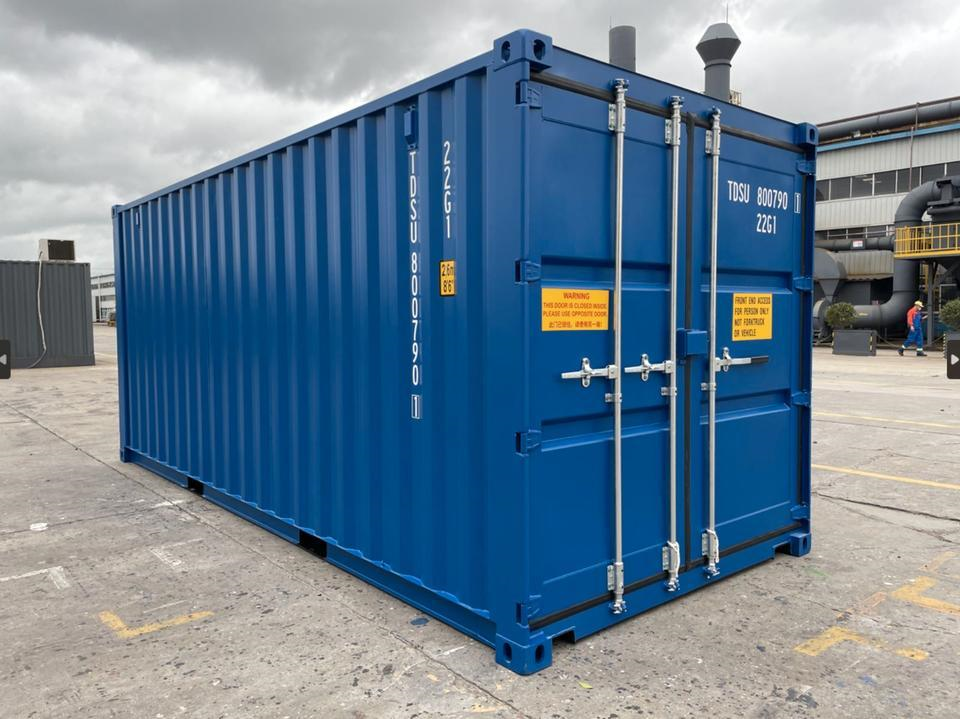
Table of Contents
ISO shipping container: the short answers
- What “ISO” means: built to International Organization for Standardization rules for freight containers, mainly ISO 668, ISO 1496, ISO 1161 and ISO 6346.
- Common sizes: 20ft and 40ft long, 8ft wide, 8ft 6in (standard) or 9ft 6in (high cube) tall.
- How to spot one: owner code and serial number, a four-character size-type code like 22G1 or 45G1, standard corner castings and a CSC safety plate.
- Cheapest ISO box we sell: a used 20ft at $1,000.
- Best value for most buyers: a one trip 20ft at $1,550 or a one trip 40ft high cube at $2,900.
- Why it matters: standard lifting, stacking and transport, proven strength, and much better resale value than non-standard boxes.
What makes a container an ISO shipping container?
A container becomes an ISO shipping container when it is designed, built and marked to a family of international standards. No single standard covers everything. Each one handles a different part of the box.
ISO 668: sizes and ratings
ISO 668 classifies series 1 freight containers by their external dimensions and sets their ratings, along with minimum inside and door sizes for some types. This is why a 40ft box from one factory is exactly the same length as a 40ft box from any other. It is also why a 20ft ISO shipping container is actually a little under 20 feet long: at 6.058 metres, two of them plus the gap for the connecting twistlocks match the length of one 40ft unit, so their corners line up in a stack.
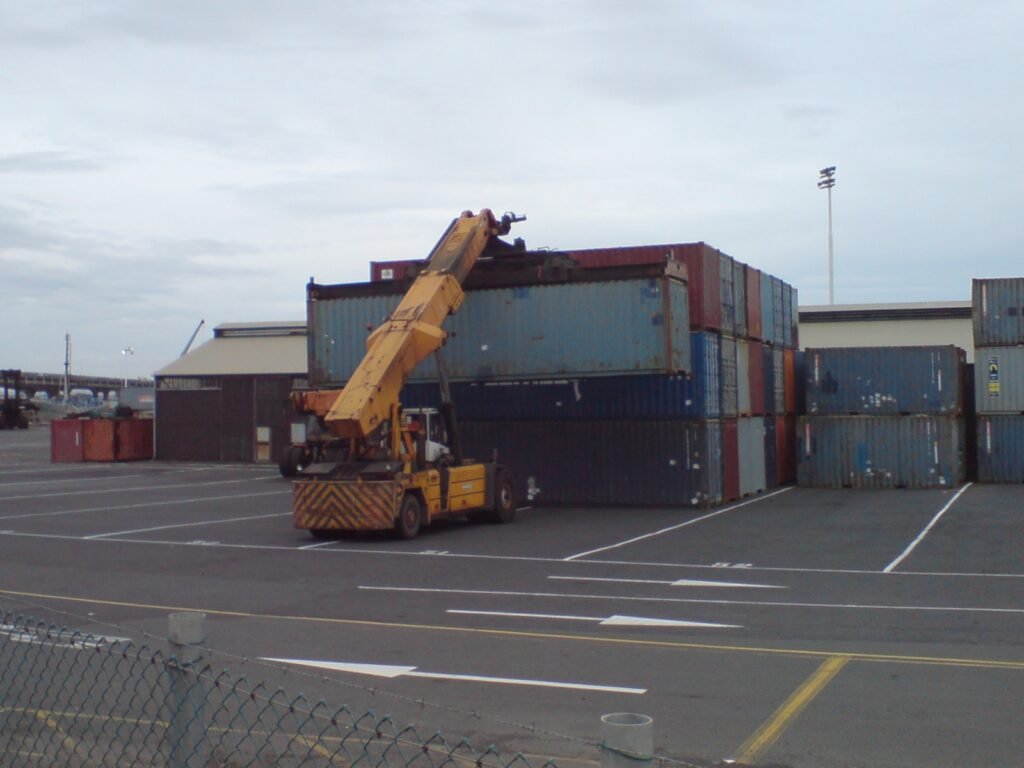
The standard also sets maximum gross mass. Most boxes in circulation are rated around 30,480 kg, and an amendment in 2016 raised the permitted maximum for most sizes to 36,000 kg. The rating of your actual box is printed on its CSC plate.
ISO 1496: strength and testing
Being the right size is not enough. ISO 1496 sets how strong the box must be and how it is tested. Part 1 covers general purpose containers, setting out the specifications and testing requirements for series 1 general cargo containers that move between road, rail and sea. Other parts cover thermal (refrigerated) containers, tanks and bulk boxes. The tests include lifting by the corners, stacking loads, racking forces, floor strength and weatherproofing.
ISO 1161: corner fittings
The eight cast steel blocks at the corners are what let cranes, spreaders, twistlocks and truck chassis grab and hold the box. Their shape, hole positions and strength are set by ISO 1161, the specification for corner and intermediate fittings, which was updated in a new edition in 2026. Standard corners are the main reason an ISO shipping container fits any port crane or container chassis anywhere.
ISO 6346: identification and codes
ISO 6346 covers the markings: owner code, serial number, check digit and the size-type code. The Bureau International des Containers manages the global register of owner codes so no two owners share the same prefix. More on reading these codes below.
The CSC plate
Strictly speaking, the safety plate comes from a convention rather than an ISO standard, but every genuine ISO shipping container used in trade carries one. Under the International Maritime Organization’s Convention for Safe Containers, approved containers get a safety approval plate with their technical data. It is your quickest proof that the box was built and approved for international transport.
Why the ISO shipping container exists
Before containers, cargo was loaded piece by piece: sacks, barrels and crates lifted in and out of ships by hand. It was slow, costly and goods went missing. In 1956 a converted tanker, the Ideal X, sailed from Newark to Houston carrying truck-sized boxes, and that voyage is usually seen as the start of modern container shipping.
The early boxes came in many sizes. A box built for one shipping line did not fit another line’s cranes, ships or trucks. Through the 1960s, the industry and governments worked through the International Organization for Standardization’s freight container committee to agree common sizes, fittings and markings, and ISO 668 was first published in 1968. From then on, an ISO shipping container built anywhere could travel anywhere.
That standardisation is the whole reason a container you buy today can be delivered by any container truck, lifted by any port crane and stacked on any other ISO box. It is also why containers became so cheap and common that they are now used for storage, sheds, offices and cold rooms as well as freight.
How to read the codes on an ISO shipping container
Walk up to the doors of any ISO shipping container and you will see a block of letters and numbers. It looks like noise until you know the pattern.
The container number
The main line looks like this: ABCU 123456 7.
- ABC: the three-letter owner code, registered with BIC.
- U: the equipment category. U means a freight container.
- 123456: the serial number, unique within that owner’s fleet.
- 7: the check digit, calculated from the other characters to catch typing errors.
The size-type code
Under or beside the number is a four-character code. The first character is the length, the second the height and width, and the last two the type. The Geography of Transport Systems, a widely used academic reference on freight transport, notes that a standard 40-footer carries 42G1 and the same box as a high cube carries 45G1 (Geography of Transport Systems on ISO container codes).
| Code | What it means | Example in our stock |
|---|---|---|
| 22G1 | 20ft long, 8ft 6in high, general purpose | One trip 20ft, $1,550 |
| 25G1 | 20ft long, 9ft 6in high cube, general purpose | One trip 20ft high cube, $2,950 |
| 42G1 | 40ft long, 8ft 6in high, general purpose | One trip 40ft, $3,200 |
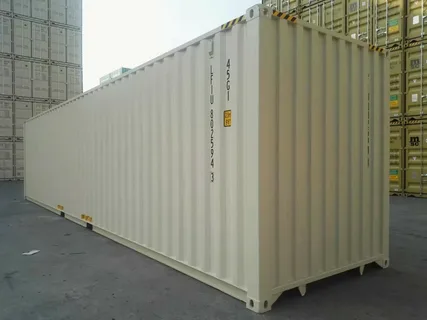
| 45G1 | 40ft long, 9ft 6in high cube, general purpose | One trip 40ft high cube, $2,900 |
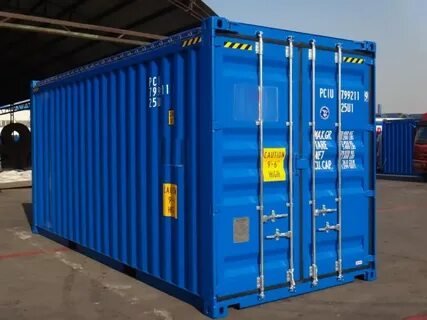
| 22U1 | 20ft open top | One trip 20ft open top, $3,150 |
| 22R1 | 20ft refrigerated | One trip 20ft reefer, $6,200 |
| 45R1 | 40ft high cube refrigerated | One trip 40ft reefer, $8,500 |
You will sometimes see codes ending in 0 instead of 1, such as 22G0. Both describe general purpose boxes; the last digit marks small detail differences in design. If the code on a box does not match what the seller says it is, ask why.
Other markings
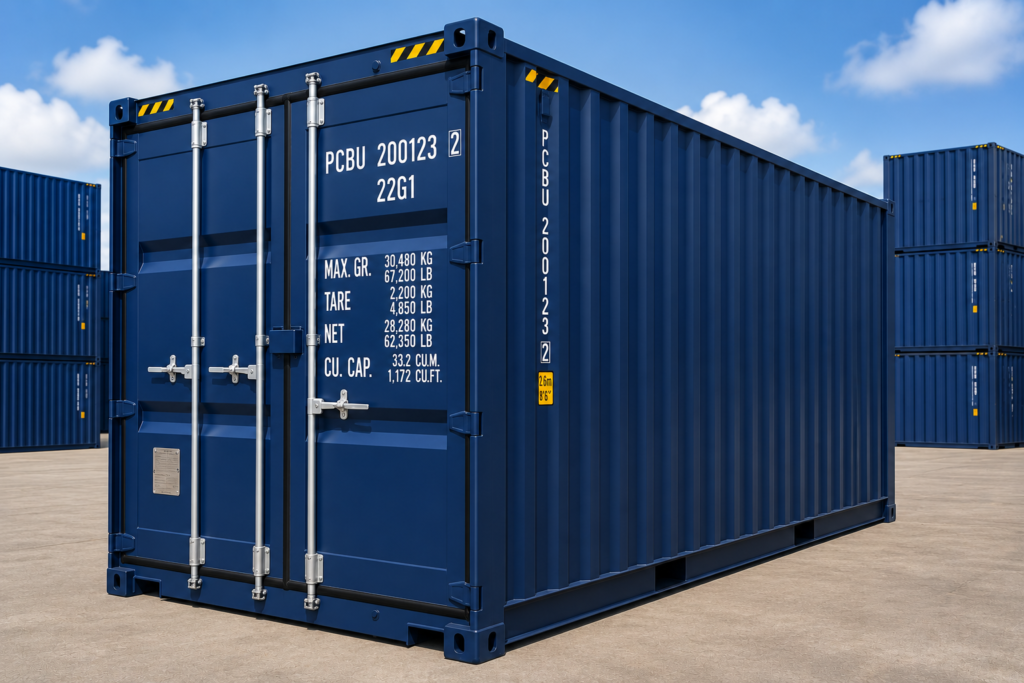
- Max gross, tare and payload: painted on the doors, in kilograms and pounds.
- Cubic capacity: often shown too.
- High cube warning stripes: yellow and black bands on the top corners of 9ft 6in boxes, warning drivers of the extra height.
- CSC plate and manufacturer’s plate: usually on the left door.
How an ISO shipping container is built
Knowing the parts helps you judge any box you look at, new or used.
- Corner posts: four heavy steel columns at the corners carry the stacking load. On an ISO shipping container they are the strongest part of the frame.
- Corner castings: the cast blocks at each corner, top and bottom, where cranes, twistlocks and chassis lock on.
- Top and bottom rails: long steel members along each side, joining the corners.
- Cross members: steel beams under the floor that carry the cargo weight.
- Floor: thick marine plywood or bamboo boards, treated against insects, screwed to the cross members.
- Walls and roof: corrugated weathering steel panels. The corrugation adds stiffness without extra weight.
- Doors: two steel doors with four vertical locking bars, cams top and bottom, and rubber gaskets.
- Vents: small covered vents high on the walls let air move and cut condensation.
- Lashing points: rings or bars on the floor rails and sometimes the top rails for tying down cargo.
- Forklift pockets: slots under many 20ft units so a forklift can move them empty.
- Gooseneck tunnel: a recess in the floor at the front of most 40ft units so they sit low on a gooseneck chassis.
When you inspect a used ISO shipping container, the corner posts, castings, rails, cross members and floor matter most. Dents in the wall panels are usually cosmetic.
ISO shipping container sizes
Here are the working dimensions of the ISO shipping container sizes we stock. Outside sizes are fixed by ISO 668. Inside sizes vary slightly by maker, so treat them as close guides.
| Type | Outside (L x W x H) | Inside (approx.) | Volume (approx.) |
|---|---|---|---|
| 20ft standard | 6.06 x 2.44 x 2.59 m | 5.90 x 2.35 x 2.39 m | 33 m³ |
| 20ft high cube | 6.06 x 2.44 x 2.90 m | 5.90 x 2.35 x 2.69 m | 37.4 m³ |
| 40ft standard | 12.19 x 2.44 x 2.59 m | 12.03 x 2.35 x 2.39 m | 67.7 m³ |
| 40ft high cube | 12.19 x 2.44 x 2.90 m | 12.03 x 2.35 x 2.70 m | 76.3 m³ |
Door openings are a little smaller than the inside sizes. For full door and inside measurements, see our shipping container dimensions guide. If you are torn between lengths, read 20ft vs 40ft shipping container, and for height, high cube vs standard container.
ISO 668 also includes 10ft, 30ft and 45ft lengths. We do not stock those right now; most buyers find a 20ft or 40ft does the job.
ISO shipping container weights and payload
Weight matters for delivery, for what you can load, and for shipping. These are typical figures for general purpose boxes. The exact ratings for any ISO shipping container are painted on its doors and stamped on its CSC plate.
| Type | Tare (empty, approx.) | Max gross (typical) | Payload (approx.) |
|---|---|---|---|
| 20ft standard | 2,200 to 2,300 kg | 30,480 kg | 28,000 kg |
| 20ft high cube | about 2,300 kg | 30,480 kg | 28,000 kg |
| 40ft standard | 3,700 to 3,800 kg | 30,480 to 32,500 kg | 26,700 to 28,700 kg |
| 40ft high cube | about 3,900 kg | 30,480 to 32,500 kg | 26,500 to 28,600 kg |
Two practical points. First, road limits in most countries stop a truck carrying anywhere near the full payload of a 40ft, so heavy cargo usually goes in 20ft boxes. Second, the empty weight tells you what kind of truck and lifting gear your delivery needs.
ISO shipping container types we sell
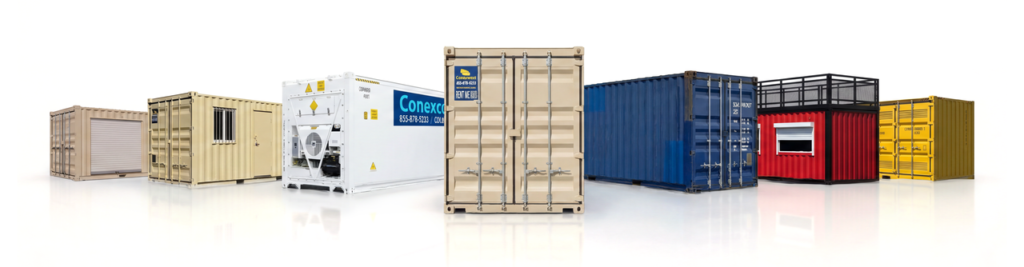
“General purpose” dry boxes are the most common, but the ISO family includes several types. All of these are ISO shipping container designs with standard corners and markings.
General purpose (dry) containers
Fully enclosed steel boxes with doors at one end. Used for most cargo and most storage. Browse the 20ft range and the 40ft range, or read our 20ft shipping container and 40ft shipping container guides.
High cube containers
One foot taller than standard. Ideal for bulky, light cargo and for workshops where headroom matters. A new 40ft high cube is $3,800.
Double door (tunnel) containers
Doors at both ends. Great for split loads and storage you need to reach from either end. A one trip 20ft double door is $2,500. See our double door container guide.
Open side containers
The full long side opens. Useful for wide items, retail pop-ups and machinery. A used 20ft open side is $2,950. More in our open side container article.
Open top containers
A removable tarp roof for loading tall items by crane. A used 20ft open top is $2,600. Read the open top container guide.
Refrigerated (reefer) containers
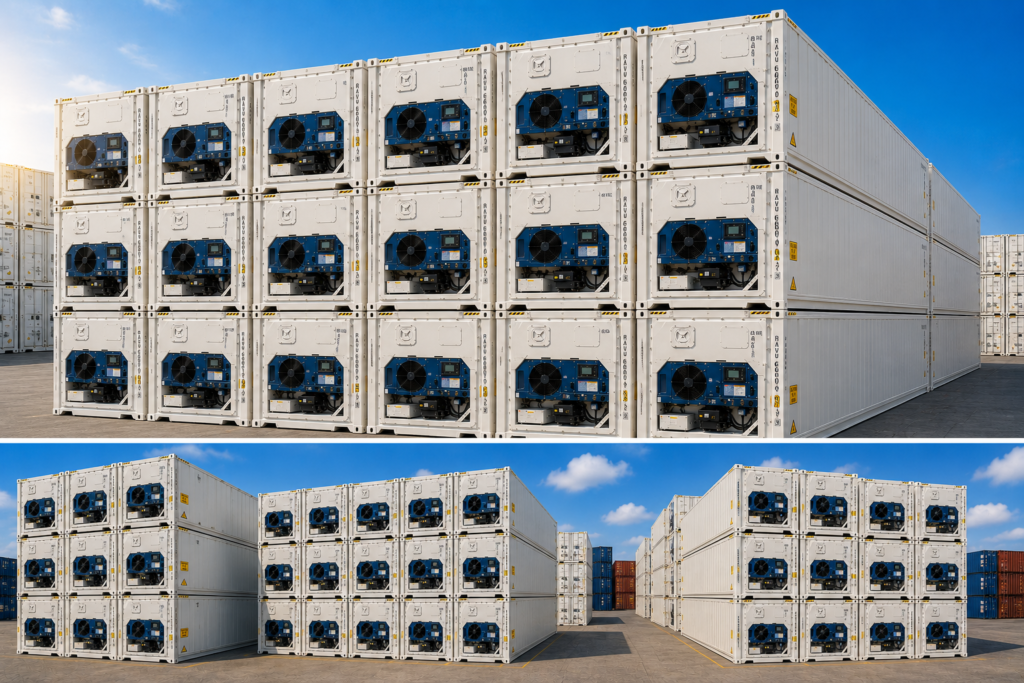
Insulated, with a built-in refrigeration unit, tested to the thermal part of ISO 1496. A used 20ft reefer is $5,800. See our cold storage container guide.
For a broader look at every style, our types of shipping containers article covers them side by side.
ISO shipping container prices
Here is our current range of ISO shipping container prices by size and condition. Delivery is quoted separately once we know the address.
| ISO shipping container | Used | One trip | New |
|---|---|---|---|
| 20ft standard (22G1) | $1,000 | $1,550 | $2,400 |
| 20ft high cube (25G1) | $1,650 | $2,950 | $4,250 |
| 40ft standard (42G1) | $1,900 | $3,200 | $3,400 |
| 40ft high cube (45G1) | $2,200 | $2,900 | $3,800 |
| 20ft double door | $1,950 | $2,500 | $3,700 |
| 20ft open top (22U1) | $2,600 | $3,150 | On request |
| 40ft open top | $3,300 | $5,100 | $4,300 |
| 20ft reefer (22R1) | $5,800 | $6,200 | $11,500 |
Prices move with stock, so the product page is always the latest figure. Our shipping container prices guide explains what drives prices around the world.
New, one trip or used ISO shipping container?
Condition does not change whether a box is an ISO shipping container. A 15-year-old used box is just as ISO as a new one, because the standard is about how it was designed and built. Condition changes how it looks, how long it lasts and whether it is still fit to ship cargo.
- Used: years of service at sea. Dents, scrapes and surface rust, but wind and watertight. Great for storage on farms, yards and building sites. See our used shipping containers for sale.
- One trip: built new and used for a single voyage. Near-new condition and ready to ship cargo again. The best value for most buyers.
- New: never loaded. Clean paint and perfect floor. Browse new shipping containers for sale.
If you plan to ship goods in the box, read our guide to the cargo worthy container grade. For a deeper comparison of conditions, see one trip vs used shipping container.
ISO shipping container vs non-ISO containers
Not every steel box sold as a “container” is an ISO shipping container. Some are built for other systems; some are built only for storage. Here is what else is out there.
Domestic containers in North America and Europe
In North America, long domestic boxes of 48 and 53 feet with a 102-inch width are standard for road and rail, and in Europe non-ISO widths of 2.5 metres are common for containers and swap bodies, as a study listed by the Transportation Research Board points out (TRB record on new container standards). These are real freight boxes, but they do not follow ISO sizes, and many are built lighter for land use. They are not interchangeable with an ISO shipping container on ships or in most ports.
Storage-only units
Some boxes are made just for storage or site use: portable storage units, mini containers, “container-style” sheds. They may look similar but often have thinner steel, no ISO corner castings, no CSC plate and no proper markings. They cannot be shipped by sea and are harder to resell.
Why the difference matters to you
| Point | ISO shipping container | Non-ISO storage box |
|---|---|---|
| Sizes | Fixed world standard | Maker’s choice |
| Strength | Tested for lifting, stacking and racking | Often unknown |
| Corner castings | Standard, fit any crane, spreader or chassis | Often missing or non-standard |
| Can ship cargo by sea | Yes, with a valid CSC plate | No |
| Resale value | Strong worldwide demand | Limited |
| Delivery and moving | Any container truck or crane | May need special handling |
Even if you only want storage, an ISO shipping container usually costs about the same as a storage-only unit and gives you more strength, easier moving and better resale. Our storage containers for sale and conex box for sale guides cover storage buying in more depth.
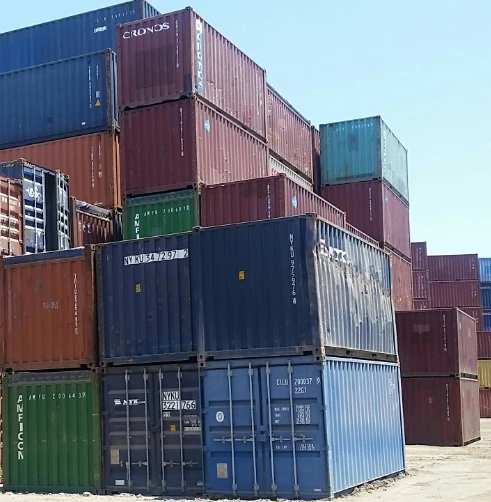
Why buy an ISO shipping container?
It fits everything
Container trucks, tilt-beds, side-lifters, cranes, forklifts, rail wagons and ships are all designed around ISO sizes and corner castings. That makes delivering, moving and stacking an ISO shipping container straightforward wherever you are. See our shipping container delivery guide for how it works.
The strength is proven
A box tested to ISO 1496 has been checked for lifting, stacking and racking loads. Loaded ISO boxes are stacked several high on ships, so a single box in your yard is working well within its limits.
You can stack and join them
Because corner castings line up, two ISO shipping container units can be stacked with twistlocks or placed side by side. Two 20ft boxes match one 40ft in length. That makes it easy to grow storage, build a two-level site office or create a barn from several boxes.
It holds its value
There is a worldwide market for ISO boxes. When you no longer need yours, you can sell it to a farmer, builder, exporter or another storage buyer. Non-standard units have a much smaller resale market.
You can ship goods in it
With a valid CSC plate and good condition, an ISO shipping container can carry your goods overseas as a shipper owned box. Storage-only units cannot.
Insurance and compliance are simpler
Insurers, ports and customs systems recognise ISO markings. A box with a clear owner code, number and plate is easier to insure, track and document.
Choosing the right ISO shipping container: three examples
These are example buyers to show how we think about the choice, not stories about real customers.
A farmer who needs a feed and tool store
The box will sit in the yard for years and never be shipped. Looks do not matter much; security and dryness do. A used 40ft ISO shipping container at $1,900 gives lots of floor space for the money, keeps rodents out of feed and can be moved later by any container truck.
An exporter sending machinery overseas
The box has to pass the terminal gate and carry heavy parts safely. A one trip 20ft ISO shipping container at $1,550 suits dense, heavy cargo, has a recent CSC plate and keeps its value after arrival. If the machinery is too tall for the doors, a one trip 20ft open top at $3,150 lets it go in by crane.
A homeowner who wants a garden workshop
The box sits near the house, so appearance matters, and headroom matters for working at a bench. A one trip or new 20ft high cube ISO shipping container gives clean paint and the extra 30 cm of height. Add a personnel door and windows later if needed.
Not sure which fits you? Tell us what you need it for and we will suggest the right unit.
How to check you are buying a genuine ISO shipping container
Use this list when you look at any box, ours or anyone else’s.
- Find the container number on the doors and check it has four letters (ending in U), six digits and a check digit.
- Look up the owner code on the BIC register if you want to confirm it is a registered prefix.
- Read the size-type code and make sure it matches the size and type you are paying for.
- Find the CSC plate on the door. It should be present, legible and fixed firmly.
- Look at the corner castings. Eight solid cast steel blocks with standard oval holes, not flat plates or welded hooks.
- Measure the outside. Width should be 2.44 m (8ft); length and height should match the standard sizes above.
- Check the floor and doors. Hardwood or bamboo marine floor, four locking bars, rubber gaskets.
- Ask for photos of the actual unit showing the number, plate and inside.
Every ISO shipping container we sell has its own product listing with photos, condition and price. If you want photos of the plate or number before you order, just ask.
What people use an ISO shipping container for
Exporting and moving overseas
Ship goods in your own box and keep it at the other end. A one trip ISO shipping container is the easiest choice because it is recent, sound and plated.
Secure storage
Farms, building sites, shops, clubs and homes use ISO boxes as lockable steel stores. See our secure storage containers, construction storage container and farm storage containers guides.
Garden and workshop sheds
A 20ft ISO shipping container makes a tough garden shed or workshop. Our shipping container shed guide covers it in detail.
Vehicle storage
Cars, bikes, boats and small tractors fit in 20ft and 40ft units. See the car storage container guide.
Cold storage
An ISO reefer works as a walk-in chiller or freezer for food businesses and farms.
Conversions
Offices, site cabins, pop-up shops and studios start with a solid ISO shell. Ask about our custom container modifications.
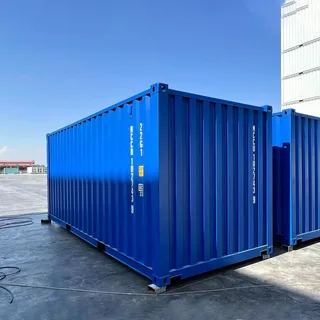
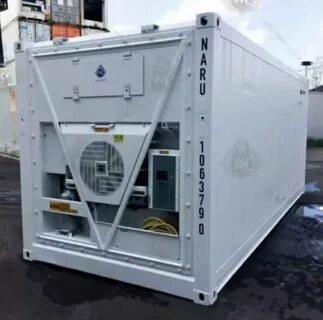
Setting up an ISO shipping container on site
Base
An ISO shipping container carries its weight on its four bottom corner castings. You do not need a full concrete slab. Concrete pads, sleepers on compacted stone or an existing concrete yard all work, as long as the four corners are solid and level. Add mid supports under a 40ft so the floor does not sag over time.
Level
If one corner sits low, the frame twists slightly and the doors become hard to open and lock. Check with a long level before the truck leaves.
Airflow and damp
Lift the box a little off the soil so air moves underneath. Keep the vents clear and add more if you store anything sensitive. Desiccant tubs and pallets keep stored goods dry.
Security
Fit a steel lock box over the hasp and use a hardened padlock. Face the doors toward a house or lit area if you can.
Maintenance
Once a year, touch up scratches with primer and paint, clear leaves off the roof, grease the hinges and locking bars, and check the door gaskets. That is enough to keep an ISO shipping container going for decades.
Specifications of our most popular ISO shipping container units
One trip 20ft (22G1), $1,550
- Outside: 20 ft x 8 ft x 8 ft 6 in (6.06 x 2.44 x 2.59 m)
- Inside volume: about 33 m³
- Tare: about 2,200 to 2,300 kg
- Build: corrugated weathering steel, marine plywood floor, four-bar locking doors
- Standards: ISO sized and marked, CSC plated
One trip 40ft high cube (45G1), $2,900
- Outside: 40 ft x 8 ft x 9 ft 6 in (12.19 x 2.44 x 2.90 m)
- Inside height: about 2.70 m
- Inside volume: about 76.3 m³
- Tare: about 3,900 kg
- Standards: ISO sized and marked, CSC plated
Used 20ft (22G1), $1,000
- Outside: 6.06 x 2.44 x 2.59 m
- Condition: wind and watertight, cosmetic wear
- Best for: storage on farms, yards and sites
Full specifications for every ISO shipping container we sell are on each product page.
Modifying an ISO shipping container without ruining it
Many buyers add doors, windows, vents, shelving or insulation. That is fine, as long as you respect how the box carries its loads.
- Leave the corners alone. Never cut or weld across corner posts or corner castings.
- Frame any opening. Cutting a large hole in a wall removes stiffness. Openings for doors and windows should be framed with steel.
- Keep the rails intact. The top and bottom rails tie the frame together.
- Know what you lose. A heavily modified box may no longer be accepted for sea freight unless it is re-examined and approved. For storage and site use this rarely matters, but it can lower resale value to exporters.
- Use proper paint. Prime and paint every cut edge so rust does not start there.
If you want modifications done before delivery, ask about our custom container modifications so the work is done properly on a sound ISO shipping container.
Buying tips for an ISO shipping container
- Decide the job first. Storage only, or shipping too? That decides condition.
- Measure your site and access. Delivery trucks need a clear straight run and room to set the box down.
- Pick the height. High cube for headroom and bulky goods, standard for lower cost and lower profile.
- Prepare the base. Level, firm ground with support under the four corners.
- Think about doors. Double door or open side if you need access from more than one end.
- Check local rules on placing containers if it will sit on residential land.
- Get the delivered price in writing before you pay.
Our step-by-step guide on how to buy a shipping container covers each stage, and our cheap shipping containers guide shows how to save without buying a bad box.
Questions to ask any seller of an ISO shipping container
- What is the container number and size-type code of this exact unit?
- Can you send a photo of the CSC plate?
- When was it built, and what condition grade is it?
- Is it wind and watertight, or cargo worthy for shipping?
- What are its tare and max gross weights?
- Has it been modified or repaired, and where?
- What is the full delivered price to my address?
A good seller of an ISO shipping container will answer every one of these clearly. If the answers are vague, look elsewhere.
Common mistakes when buying an ISO shipping container
- Buying a storage-only box when you need to ship. It will not be accepted for sea freight.
- Assuming “ISO” means “good condition”. ISO describes design and build. A used ISO box can still be battered.
- Not checking the size-type code. A seller may describe a 22G1 as a high cube. The code tells the truth.
- Ignoring height limits. A 9ft 6in high cube may be too tall for some sites, garages or local rules.
- Forgetting delivery access. The box fits the plot, but the truck cannot reach it.
- Paying for new when used will do. For a yard store, a used ISO shipping container is often all you need.

How to order an ISO shipping container from Prime Cargo Box
Ordering an ISO shipping container from us is simple, and we deliver worldwide.
- Choose size, type and condition. Browse all our containers.
- Tell us how you will use it. Storage, shipping, cold storage or conversion.
- Send your delivery details. Address, photos of the spot and the access route.
- Get your delivery quote. We confirm the truck type and total price.
- Pay and book. Our billing and payment policy lists the options.
- Take delivery. Check the number, plate and doors, then put it to work. Our shipping and delivery policy explains how we arrange delivery.
Container terms you will hear when buying
- TEU: twenty-foot equivalent unit. One 20ft box is one TEU; a 40ft is two. Ports and ships measure capacity this way.
- FEU: forty-foot equivalent unit, used less often.
- High cube (HC): a box 9ft 6in tall instead of 8ft 6in.
- Tare: the weight of the empty container.
- Payload: the most cargo the box can carry.
- Max gross: tare plus payload, the total the box is rated for.
- CSC plate: the safety approval plate required for containers in international transport.
- ACEP: an approved continuous examination programme, an alternative to fixed inspection dates.
- Twistlock: a locking device that fits into corner castings to join boxes or secure them to a truck or ship.
- One trip: a box built new and used for a single voyage before sale.
- WWT: wind and watertight. Keeps weather out; not necessarily fit to ship cargo.
- CW: cargo worthy. Sound enough to carry goods by sea.
- IICL: the strict inspection standard used by container leasing companies.
- Dry van: another name for a general purpose dry container.
- Tunnel container: a box with doors at both ends.
- Reefer: a refrigerated container.
ISO shipping container FAQs
What is an ISO shipping container?
A steel freight container built to international ISO standards for size, strength, corner fittings and markings, so it can move by ship, rail and truck anywhere in the world.
Are all shipping containers ISO containers?
No. Marine containers used in world trade are ISO boxes, but North American domestic containers, European swap bodies and many storage-only units follow other sizes or no standard at all.
What does 22G1 mean?
A 20ft long, 8ft 6in high, general purpose container. 42G1 is the 40ft standard version and 45G1 is the 40ft high cube.
How much does an ISO shipping container cost?
At Prime Cargo Box, from $1,000 for a used 20ft, $1,550 for a one trip 20ft, $2,900 for a one trip 40ft high cube and $3,800 for a new 40ft high cube. Delivery is extra.
Is a used container still an ISO shipping container?
Yes. ISO describes how the box was designed and built. A used box keeps its ISO status, though its condition decides whether it is still fit to ship cargo.
Can I stack ISO shipping containers?
Yes. Their corner castings line up so they can be stacked and locked together with twistlocks. Always use proper equipment and a level base.
How wide is an ISO shipping container?
2.44 metres (8 feet) on the outside. Length is about 6.06 m for a 20ft and 12.19 m for a 40ft.
How do I know the container is genuine?
Check the owner code and number, the size-type code, the CSC plate, the eight standard corner castings and the outside measurements.
Do you deliver an ISO shipping container to my country?
Yes. We sell and deliver worldwide. Send us your address and site photos for a quote.
Is a conex box the same as an ISO shipping container?
Usually, yes. “Conex box” is a common nickname in some countries for a steel shipping container. Most conex boxes sold today are standard ISO boxes, but it is still worth checking the number, code and plate, because the name is also used loosely for storage-only units.
How long does an ISO shipping container last?
In ocean service, boxes are often retired after many years at sea, but on land a well-placed container on a level base, with clear vents and a little paint now and then, can serve as storage for decades. New and one trip boxes give you the longest working life.
About Prime Cargo Box
Prime Cargo Box sells new, one trip and used ISO shipping containers to homeowners, farms, contractors, exporters and businesses around the world. Each product page shows photos, a condition grade and a clear price, and we help you pick the right size, type and condition for your job. Read more about us.
Final word
An ISO shipping container is built to a world standard for size, strength, corners and markings, which is why it fits every truck, crane and ship, stacks safely and keeps its resale value. Read the number, the size-type code and the CSC plate, check the corners and measurements, and pick condition by the job. For most buyers, a one trip 20ft at $1,550 or a one trip 40ft high cube at $2,900 is the right place to start, while a used 20ft at $1,000 is ideal for plain storage. Browse our containers or ask for a quote today.